4,068 posters, 219 videos, 101 topics, 69 sessions, 14,365 authors, 6,128 institutions
ePostersLive by SciGen Technologies S.A. All rights reserved.
Alzheimer's Association International Conference 2026
July 12-15, 2026 | London, United Kingdom, and Online

2337
Associations Of 20-year Trajectories Of Systemic Inflammation With Structural Brain Imaging Markers And Incident Dementia In Aging Adults
Part of Topic
Background: Systemic inflammation has been implicated in Alzheimer's disease and related dementia but is also associated with cerebral small vessel disease and brain atrophy. However, the long-term cumulative effects and temporal trajectories of systemic inflammation from midlife through late life in relation to later-life dementia risk have not been fully characterized. Moreover, the potential mediating role of structural brain MRI markers, including white matter hyperintensity (WMH) and hippocampal volumes, in these associations is unexplored.
Methods: 3,879 dementia-free participants in the Atherosclerosis Risk in Communities study with complete laboratory data across visits from midlife (visit 2: study baseline) through late-life (visit 5) were included (mean age at visit 2=54.9 years, 56.9% women, 17.1% Black, 45.3% >high school education). We used latent class mixed model analysis to identify distinct longitudinal patterns of high-sensitivity C-reactive protein (hs-CRP) levels over 20+ years of follow-up. We applied Cox proportional hazards and mediation models to investigate associations between differing longitudinal hs-CRP trajectories, WMH and hippocampal volumes (visit 5), and subsequent late-life dementia risk over 11 years.
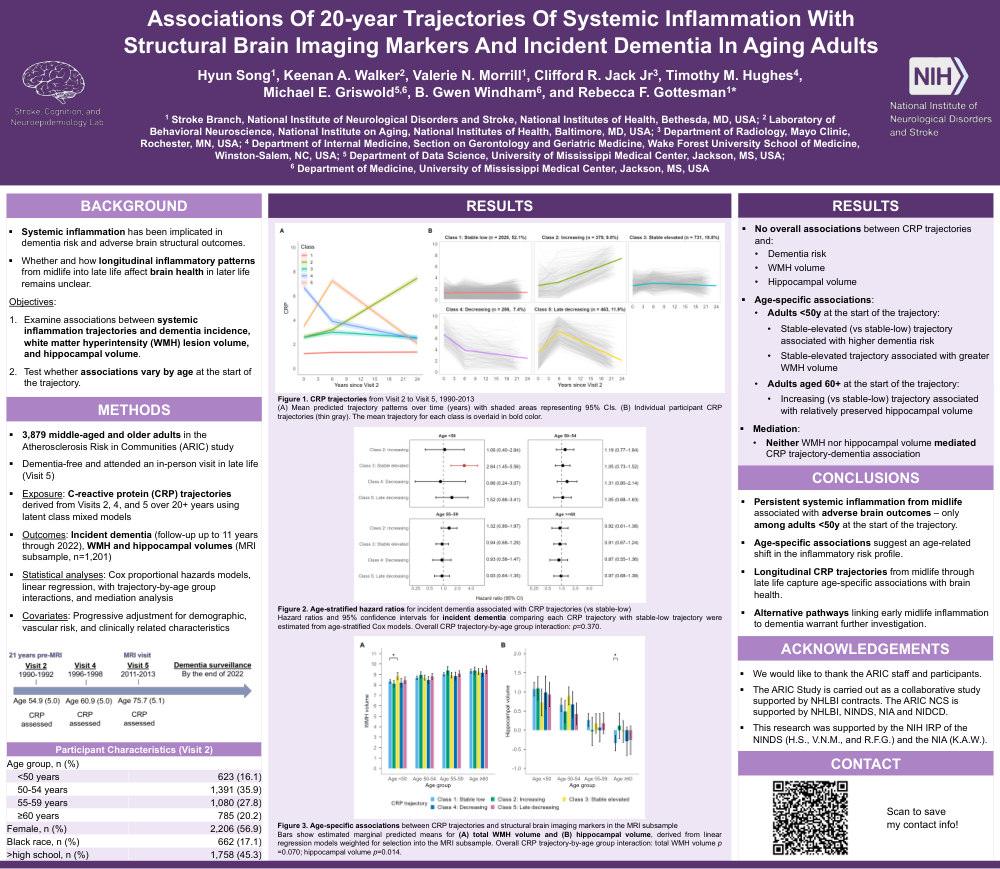
Results: Five characteristic mid- to late-life hs-CRP patterns were identified: stable low, increasing, stable elevated, decreasing, and late decreasing (Figure 1). Compared with stable-low trajectory, hs-CRP trajectories were not associated with dementia in adjusted models. In age-stratified models, stable-elevated (vs stable-low) hs-CRP trajectory was associated with an increased risk of dementia in adults whose baseline age was <50 years (Figure 2). Statistically significant indirect effects through WMH or hippocampal volumes were not observed in the association between hs-CRP trajectories and dementia risk in adjusted models. However, stable-elevated (vs stable-low) hs-CRP trajectory was associated with greater WMH volume in adults<50 years at baseline (Figure 3).
Conclusion: Among adults<50 at baseline, having systemic inflammation markers consistently elevated from midlife through late life was associated with greater WMH volume and an increased dementia risk of late life. Persistent systemic inflammation from early midlife may be linked to increased vulnerability to adverse brain outcomes, and mid- to late-life systemic inflammation patterns may help to identify higher-risk individuals. Further investigation of alternative pathways linking early midlife systemic inflammation to dementia is needed.
Comments
Email is required but is not shown publicly.
Loading comments...