Loading...

4,068 posters, 219 videos, 101 topics, 69 sessions, 14,365 authors, 6,128 institutions

ePostersLive by SciGen Technologies S.A. All rights reserved.

Alzheimer's Association International Conference 2026

July 12-15, 2026 | London, United Kingdom, and Online

Alzheimer's Association International Conference 2026 banner

8676

Blood-based Biomarkers As Predictors Of Longitudinal Cognitive Decline And Hippocampal Atrophy -the Vallecas Study
Poster Presenter

Michelle Guamán Chulunchana

Authors

Michelle Estefanía Guamán Chulunchana, Linda Zhang, Francisco Javier López-González, Sonia Wagner Reguero, Minerva Martinez Castillo, Ana Belén Pastor, Nekane Moreno, Andrea Ruiz-Calvo, Cristina Sánchez-Martín, Eva Alfayate, Marta Molero-Cartón, Elizabeth L Valeriano-Lorenzo, Belén Frades-Payo, Meritxell Valentí, María Ascensión Zea-Sevilla, Alexis Moscoso Rial, Alfredo Ramirez, Pamela Martino-Adami, Steffi G. Riedel-Heller, Martin Scherer, Andreas Jeromin, Miguel Calero, Michel J. Grothe, Anja Schneider, Teodoro Del Ser, Aitana Sogorb-Esteve, Jesús Silva-Rodríguez, Pascual Sánchez-Juan

Affiliations

CIEN Foundation, Queen Sofia Foundation Alzheimer Center, ISCIII, Madrid, Spain,, Bioinformatics department, CIEN Foundation, Queen Sofia Foundation Alzheimer Center, ISCIII, Madrid, Spain, Department of Biomarkers, Biochemistry and Molecular Genetics, CIEN Foundation, Queen Sofia Foundation Alzheimer Center, ISCIII, Madrid, Spain,, 2Neuroimaging department, CIEN Foundation, Queen Sofia Foundation Alzheimer Center, ISCIII, Madrid, Spain,, Neuroimaging department, CIEN Foundation, Queen Sofia Foundation Alzheimer Center, ISCIII, Madrid, Spain,, Clinical evaluation department, CIEN Foundation, Queen Sofia Foundation Alzheimer Center, ISCIII, Madrid, Spain,, Wallenberg Centre for Molecular and Translational Medicine, University of Gothenburg, Gothenburg, Sweden,, University Hospital Cologne, Cologne, Germany,, Institute of Social Medicine, Occupational Health and Public Health, University of Leipzig, Leipzig, Germany, 9Department of Primary Medical Care, Center for Psychosocial Medicine, University Medical Center Hamburg-Eppendorf, Hamburg, Germany,, Tau Biosciences, Inc, Carlsbad, CA, USA, Chronic Disease Programme (UFIEC), Instituto de Salud Carlos III, Madrid, Spain,, Neuroimaging department, CIEN Foundation, Queen Sofia Foundation Alzheimer Center, ISCIII,, Madrid, Spain,, DZNE, Germany,, 14Scientific Director, CIEN Foundation, Queen Sofia Foundation Alzheimer Center, ISCIII, Madrid, Spain

Part of Topic


Blood-based Biomarkers As Predictors Of Longitudinal Cognitive Decline And Hippocampal Atrophy -the Vallecas Study:


Author Block: Michelle Estefanía Guamán Chulunchana1, Linda Zhang3, Francisco Javier López-González4, Sonia Wagner Reguero3, Minerva Martinez Castillo3, Ana Belén Pastor1, Nekane Moreno1, Andrea Ruiz-Calvo1, Cristina Sánchez-Martín2, Eva Alfayate2, Marta Molero-Cartón2, Elizabeth L. Valeriano-Lorenzo5, Belén Frades-Payo5, Meritxell Valentí5, María Ascensión Zea-Sevilla, PhD5, Alexis Moscoso Rial6, Alfredo Ramirez7, Pamela Martino-Adami7, Steffi G. Riedel-Heller8, Martin Scherer9, Andreas Jeromin10, Miguel Calero11, Michel J. Grothe12, Anja Schneider13, Teodoro Del Ser5, Aitana Sogorb-Esteve1, Jesús Silva-Rodríguez2, Pascual Sánchez-Juan14.
1Department of Biomarkers, Biochemistry and Molecular Genetics, CIEN Foundation, Queen Sofia Foundation Alzheimer Center, ISCIII, Madrid, Spain, 2Neuroimaging department, CIEN Foundation, Queen Sofia Foundation Alzheimer Center, ISCIII, Madrid, Spain, 3CIEN Foundation, Queen Sofia Foundation Alzheimer Center, ISCIII, Madrid, Spain, 4Bioinformatics department, CIEN Foundation, Queen Sofia Foundation Alzheimer Center, ISCIII, Madrid, Spain, 5Clinical evaluation department, CIEN Foundation, Queen Sofia Foundation Alzheimer Center, ISCIII, Madrid, Spain, 6Wallenberg Centre for Molecular and Translational Medicine, University of Gothenburg, Gothenburg, Sweden, 7University Hospital Cologne, Cologne, Germany, 8Institute of Social Medicine, Occupational Health and Public Health, University of Leipzig, Leipzig, Germany, 9Department of Primary Medical Care, Center for Psychosocial Medicine, University Medical Center Hamburg-Eppendorf, Hamburg, Germany, 10Tau Biosciences, Inc, Carlsbad, CA, USA, 11Chronic Disease Programme (UFIEC), Instituto de Salud Carlos III, Madrid, Spain, 12Neuroimaging department, CIEN Foundation, Queen Sofia Foundation Alzheimer Center, ISCIII,, Madrid, Spain, 13DZNE, Germany, 14Scientific Director, CIEN Foundation, Queen Sofia Foundation Alzheimer Center, ISCIII, Madrid, Spain.

Abstract:
Background: Early identification of cognitively unimpaired individuals at high risk of progressing to Alzheimer’s Disease is a priority for prevention. While plasma p-tau217 is a leading biomarker, longitudinal comparisons between mass spectrometry metrics for predicting long-term clinical and biological outcomes remain scarce.
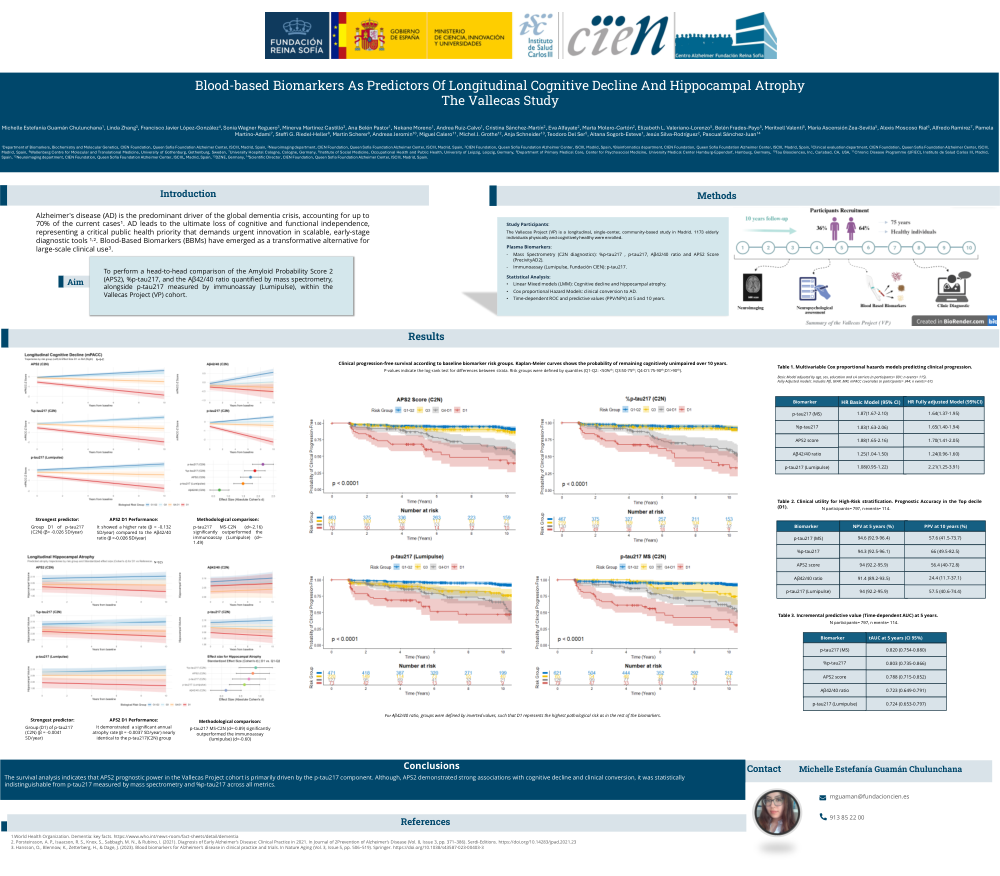
Methods: We analyzed Cognitively unimpaired older adults from the Vallecas Cohort with 10 years of follow-up were analyzed. Baseline plasma was analyzed using the PrecivityAD blood test (C2N) for %p-tau217, p-tau217, and Aβ42/40 ratio. We evaluated biomarker efficiency, particularly the APS2 score, predicting: i) cognitive decline and hippocampal atrophy, ii) clinical conversion to AD, and iii) accuracy using time-dependent ROC (tAUC) and predictive values (PPV/NPV) at 5 and 10 years.
Results: Linear mixed models revealed that individuals in the top decile (D1) of %p-tau217 and APS2 exhibited significantly faster mPACC decline and accelerated hippocampal atrophy vs. Q1-Q2 (p<0.001).

In Cox models, p-tau217 MS (HR=1.88, p<0.001) and APS2 (HR=1.95, p<0.001) were the strongest conversion predictors. While Aβ42/40 ratio showed a modest association (HR=1.25, p=0.0216), in fully adjusted models (including MRI and NfL), %p-tau217 had the strongest association (HR=1.69, p<0.001), followed by APS2 (HR=1.74, p<0.001); Aβ42/40 added no significance (p=0.08). Time-dependent ROC analysis showed %p-tau217 (MS) and APS2 achieved the highest discriminatory power at 5 years (tAUC=0.79 and 0.75), outperforming clinical-only (tAUC=0.69) and Aβ42/40 (tAUC=0.66). At 5 years, both %p-tau217 and APS2 demonstrated similar NPV (94.3% and 94%) for ruling out progression, whereas Aβ42/40 had 91% NPV. Being in the P90 for %p-tau217 yielded 66% PPV at 10 years for clinical conversion, while Aβ42/40 exhibited the lowest PPV (24.4%).
Conclusion: Plasma %p-tau217 and APS2 score are the most robust predictors of hippocampal atrophy and clinical progression to AD. The high NPV supports their use as reliable rule-out criteria, while the top decile identifies high-risk individuals with a >50% conversion rate within 10 years.


Comments

Email is required but is not shown publicly.

Loading comments...

aaic2026 banner
Copyright © 2015-2026, ePostersLive® SciGen is a registered trademark of SciGen Technologies S.A. Patent pending.

This website and third-party tools we use rely on cookies for the best user experience. By selecting "I agree", you agree to cookie usage as described in our Privacy Policy.