4,068 posters, 219 videos, 101 topics, 69 sessions, 14,365 authors, 6,128 institutions
ePostersLive by SciGen Technologies S.A. All rights reserved.
Alzheimer's Association International Conference 2026
July 12-15, 2026 | London, United Kingdom, and Online

10050
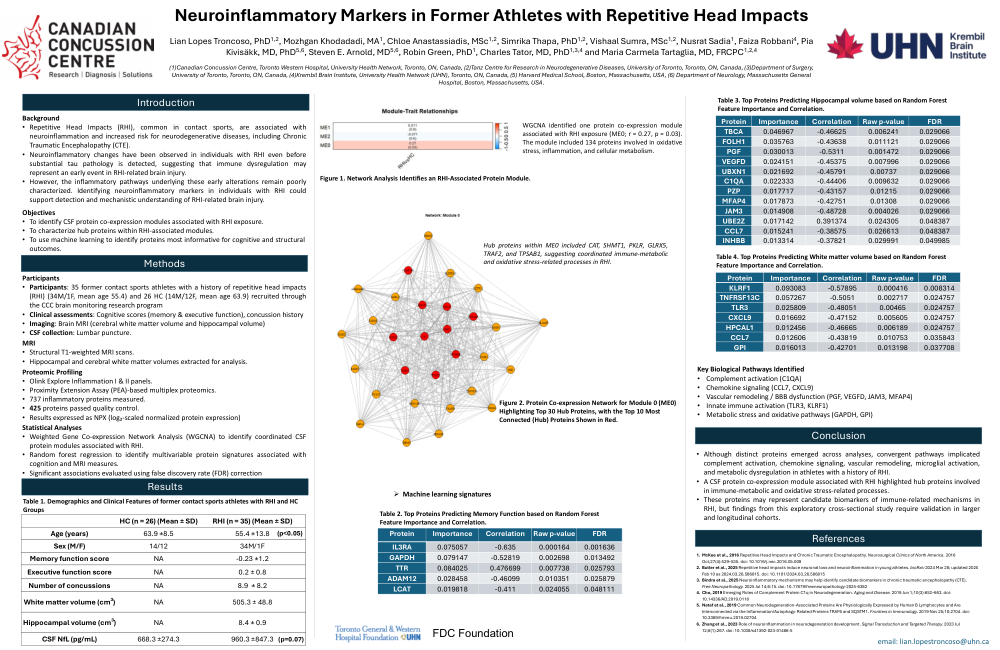
Neuroinflammatory Markers In Former Athletes With Repetitive Head Impacts: A Network And Machine-learning Approach.
Poster Presenter
Authors
Part of Topic
Background:
Repetitive head impacts (RHI) are associated with chronic traumatic encephalopathy, a progressive tauopathy marked by cognitive and behavioral changes. Previously, cerebrospinal fluid (CSF) proteomic studies in former contact sport athletes with RHI exposure have identified inflammatory alterations. Here, we applied network-based and machine-learning approach to define CSF proteomic signatures associated with RHI and related clinical and structural outcomes.
Methods:
CSF proteomic profiles from 35 RHI-exposed athletes and 26 healthy controls were analyzed using weighted gene co-expression network analysis (WGCNA) and Random Forest regression. RHI-associated protein modules were interrogated for hub proteins. Machine-learning models were trained using executive, memory, and mood/behavior composite scores, as well as MRI-derived hippocampal and white matter volumes. Feature importance was assessed, and key proteins were validated using correlation analyses (FDR < 0.10).
Results:
WGCNA identified a single protein module (134 proteins) associated with RHI exposure (r = 0.27, p = 0.03), enriched for oxidative stress, inflammatory, and metabolic pathways. Hub proteins included CAT, SHMT1, TRAF2, and GLRX5, implicating immune–metabolic regulation. Machine-learning analyses identified immune proteins negatively associated with executive function (CD4, CCL24, CXCL1), metabolic and transport proteins associated with memory performance (IL3RA, GAPDH, TTR), and vascular–immune proteins linked to mood/behavior (ICAM4, CD200R1). Vascular–inflammatory proteins were negatively associated with hippocampal (PGF, VEGFD, C1QA) and white matter volumes (KLRF1, TNFRSF13C, TLR3, CXCL9).
Conclusion:
Integrated network and machine-learning analyses implicate immune–metabolic and vascular pathways linking RHI exposure to cognitive, behavioral and structural brain changes, suggesting coordinated neuroinflammatory and neurobiological mechanisms underlying long-term vulnerability after RHI.
Comments
Email is required but is not shown publicly.
Loading comments...