4,068 posters, 219 videos, 101 topics, 69 sessions, 14,365 authors, 6,128 institutions
ePostersLive by SciGen Technologies S.A. All rights reserved.
Alzheimer's Association International Conference 2026
July 12-15, 2026 | London, United Kingdom, and Online

2343
Distinct Gut Community States Reveal Opposing Alzheimer's Disease Associations For Phocaeicola Vulgatus
Part of Topic
Distinct Gut Community States Reveal Opposing Community Membership for Phocaeicola vulgatus in Alzheimer’s Disease
Ziyuan Huang1, Roozbeh Sadeghian2, Maria L. Vaida2, Doyle V. Ward1, Vanni Bucci1, John P. Haran1
1UMass Chan Medical School, Worcester, MA, USA
2Harrisburg University of Science and Technology, Harrisburg, PA, USA
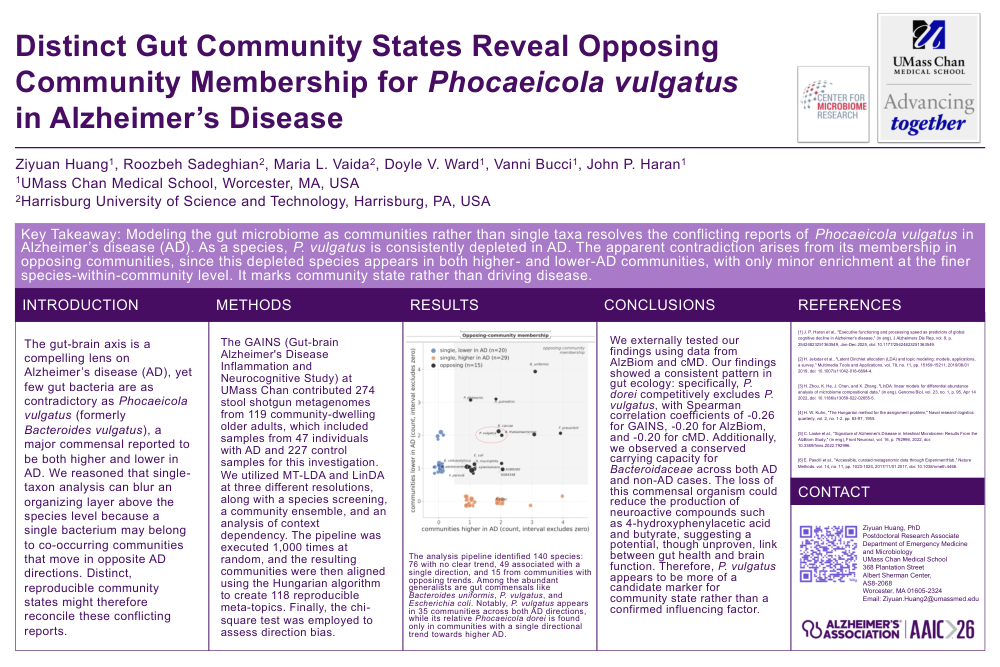
Key Takeaway: Modeling the gut microbiome as communities rather than single taxa resolves the conflicting reports of Phocaeicola vulgatus in Alzheimer’s disease (AD). As a species, P. vulgatus is consistently depleted in AD. The apparent contradiction arises from its membership in opposing communities, since this depleted species appears in both higher- and lower-AD communities, with only minor enrichment at the finer species-within-community level. It marks community state rather than driving disease.
Introduction: The gut-brain axis is a compelling lens on Alzheimer’s disease (AD), yet few gut bacteria are as contradictory as Phocaeicola vulgatus (formerly Bacteroides vulgatus), a major commensal reported to be both higher and lower in AD. We reasoned that single-taxon analysis can blur an organizing layer above the species level because a single bacterium may belong to co-occurring communities that move in opposite AD directions. Distinct, reproducible community states might therefore reconcile these conflicting reports.
Methods: The GAINS (Gut-brain Alzheimer's Disease Inflammation and Neurocognitive Study) at UMass Chan contributed 274 stool shotgun metagenomes from 119 community-dwelling older adults, which included samples from 47 individuals with AD and 227 control samples for this investigation. We utilized MT-LDA and LinDA at three different resolutions, along with a species screening, a community ensemble, and an analysis of context dependency. The pipeline was executed 1,000 times at random, and the resulting communities were then aligned using the Hungarian algorithm to create 118 reproducible meta-topics. Finally, the chi-square test was employed to assess direction bias.
Results: The analysis pipeline identified 140 species: 76 with no clear trend, 49 associated with a single direction, and 15 from communities with opposing trends. Among the abundant generalists are gut commensals like Bacteroides uniformis, P. vulgatus, and Escherichia coli. Notably, P. vulgatus appears in 35 communities across both AD directions, while its relative Phocaeicola dorei is found only in communities with a single directional trend towards higher AD.
Conclusions: We externally tested our findings using data from AlzBiom and cMD. Our findings showed a consistent pattern in gut ecology: specifically, P. dorei competitively excludes P. vulgatus, with Spearman correlation coefficients of -0.26 for GAINS, -0.20 for AlzBiom, and -0.20 for cMD. Additionally, we observed a conserved carrying capacity for Bacteroidaceae across both AD and non-AD cases. The loss of this commensal organism could reduce the production of neuroactive compounds such as 4-hydroxyphenylacetic acid and butyrate, suggesting a potential, though unproven, link between gut health and brain function. Therefore, P. vulgatus appears to be more of a candidate marker for community state rather than a confirmed influencing factor.
References:
[1] J. P. Haran et al., "Executive functioning and processing speed as predictors of global cognitive decline in Alzheimer's disease," (in eng), J Alzheimers Dis Rep, vol. 9, p. 25424823251363549, Jan-Dec 2025, doi: 10.1177/25424823251363549.
[2] H. Jelodar et al., "Latent Dirichlet allocation (LDA) and topic modeling: models, applications, a survey," Multimedia Tools and Applications, vol. 78, no. 11, pp. 15169-15211, 2019/06/01 2019, doi: 10.1007/s11042-018-6894-4.
[3] H. Zhou, K. He, J. Chen, and X. Zhang, "LinDA: linear models for differential abundance analysis of microbiome compositional data," (in eng), Genome Biol, vol. 23, no. 1, p. 95, Apr 14 2022, doi: 10.1186/s13059-022-02655-5.
[4] H. W. Kuhn, "The Hungarian method for the assignment problem," Naval research logistics quarterly, vol. 2, no. 1‐2, pp. 83-97, 1955.
[5] C. Laske et al., "Signature of Alzheimer's Disease in Intestinal Microbiome: Results From the AlzBiom Study," (in eng), Front Neurosci, vol. 16, p. 792996, 2022, doi: 10.3389/fnins.2022.792996.
[6] E. Pasolli et al., "Accessible, curated metagenomic data through ExperimentHub," Nature Methods, vol. 14, no. 11, pp. 1023-1024, 2017/11/01 2017, doi: 10.1038/nmeth.4468.
Comments
Email is required but is not shown publicly.
Loading comments...