4,068 posters, 219 videos, 101 topics, 69 sessions, 14,365 authors, 6,128 institutions
ePostersLive by SciGen Technologies S.A. All rights reserved.
Alzheimer's Association International Conference 2026
July 12-15, 2026 | London, United Kingdom, and Online

10087
Persistent Functional Impairment: Associations With Plasma P-tau217 And Neurofilament Light
Poster Presenter
Authors
Part of Topic
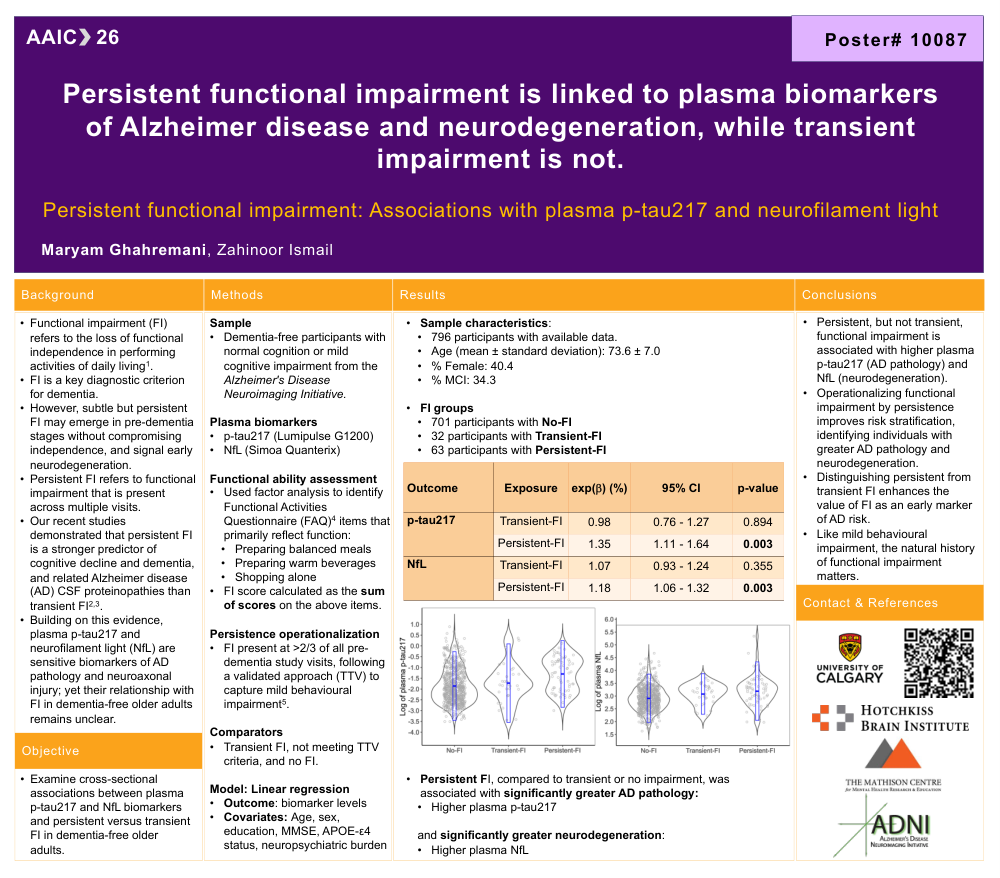
Background: Loss of independence in activities of daily living (ADL) is a defining feature of dementia, including Alzheimer’s disease (AD). However, subtle functional difficulties that do not compromise independent living can emerge in pre-dementia stages. These mild functional impairments (FIs), while insufficient to meet diagnostic criteria for dementia, may nonetheless signal early neurodegenerative changes, particularly when they persist over time. Plasma phosphorylated tau 217 (p-tau217) and neurofilament light (NfL) are sensitive biomarkers of AD pathology and neuroaxonal injury, respectively. Yet the relationship between FI and these plasma biomarkers in dementia-free older adults remains unclear. Here, we examined this association to determine whether persistent FI represents a clinically meaningful early marker of underlying AD-related pathology and neurodegeneration.
Methods: Participants were drawn from the Alzheimer's Disease Neuroimaging Initiative and were dementia-free at baseline. Factor analysis identified three Functional Activities Questionnaire items of “preparing a hot beverage”, “preparing a balanced meal”, and “shopping alone” as primarily reflecting functional abilities in contrast to simple proxies for cognition. Persistent-FI was operationalized as FI present at >two-thirds of pre-dementia visits. Comparator groups included Transient-FI and No-FI. Plasma p-tau217 and NfL were measured using the Lumipulse immunoassay platform [G1200]. Linear regressions modeled the association between FI status and baseline biomarker levels, adjusting for age, sex, education, cognitive performance, neuropsychiatric symptoms (NPS) burden, and apolipoprotein E ε4 genotype. Cognitive performance was measured using the Mini-Mental State Examination (MMSE), while NPS burden was captured using the Neuropsychiatric Inventory (NPI) or NPI Questionnaire (NPI-Q).
Results: Among 796 dementia-free individuals (age=73.6; 40.4% female; 34.3% mild cognitive impairment), Persistent FI was associated with higher plasma p-tau217 (exp(β)=1.35; 95%CI: 1.11-1.64; p=0.003), ptau217/Ab42 (exp(β)=1.32; 95%CI: 1.06-1.64; p=0.012), and NfL (exp(β)=1.18; 95%CI: 1.06-1.32; p=0.003), relative to no FI. Transient FI showed no biomarker associations.
Conclusions: Persistent mild FIs may represent early functional manifestations of AD-related neurodegenerative processes. Longitudinal assessment of subtle functional changes in dementia-free older adults could enhance early identification of individuals harbouring underlying AD pathology and neurodegeneration.
Comments
Email is required but is not shown publicly.
Loading comments...