4,068 posters, 219 videos, 101 topics, 69 sessions, 14,365 authors, 6,128 institutions
ePostersLive by SciGen Technologies S.A. All rights reserved.
Alzheimer's Association International Conference 2026
July 12-15, 2026 | London, United Kingdom, and Online

6362
MT-LDA: A Multi-run Alignment Framework For Robust Gut Microbiome Meta-topics In Alzheimer's Disease
Part of Topic
MT-LDA: A Multi-run Alignment Framework for Robust Gut Microbiome Meta-topics in Alzheimer’s Disease
Ziyuan Huang1, Roozbeh Sadeghian2, Maria L. Vaida2, Doyle V. Ward1, Vanni Bucci1, John P. Haran1
1UMass Chan Medical School, Worcester, MA, USA
2Harrisburg University of Science and Technology, Harrisburg, PA, USA
Key Takeaway: Meta-Topic Latent Dirichlet Allocation (MT-LDA) converts stochastic single-run LDA into a reproducible, quality-controlled map of gut communities, aligning 1,000 fits and gating each reported community through a cross-seed consistency screen.
Introduction: Latent Dirichlet Allocation (LDA) is used to identify co-occurrence communities related to the gut-brain axis in Alzheimer's disease (AD), but it has a notable reproducibility issue. The stochastic nature of the fitting process can lead to relabeling of communities across different runs, and standard one-model workflows do not provide a stability diagnostic. As a result, it is difficult to determine whether a community is genuine or merely an artifact. We developed Meta-Topic LDA (MT-LDA) to standardize microbiome discovery across various AD and gut microbiome cohorts. We identified five competitive exclusion relationships from the GAINS cohort across the AlzBiom and cMD cohorts.
Methods: MT-LDA defines a transferable protocol with stability safeguards at each stage. We applied it to GAINS stool shotgun metagenomes, comprising 274 metagenomes from 119 subjects, including 47 AD cases and 227 controls. We ran 1,000 independent LDA fits; for each seed, K was set by LDA Tuning (CaoJuan2009 density, Arun2010 divergence; K from 3 to 100 in steps of 3), yielding data-driven K values from 21 to 96 (median 48). Communities were aligned label-free and AD-blind by Jensen-Shannon nearest-match clustering with a Hungarian consensus step, opening a meta-topic when no match cleared the threshold. LinDA estimated per-community differential abundance as a feature selection mechanism. A cross-seed reproducibility screen applied a chi-square direction-bias test against the pooled base-rate null (Benjamini-Hochberg-adjusted), a 70% consistency floor, and recurrence above 500 across 1,000 seeds.
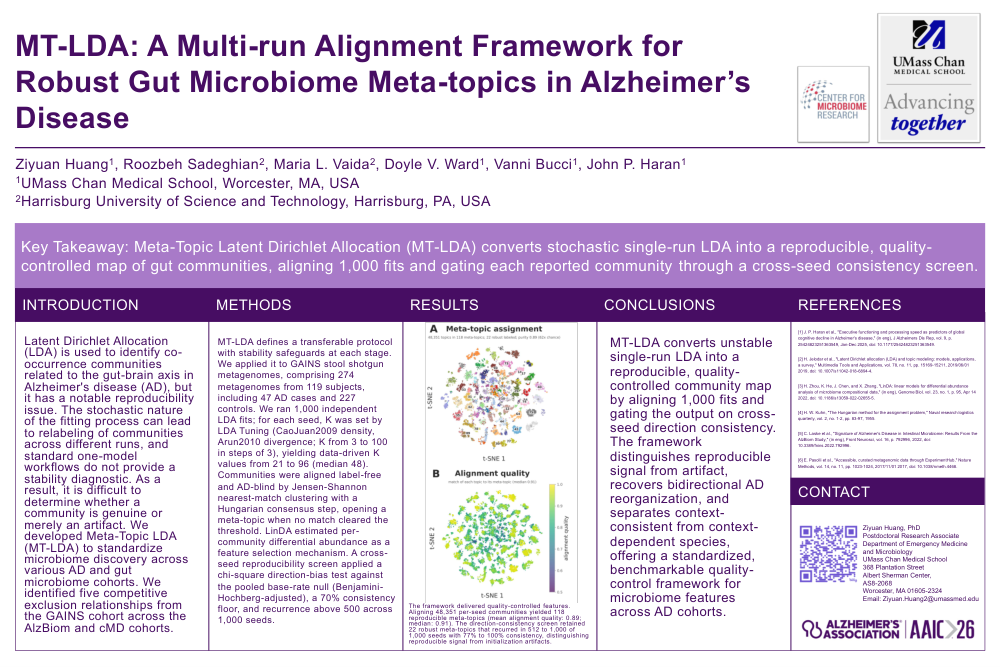
Results: The framework delivered quality-controlled features. Aligning 48,351 per-seed communities yielded 118 reproducible meta-topics (mean alignment quality: 0.89; median: 0.91). The direction-consistency screen retained 22 robust meta-topics that recurred in 512 to 1,000 of 1,000 seeds with 77% to 100% consistency, distinguishing reproducible signal from initialization artifacts.
Conclusion: MT-LDA converts unstable single-run LDA into a reproducible, quality-controlled community map by aligning 1,000 fits and gating the output on cross-seed direction consistency. The framework distinguishes reproducible signal from artifact, recovers bidirectional AD reorganization, and separates context-consistent from context-dependent species, offering a standardized, benchmarkable quality-control framework for microbiome features across AD cohorts.
Reference:
[1] J. P. Haran et al., "Executive functioning and processing speed as predictors of global cognitive decline in Alzheimer's disease," (in eng), J Alzheimers Dis Rep, vol. 9, p. 25424823251363549, Jan-Dec 2025, doi: 10.1177/25424823251363549.
[2] H. Jelodar et al., "Latent Dirichlet allocation (LDA) and topic modeling: models, applications, a survey," Multimedia Tools and Applications, vol. 78, no. 11, pp. 15169-15211, 2019/06/01 2019, doi: 10.1007/s11042-018-6894-4.
[3] H. Zhou, K. He, J. Chen, and X. Zhang, "LinDA: linear models for differential abundance analysis of microbiome compositional data," (in eng), Genome Biol, vol. 23, no. 1, p. 95, Apr 14 2022, doi: 10.1186/s13059-022-02655-5.
[4] H. W. Kuhn, "The Hungarian method for the assignment problem," Naval research logistics quarterly, vol. 2, no. 1‐2, pp. 83-97, 1955.
[5] C. Laske et al., "Signature of Alzheimer's Disease in Intestinal Microbiome: Results From the AlzBiom Study," (in eng), Front Neurosci, vol. 16, p. 792996, 2022, doi: 10.3389/fnins.2022.792996.
[6] E. Pasolli et al., "Accessible, curated metagenomic data through ExperimentHub," Nature Methods, vol. 14, no. 11, pp. 1023-1024, 2017/11/01 2017, doi: 10.1038/nmeth.4468.
Comments
Email is required but is not shown publicly.
Loading comments...