4,068 posters, 219 videos, 101 topics, 69 sessions, 14,365 authors, 6,128 institutions
ePostersLive by SciGen Technologies S.A. All rights reserved.
Alzheimer's Association International Conference 2026
July 12-15, 2026 | London, United Kingdom, and Online

9471
Metabolic Modifiers Of Blood-based Neurodegeneration, Tau Biomarkers And Cognitive Performance
Poster Presenter
Authors
Ramkrishna K. Singh, Semere Bekena, Yiqi Zhu, Jean-Francois Trani, Melissa E. Petersen, Beau M. Ances, Ganesh M. Babulal
Affiliations
Department of Neurology, Mayo Clinic, Rochester, MN, USA, Department of Neurology, Washington University School of Medicine, St Louis, Missouri, USA, School of Public Health, Washington University in St Louis, Missouri, USA, University of North Texas Health Science Center, Fort Worth, TX, USA
Part of Topic
Abstract
Background
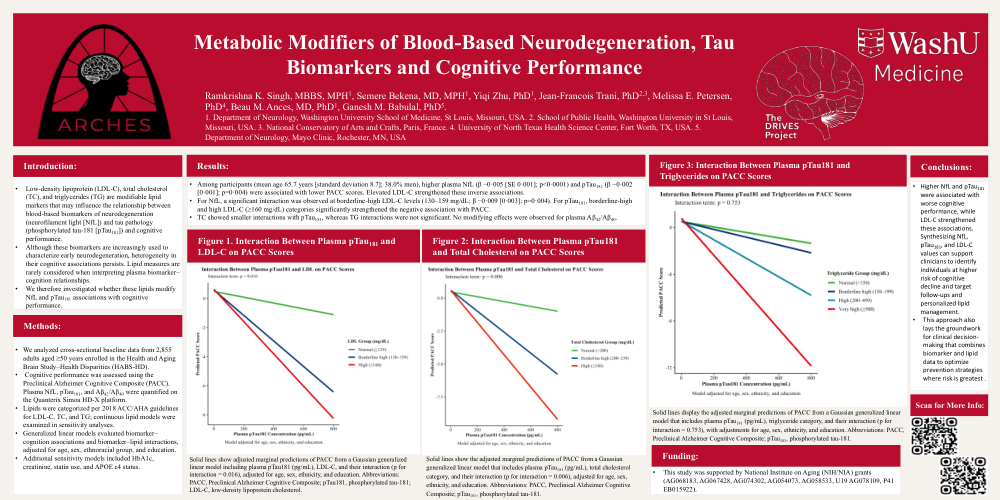
Low-density lipoprotein (LDL-C), total cholesterol (TC), and triglycerides (TG) are modifiable lipid markers that may influence the relationship between blood-based biomarkers of neurodegeneration (neurofilament light [NfL]) and tau pathology (phosphorylated tau-181 [pTau181]) and cognitive performance. Although these biomarkers are increasingly used to characterize early neurodegeneration, heterogeneity in their cognitive associations persists. Lipid measures are rarely considered when interpreting plasma biomarker–cognition relationships. We therefore investigated whether these lipids modify NfL and pTau181 associations with cognitive performance.
Methods
We analyzed cross-sectional baseline data from 2,855 adults aged ≥50 years enrolled in the Health and Aging Brain Study–Health Disparities (HABS-HD). Cognitive performance was assessed using the Preclinical Alzheimer Cognitive Composite (PACC). Plasma NfL, pTau181, and Aβ42/Aβ40 were quantified on the Quanterix Simoa HD-X platform. Lipids were categorized per 2018 ACC/AHA guidelines for LDL-C, TC, and TG; continuous lipid models were examined in sensitivity analyses. Generalized linear models evaluated biomarker–cognition associations and biomarker–lipid interactions, adjusted for age, sex, ethnoracial group, and education. Additional sensitivity models included HbA1c, creatinine, statin use, and APOE ε4 status.
Findings
Among participants (mean age 65.7 years [standard deviation 8.7]; 38.0% men), higher plasma NfL (β −0·005 [SE 0·001]; p<0·0001) and pTau181 (β −0·002 [0·001]; p=0·004) were associated with lower PACC scores. Elevated LDL-C strengthened these inverse associations. For NfL, a significant interaction was observed at borderline-high LDL-C levels (130–159 mg/dL; β −0·009 [0·003]; p=0·004). For pTau181, borderline-high and high LDL-C (≥160 mg/dL) categories significantly strengthened the negative association with PACC. TC showed smaller interactions with pTau181, whereas TG interactions were not significant. No modifying effects were observed for plasma Aβ42/Aβ40.
Interpretation
Higher NfL and pTau181 were associated with worse cognitive performance, while LDL-C strengthened these associations. Synthesizing NfL, pTau181, and LDL-C values can support clinicians to identify individuals at higher risk of cognitive decline and target follow-ups and personalized lipid management. This approach also lays the groundwork for clinical decision-making that combines biomarker and lipid data to optimize prevention strategies where risk is greatest.
Figure 1
Figure 2
Figure 3
Comments
Email is required but is not shown publicly.
Loading comments...