4,068 posters, 219 videos, 101 topics, 69 sessions, 14,365 authors, 6,128 institutions
ePostersLive by SciGen Technologies S.A. All rights reserved.
Alzheimer's Association International Conference 2026
July 12-15, 2026 | London, United Kingdom, and Online

6793
How Much Is Increased Diagnostic Accuracy Worth? Willingness To Pay For Blood Biomarkers For Dementia In The Mind Study
Poster Presenter
Part of Topic
Valuing blood-based biomarkers for diagnostic confidence of dementia: willingness to pay for neurofilament light testing in The MiND Study
Dhamidhu Eratne deratne@unimelb.edu.au 1,2,3, Francisco Santos Gonzalez2, Dr Christa Dang2, Dr Matthew Kang1.2, Dr Tianxin Pan2, Ilias Goranitis2, Dennis Velakoulis1.2, and The MiND Study Group. (1)Neuropsychiatry Centre, The Royal Melbourne Hospital, VIC, Australia, (2)University of Melbourne, Parkville, VIC, Australia, (3) Florey, Parkville, VIC, Australia
Background
Blood biomarkers such as neurofilament light chain (NfL) have the potential to improve diagnostic accuracy and reduce prolonged uncertainty for patients presenting with cognitive, psychiatric, and neurological symptoms. While their analytical performance is increasingly well established, successful translation into routine care also depends on patient and family acceptability and perceived value. Willingness to pay (WTP) offers a patient-centred measure of how individuals value diagnostic certainty and can inform the feasibility of implementing biomarker-based testing in clinical practice.
Methods
WTP was assessed in participants of The Markers in Neuropsychiatric Disorders Study (The MiND Study) using a structured contingent valuation survey. Participants or carers/informants were presented with a hypothetical blood biomarker test that could establish diagnosis with high certainty and reduce years of diagnostic uncertainty, with payment required out-of-pocket. A multi-stage bidding approach was used, followed by a final item capturing the maximum amount respondents were willing to pay. The primary outcome was the maximum stated WTP. Participants were grouped by diagnosis into neurodegenerative disorders (ND; including Alzheimer’s disease, frontotemporal dementia, and other dementias), primary psychiatric disorders (PPD), controls, and other diagnoses. WTP was summarised using descriptive statistics.
Results
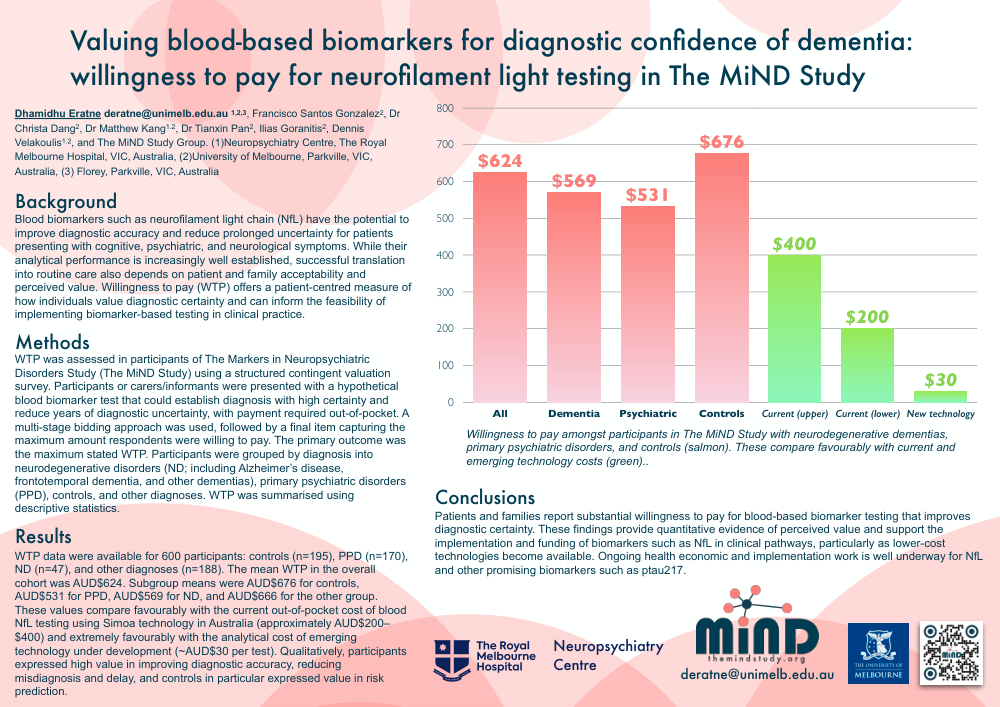
WTP data were available for 600 participants: controls (n=195), PPD (n=170), ND (n=47), and other diagnoses (n=188). The mean WTP in the overall cohort was AUD$624. Subgroup means were AUD$676 for controls, AUD$531 for PPD, AUD$569 for ND, and AUD$666 for the other group. These values compare favourably with the current out-of-pocket cost of blood NfL testing using Simoa technology in Australia (approximately AUD$200–$400) and extremely favourably with the analytical cost of emerging technology under development (~AUD$30 per test). Qualitatively, participants expressed high value in improving diagnostic accuracy, reducing misdiagnosis and delay, and controls in particular expressed value in risk prediction.
Conclusions
Patients and families report substantial willingness to pay for blood-based biomarker testing that improves diagnostic certainty. These findings provide quantitative evidence of perceived value and support the implementation and funding of biomarkers such as NfL in clinical pathways, particularly as lower-cost technologies become available. Ongoing health economic and implementation work is well underway for NfL and other promising biomarkers such as ptau217.
Comments
Email is required but is not shown publicly.
Loading comments...