4,068 posters, 219 videos, 101 topics, 69 sessions, 14,365 authors, 6,128 institutions
ePostersLive by SciGen Technologies S.A. All rights reserved.
Alzheimer's Association International Conference 2026
July 12-15, 2026 | London, United Kingdom, and Online

1432
Peripheral Tnf-α-driven Inflammation & Its Effect On Cognition In Alzheimer’S Disease (ad) Adjuvant Therapies
Poster Presenter
Authors
Samer Salama, Mohamed A. Wafa, Nehal M. Ramadan, Gabriel Andrade, Raghda Kharoub, Youssef Elshablangy, Abdallah Falaky, Amr A. Wafa, Youssef A. Sanad
Affiliations
Mansoura University Faculty of Medicine, Mansoura, Egypt, Ajman University, Ajman, United Arab Emirates, New Mansoura University, New Mansoura, Egypt
Part of Topic
Alzheimer's Association International Conference 2026 (AAIC 2026) ePoster Submission
Poster Code: aaic2026.4d00885
Peripheral TNF-α-Driven Inflammation & Its Effect on Cognition in Alzheimer's Disease (AD) Adjuvant Therapies
Authors:
Mohamed A. Wafa, Nehal M. Ramadan, Gabriel Andrade, Raghda Kharoub, Youssef Elshablangy, Abdallah Falaky, Amr A. Wafa, Youssef A. Sanad, Karim Y. El-Deeb, Samer Salama
Affiliations:
Mansoura University (Egypt), Ajman University (UAE), New Mansoura University (Egypt)
BACKGROUND
Tumor necrosis factor-alpha (TNF-α) plays a central role in neuroinflammation and has been associated with Alzheimer's disease (AD) progression.
Although individual studies suggest links between TNF-α levels and cognitive decline, the relationship remains uncertain. To address this gap, the present review correlates plasma TNF-α with cognition in clinical trials targeting AD.
METHODS
Following PRISMA 2020 guidelines and a prospective registration in PROSPERO (CRD42025345678), CENTRAL, MEDLINE, Scopus, Web of Science, and medRxiv were searched (up to November 2025).
Dual screening was performed, with disagreements resolved through consensus.
For each eligible randomized controlled trial (RCT) reporting longitudinal plasma TNF-α alongside cognition (MMSE, ADAS-Cog, MoCA, TYM), data extraction and risk-of-bias assessment were performed.
Outcomes were Z-standardized, and correlations between TNF-α and cognitive changes were explored by meta-regression (REML, Knapp-Hartung).
KEY FINDINGS
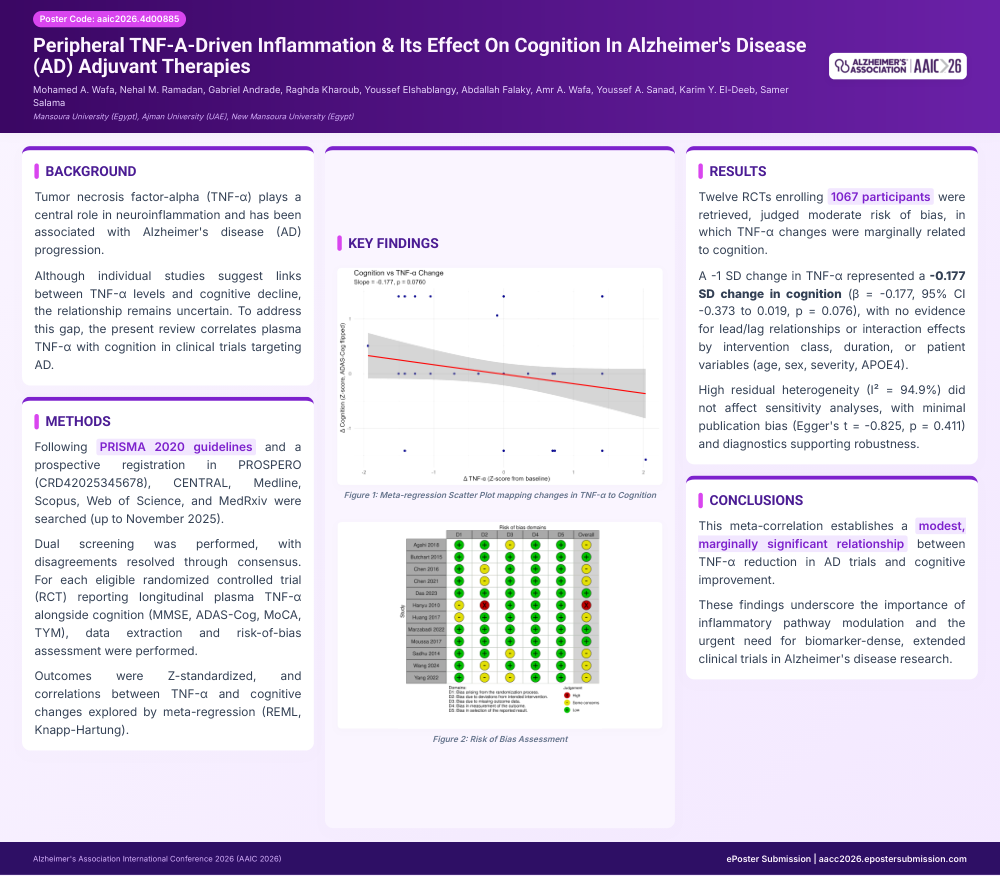
Figure 1: Meta-regression scatter plot mapping changes in TNF-α to cognition.
Figure 2: Risk of bias assessment.
RESULTS
Twelve RCTs enrolling 1,067 participants were retrieved and judged to have a moderate risk of bias, in which TNF-α changes were marginally related to cognition.
A −1 SD change in TNF-α represented a −0.177 SD change in cognition (β = −0.177, 95% CI −0.373 to 0.019, p = 0.076), with no evidence for lead/lag relationships or interaction effects by intervention class, duration, or patient variables (age, sex, severity, APOE ε4).
High residual heterogeneity (I² = 94.9%) did not affect sensitivity analyses, with minimal publication bias (Egger's t = −0.825, p = 0.411), and diagnostics supported the robustness of the findings.
CONCLUSIONS
This meta-correlation establishes a modest, marginally significant relationship between TNF-α reduction in AD trials and cognitive improvement.
These findings underscore the importance of inflammatory pathway modulation and the urgent need for biomarker-dense, extended clinical trials in Alzheimer's disease research.
Comments
Email is required but is not shown publicly.
Loading comments...