4,068 posters, 219 videos, 101 topics, 69 sessions, 14,365 authors, 6,128 institutions
ePostersLive by SciGen Technologies S.A. All rights reserved.
Alzheimer's Association International Conference 2026
July 12-15, 2026 | London, United Kingdom, and Online

7044
No Association Of Plasma P-tau217 And Apoe ε4 With Practice Effects In Subjective Cognitive Decline - Brascode Cohort
Poster Presenter
Authors
Affiliations
Part of Topic
Background
Practice effects (PE), performance improvements upon repeated cognitive testing, represent an important marker of early cognitive efficiency and neural plasticity. Whether plasma p-tau217 or APOE ε4 carrier status modulates these short-term learning gains in individuals with subjective cognitive decline (SCD) remains unclear, particularly in low- and middle-income settings.
Methods
Baseline plasma p-tau217, APOE genotyping, and detailed cognitive assessments were obtained in participants of the Brazilian Subjective Cognitive Decline (BRASCODE) cohort. Cognitive testing was repeated after 12 months. Domain-specific practice effects were computed as z-standardized change scores from baseline. Linear regression models examined whether p-tau217 (log-transformed) or APOE ε4 status predicted 12-month practice effects across memory, executive function, and language, adjusting for baseline domain performance, age, sex, and education.
Results
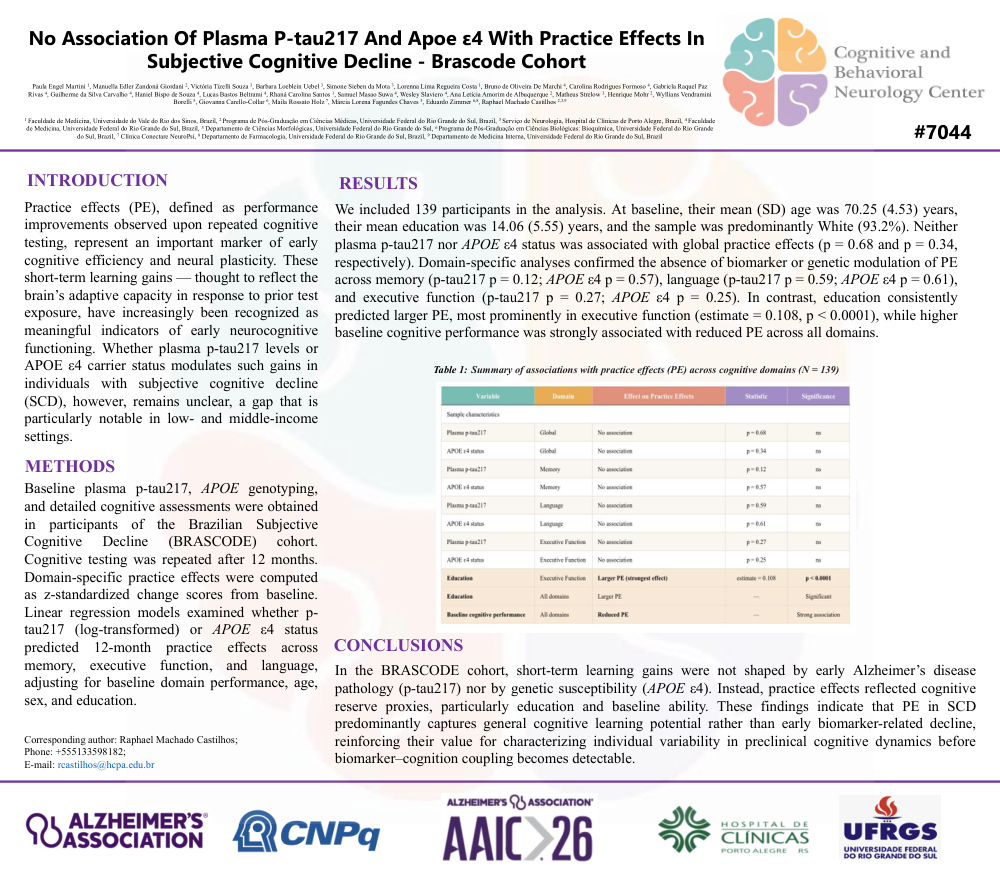
We included 139 participants in the analysis. At baseline, their mean (SD) age was 70.25 (4.53) years, their mean education was 14.06 (5.55) years, and the sample was predominantly White (93.2%). Neither plasma p-tau217 nor APOE ε4 status was associated with global practice effects (p = 0.68 and p = 0.34, respectively). Domain-specific analyses confirmed the absence of biomarker or genetic modulation of PE across memory (p-tau217 p = 0.12; APOE ε4 p = 0.57), language (p-tau217 p = 0.59; APOE ε4 p = 0.61), and executive function (p-tau217 p = 0.27; APOE ε4 p = 0.25). In contrast, education consistently predicted larger PE, most prominently in executive function (estimate = 0.108, p < 0.0001), while higher baseline cognitive performance was strongly associated with reduced PE across all domains.
Conclusions
In the BRASCODE cohort, short-term learning gains were not shaped by early Alzheimer’s disease pathology (p-tau217) nor by genetic susceptibility (APOE ε4). Instead, practice effects reflected cognitive reserve proxies, particularly education and baseline ability. These findings indicate that PE in SCD predominantly captures general cognitive learning potential rather than early biomarker-related decline, reinforcing their value for characterizing individual variability in preclinical cognitive dynamics before biomarker–cognition coupling becomes detectable.
Comments
Email is required but is not shown publicly.
Loading comments...