4,068 posters, 219 videos, 101 topics, 69 sessions, 14,365 authors, 6,128 institutions
ePostersLive by SciGen Technologies S.A. All rights reserved.
Alzheimer's Association International Conference 2026
July 12-15, 2026 | London, United Kingdom, and Online

9606
Early Plasma Neuroinflammation Is Associated With Alzheimer’S Onset: 8-year Follow-up From Invece.ab Cohort
Poster Presenter
Authors
Riccardo Rocco Ferrari, Michele Rossi, Elisa Pellegrini, Bartolo Rizzo, Antonio Guaita, Annalisa Davin
Affiliations
Part of Topic
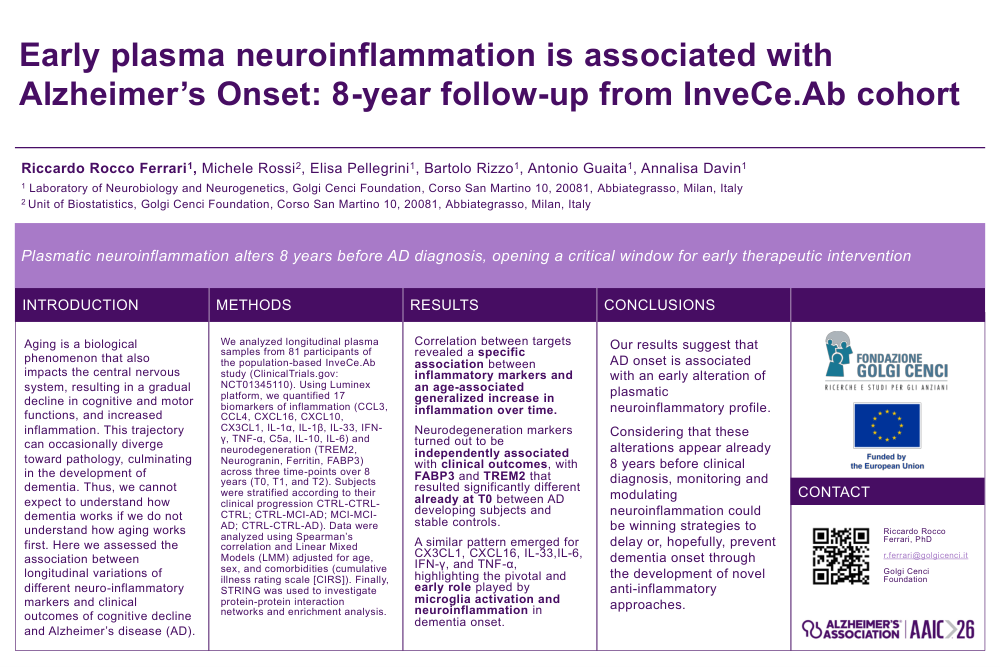
Background: Aging is a biological phenomenon that also impacts the central nervous system, resulting in a gradual decline in cognitive and motor functions, and increased inflammation. This trajectory can occasionally diverge toward pathology, culminating in the development of dementia. Thus, we cannot expect to understand how dementia works if we do not understand how aging works first. Here we assessed the association between longitudinal variations of different neuro-inflammatory markers and clinical outcomes of cognitive decline and Alzheimer’s disease (AD).
Methods: We analyzed longitudinal plasma samples from 81 participants of the population-based InveCe.Ab study (ClinicalTrials.gov: NCT01345110). Using Luminex platform, we quantified 17 biomarkers of inflammation (CCL3, CCL4, CXCL16, CXCL10, CX3CL1, IL-1α, IL-1β, IL-33, IFN-γ, TNF-α, C5a, IL-10, IL-6) and neurodegeneration (TREM2, Neurogranin, Ferritin, FABP3) across three time-points over 8 years (T0, T1, and T2). Subjects were stratified according to their clinical progression CTRL-CTRL-CTRL; CTRL-MCI-AD; MCI-MCI-AD; CTRL-CTRL-AD). Data were analyzed using Spearman’s correlation and Linear Mixed Models (LMM) adjusted for age, sex, and comorbidities (cumulative illness rating scale [CIRS]). Finally, STRING was used to investigate protein-protein interaction networks and enrichment analysis.
Results: Correlation between targets revealed a specific association between inflammatory markers and an age-associated generalized increase in inflammation over time. Neurodegeneration markers turned out to be independently associated with clinical outcomes, with FABP3 and TREM2 that resulted significantly different already at T0 between AD developing subjects and stable controls. A similar pattern emerged for CX3CL1, CXCL16, IL-33, IL-6, IFN-γ, and TNF-α, highlighting the pivotal and early role played by microglia activation and neuroinflammation in dementia onset.
Conclusions: Our results suggest that AD onset is associated with an early alteration of plasmatic neuroinflammatory profile. Considering that these alterations appear already 8 years before clinical diagnosis, monitoring and modulating neuroinflammation could be winning strategies to delay or, hopefully, prevent dementia onset through the development of novel anti-inflammatory approaches.
Comments
Email is required but is not shown publicly.
Loading comments...