4,068 posters, 219 videos, 101 topics, 69 sessions, 14,365 authors, 6,128 institutions
ePostersLive by SciGen Technologies S.A. All rights reserved.
Alzheimer's Association International Conference 2026
July 12-15, 2026 | London, United Kingdom, and Online

7446
Association Of Apolipoprotein E Genotype And Blood-based Biomarkers In The Cog-aging Cohort Study
Poster Presenter
Authors
Part of Topic
Video
Association Of Apolipoprotein E Genotype And Blood-based Biomarkers In The Cog-aging Cohort Study:
Author Block:Maurício Lemos Bueno Fontes1,2, Joice Coutinho Alvarenga2,3, Rafaela D'Angelo Machado2,4, Giovanna Correia Pereira Moro1,2, João Arthur Rodrigues Barbosa5, Gabriela Tomé Oliveira Engelmann2,3, Jonas Jardim de Paula3,6, Marco Aurélio Fagundes Angelo7, Anja Schneider8, Pamela Martino Adami9, Maria Carolina DALMASSO, PhD10, Débora Marques de Miranda11,3, Marco Aurélio Romano-Silva3,11, Luiz Armando Cunha de Marco3,11, Bernardo de Mattos Viana3,6, Alfredo Ramírez Zuniga9,8, MARIA APARECIDA BICALHO, PhD3,12.
1Undergraduate Medicine, Federal University of Minas Gerais, Belo Horizonte, Brazil, 2Cog-Aging Research Group, Universidade Federal de Minas Gerais, Belo Horizonte, Brazil, 3Molecular Medicine Postgraduate Program, School of Medicine, Universidade Federal de Minas Gerais (UFMG), Belo Horizonte, Brazil, 4Undergraduate Psychology, Faculty of Health Sciences of Minas Gerais, Belo Horizonte, Brazil, 5Older Adult’s Psychiatry and Psychology Extension Program (PROEPSI), School of Medicine, Universade Federal de Minas Gerais (UFMG), Belo Horizonte, Brazil, 6Department of Psychiatry, School of Medicine, Universidade Federal de Minas Gerais (UFMG), Belo Horizonte, Brazil, 7Federal University of Minas Gerais, Belo Horizonte, Brazil, 8German Center for Neurodegenerative Diseases (DZNE), Bonn, Germany, 9Division of Neurogenetics and Molecular Psychiatry, Department of Psychiatry and Psychotherapy, Faculty of Medicine and University Hospital Cologne, University of Cologne, Cologne, Germany, 10Neuroscience and Complex Systems Unit - CONICET, Florencio Varela, Argentina, 11Neurotec R National Institute of Science and Technology (INCT-Neurotec R), Faculty of Medicine, Universidade Federal de Minas Gerais (UFMG), Belo Horizonte, Brazil, 12Department of Internal Medicine, School of Medicine, Federal University of Minas gerais, Belo Horizonte, Brazil.
Abstract:
Background: Variations in blood-based biomarkers (BBM) have been reported across different apolipoprotein E (APOE) genotypes along the Alzheimer’s disease (AD) continuum. These alterations remain understudied in populations with low educational attainment. Objectives: To investigate the association between BBM and APOE genotype across the clinical continuum of AD.
Methods: A total of 316 participants, from Brazilian Cog-Aging cohort, were stratified into cognitively unimpaired (CU=29.8%), mild cognitive impairment (MCI=43.7%), dementia of the Alzheimer’s type (DAT=23.9%) and other dementias (2.5%). APOE genotyping was performed using real-time PCR. Participants were classified by the presence of at least one ε4 allele (ε4+ and ε4-). BBM (pTau-217, Aβ42, Aβ40, GFAP, and NfL) were quantified using single-molecule array technology (Simoa®). The Mann-Whitney U test was employed for hypothesis testing (JASP software). Clustermaps and hierarchical clustering were performed using Python (Seaborn package). Individual values were grouped by genotype using the median, standardized by z-score. Genotypes ε2/ε2 and ε2/ε4 were excluded due to small sample size.
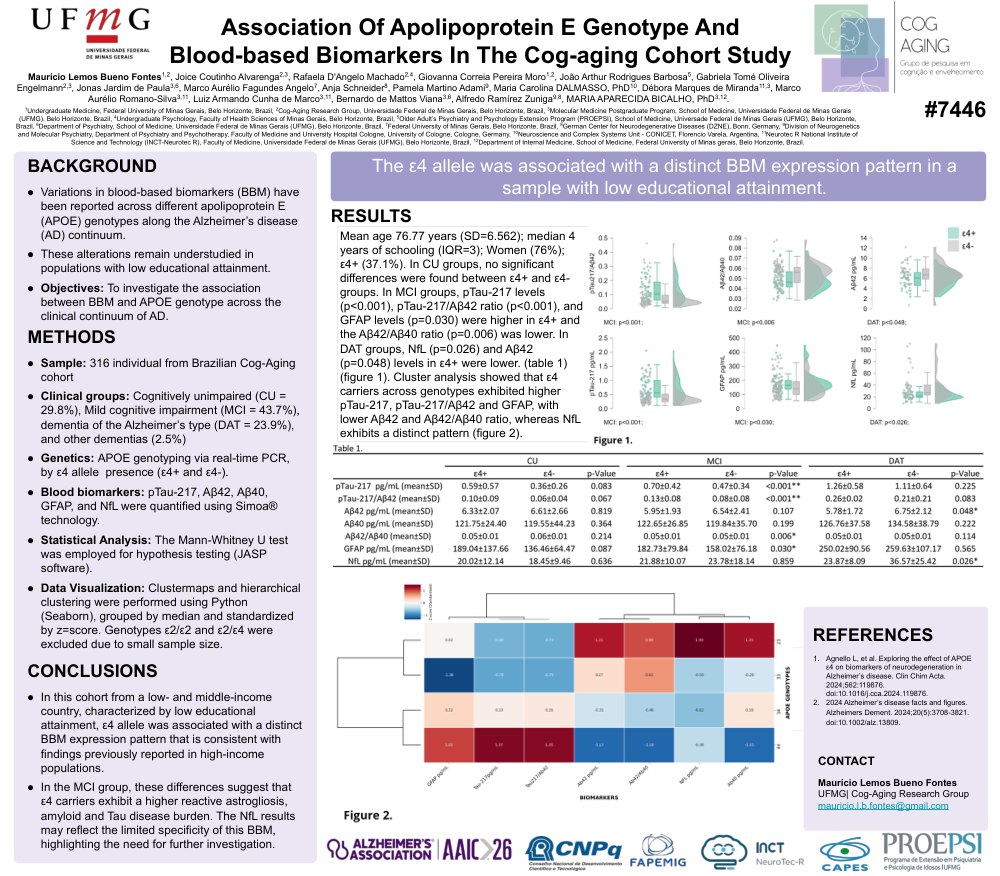
Results: Mean age 76.77 years (SD=6.562); median 4 years of schooling (IQR=3); Women (76%); ε4+ (37.1%). In CU groups, no significant differences were found between ε4+ and ε4- groups. In MCI groups, pTau-217 levels (p<0.001), pTau-217/Aβ42 ratio (p<0.001), and GFAP levels (p=0.030) were higher in ε4+ and the Aβ42/Aβ40 ratio (p=0.006) was lower. In DAT groups, NfL (p=0.026) and Aβ42 (p=0.048) levels in ε4+ were lower. (table 1) (figure 1). Cluster analysis showed that ε4 carriers across genotypes exhibited higher pTau-217, pTau-217/Aβ42 and GFAP, with lower Aβ42 and Aβ42/Aβ40 ratio, whereas NfL exhibits a distinct pattern (figure 2).
Conclusion: In this cohort from a low- and middle-income country, characterized by low educational attainment, ε4 allele was associated with a distinct BBM expression pattern that is consistent with findings previously reported in high-income populations. In the MCI group, these differences suggest that ε4 carriers exhibit a higher reactive astrogliosis, amyloid and Tau disease burden. The NfL results may reflect the limited specificity of this BBM, highlighting the need for further investigation.
Comments
Email is required but is not shown publicly.
Loading comments...