4,068 posters, 219 videos, 101 topics, 69 sessions, 14,365 authors, 6,128 institutions
ePostersLive by SciGen Technologies S.A. All rights reserved.
Alzheimer's Association International Conference 2026
July 12-15, 2026 | London, United Kingdom, and Online

6814
Alzheimer's Biomarker Status Modifies Associations Of Aortic Stiffness And Extracellular Matrix Integrity In Aging Adults Over 11 Years
Poster Presenter
Authors
Part of Topic
Video
Background
Central arterial stiffness has been linked to Alzheimer’s disease (AD) and related dementias, particularly through cerebrovascular disease and dysregulation. However, the extent to which vascular risk and AD neuropathology jointly influence cerebrovascular injury, particularly across distinct pathways, remains unclear.
We investigated whether AD biomarker status modifies aortic stiffness associations with cerebrospinal fluid (CSF) measures of cerebrovascular structural integrity.
Methods & Analysis Plan
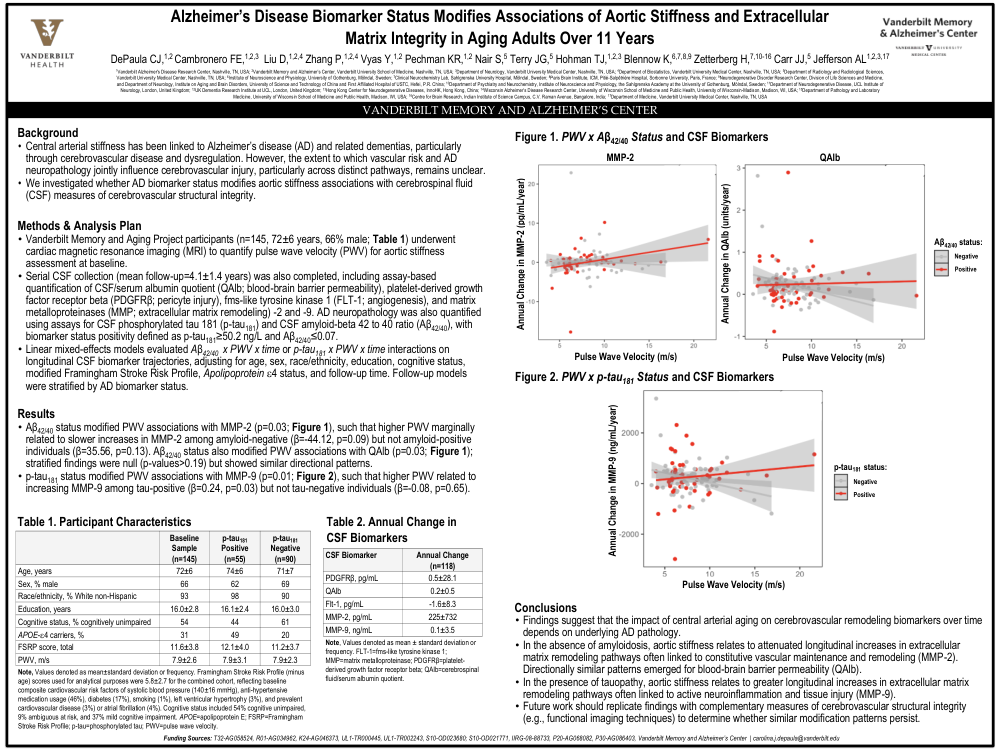
Vanderbilt Memory and Aging Project participants (n=145, 72±6 years, 66% male; Table 1) underwent cardiac magnetic resonance imaging (MRI) to quantify pulse wave velocity (PWV) for aortic stiffness assessment at baseline.
Serial CSF collection (mean follow-up=4.1±1.4 years) was also completed, including assay-based quantification of CSF/serum albumin quotient (QAlb; blood-brain barrier permeability), platelet-derived growth factor receptor beta (PDGFRβ; pericyte injury), fms-like tyrosine kinase 1 (FLT-1; angiogenesis), and matrix metalloproteinases (MMP; extracellular matrix remodeling) -2 and -9. AD neuropathology was also quantified using assays for CSF phosphorylated tau 181 (p-tau181) and CSF amyloid-beta 42 to 40 ratio (Aβ42/40), with biomarker status positivity defined as p-tau181≥50.2 ng/L and Aβ42/40≤0.07.
Linear mixed-effects models evaluated Aβ42/40 x PWV x time or p-tau181 x PWV x time interactions on longitudinal CSF biomarker trajectories, adjusting for age, sex, race/ethnicity, education, cognitive status, modified Framingham Stroke Risk Profile, Apolipoprotein e4 status, and follow-up time. Follow-up models were stratified by AD biomarker status.
Results
Aβ42/40 status modified PWV associations with MMP-2 (p=0.03; Figure 1), such that higher PWV marginally related to slower increases in MMP-2 among amyloid-negative (β=-44.12, p=0.09) but not amyloid-positive individuals (β=35.56, p=0.13). Aβ42/40 status also modified PWV associations with QAlb (p=0.03; Figure 1); stratified findings were null (p-values>0.19) but showed similar directional patterns.
p-tau181 status modified PWV associations with MMP-9 (p=0.01; Figure 2), such that higher PWV related to increasing MMP-9 among tau-positive (β=0.24, p=0.03) but not tau-negative individuals (β=-0.08, p=0.65).
Conclusions
Findings suggest that the impact of central arterial aging on cerebrovascular remodeling biomarkers over time depends on underlying AD pathology.
In the absence of amyloidosis, aortic stiffness relates to attenuated longitudinal increases in extracellular matrix remodeling pathways often linked to constitutive vascular maintenance and remodeling (MMP-2). Directionally similar patterns emerged for blood-brain barrier permeability (QAlb).
In the presence of tauopathy, aortic stiffness relates to greater longitudinal increases in extracellular matrix remodeling pathways often linked to active neuroinflammation and tissue injury (MMP-9).
Future work should replicate findings with complementary measures of cerebrovascular structural integrity (e.g., functional imaging techniques) to determine whether similar modification patterns persist.
Comments
Email is required but is not shown publicly.
Loading comments...