4,068 posters, 219 videos, 101 topics, 69 sessions, 14,365 authors, 6,128 institutions
ePostersLive by SciGen Technologies S.A. All rights reserved.
Alzheimer's Association International Conference 2026
July 12-15, 2026 | London, United Kingdom, and Online

9192
Impact Of Renal Function And BMI On The Interpretation Of Alzheimer's Blood-based Biomarkers In The Cog-Aging Cohort.
Poster Presenter
Authors
Felipe Pereira Ferreira Sales, Joice Coutinho de Alvarenga, Giovanna Correia Pereira Moro, Iara Souza Santos, Gabriela Tomé Oliveira Engelmann, Isabella de Abreu Nepomuceno, Jonas Jardim de Paula, Marco Aurélio Fagundes Angelo, Anja Schneider, Pamela Martino Adami, Maria Carolina Dalmasso, Débora Marques de Miranda, Marco Aurélio Romano Silva, Luiz Armando Cunha de Marco, Bernardo de Mattos Viana, Alfredo Ramírez Zuniga, Maria Aparecida Camargos Bicalho
Affiliations
Universidade Federal de Minas Gerais, Belo Horizonte, Brazil, Neuroscience and Complex Systems Unit - CONICET, Florencio Varela, Argentina, Cog-Aging Research Group, Universidade Federal de Minas Gerais, Belo Horizonte, Brazil, Neurotec R National Institute of Science and Technology (INCT-Neurotec R), Universidade Federal de Minas Gerais, Belo Horizonte, Brazil, Geriatrics and Gerontology Center Clinical Hospital of University of Minas Gerais, Universidade Federal de Minas Gerais, Belo Horizonte, Brazil, Molecular Medicine Postgraduate Program, School of Medicine, Universidade Federal de Minas Gerais, Belo Horizonte, Brazil, German Center of Neurodegenerative Diseases (DZNE), Bonn, Germany, Department of Psychiatry and Psychotherapy, University of Cologne, Cologne, Germany, Department of Psychiatry and Psychotherapy, University of Cologne, Cologne, Germany; German Center of Neurodegenerative Diseases (DZNE), Bonn, Germany
Part of Topic
Video
Title: Impact of Renal Function and BMI on the Interpretation of Alzheimer's Blood-Based Biomarkers in the Cog-Aging Cohort
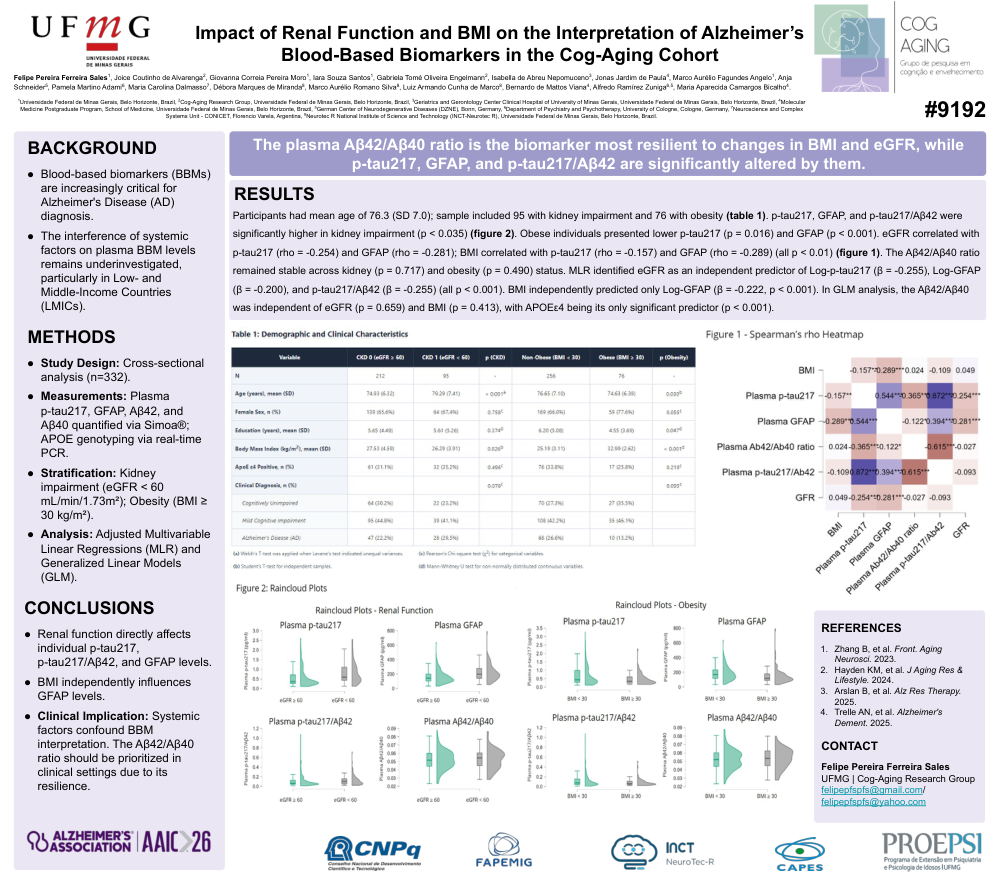
Key Finding: The plasma Aβ42/Aβ40 ratio is the biomarker most resilient to changes in BMI and eGFR, while p-tau217, GFAP, and p-tau217/Aβ42 are significantly altered by them.
Background: Blood-based biomarkers (BBMs) are increasingly critical for Alzheimer's Disease (AD) diagnosis. The interference of systemic factors on plasma BBM levels remains underinvestigated, particularly in Low- and Middle-Income Countries (LMICs).
Methods:
-
Study Design: Cross-sectional analysis (n=332).
-
Measurements: Plasma p-tau217, GFAP, Aβ42, and Aβ40 quantified via Simoa®; APOE genotyping via real-time PCR.
-
Stratification: Kidney impairment (eGFR < 60 mL/min/1.73m²); Obesity (BMI ≥ 30 kg/m²).
-
Analysis: Adjusted Multivariable Linear Regressions (MLR) and Generalized Linear Models (GLM)
Conclusions:
-
Renal function directly affects individual p-tau217, p-tau217/Aβ42, and GFAP levels.
-
BMI independently influences GFAP levels.
-
Clinical Implication: Systemic factors confound BBM interpretation. The Aβ42/Aβ40 ratio should be prioritized in clinical settings due to its resilience.
Comments
Email is required but is not shown publicly.
Loading comments...