4,068 posters, 219 videos, 101 topics, 69 sessions, 14,365 authors, 6,128 institutions
ePostersLive by SciGen Technologies S.A. All rights reserved.
Alzheimer's Association International Conference 2026
July 12-15, 2026 | London, United Kingdom, and Online

6996
Tau Seeding Activity In Alzheimer’s Disease
Poster Presenter
Authors
Part of Topic
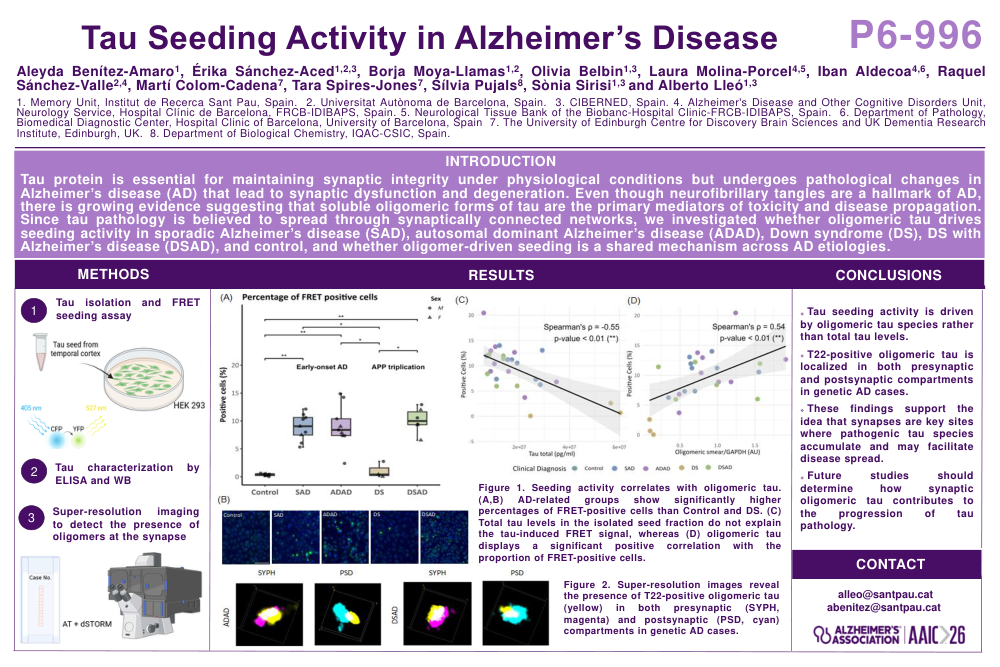
Introduction: Tau protein is essential for maintaining synaptic integrity under physiological conditions but undergoes pathological changes in Alzheimer’s disease (AD) that lead to synaptic dysfunction and degeneration. Even though neurofibrillary tangles are a hallmark of AD, there is growing evidence that soluble oligomeric forms of tau are the primary mediators of toxicity and disease propagation. Since tau pathology is believed to spread through synaptically connected networks, we investigated whether oligomeric tau drives seeding activity in sporadic Alzheimer’s disease (SAD), autosomal dominant Alzheimer’s disease (ADAD), Down syndrome (DS), DS with Alzheimer’s disease (DSAD), and control, and whether oligomer-driven seeding is a shared mechanism across AD etiologies.
Methods: Tau-enriched fractions (tau seeds) were isolated from temporal cortex homogenates of post-mortem brains from individuals with different forms of AD and age-matched controls. CRL-3275™ tauRD-P301S FRET biosensor cells were transfected with 16 ng of tau. Seventy-two hours after transfection, cells were fixed, and the percentage of FRET-positive cells was quantified using a 3DHISTECH digital slide scanner, followed by ImageJ and MATLAB-based image analysis. Tau seeding activity was compared across groups and correlated with the levels of total tau and oligomeric tau species. In addition, super-resolution microscopy was used to assess the synaptic localization of T22-positive oligomeric tau in genetic AD cases.
Results: Seeding activity correlated with oligomeric tau. AD-related groups show significantly higher percentages of FRET-positive cells than Control and DS. Total tau levels in the isolated seed fraction do not explain the tau-induced FRET signal, whereas oligomeric tau displays a significant positive correlation with the proportion of FRET-positive cells. Super-resolution images reveal the presence of T22-positive oligomeric tau in both presynaptic and postsynaptic compartments in genetic AD cases.
Conclusions: Our data suggest that seeding capacity is driven by oligomeric tau species rather than total tau, and that these oligomers (T22) are present at synapses in genetic AD cases, within both pre- and postsynaptic compartments. Taken together, this supports the idea that the synapse may represent a key site for pathogenic tau species, pending validation in a larger cohort and direct testing of its relationship to tau progression.
Comments
Email is required but is not shown publicly.
Loading comments...