4,068 posters, 219 videos, 101 topics, 69 sessions, 14,365 authors, 6,128 institutions
ePostersLive by SciGen Technologies S.A. All rights reserved.
Alzheimer's Association International Conference 2026
July 12-15, 2026 | London, United Kingdom, and Online

2212
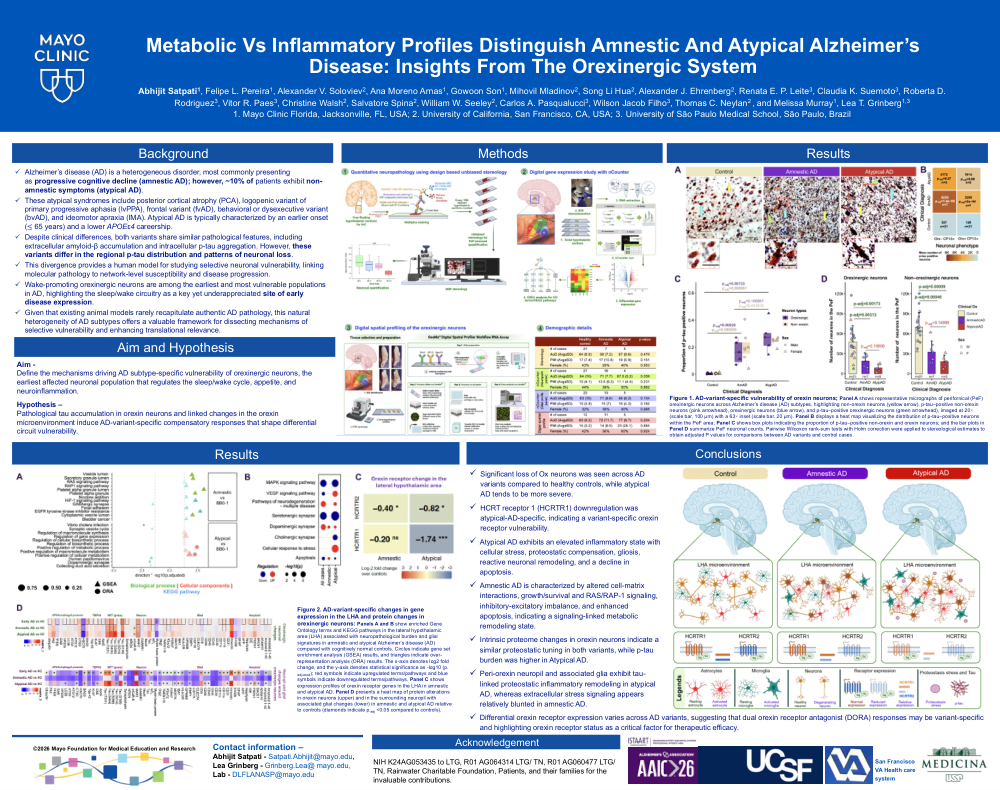
Metabolic Vs Inflammatory Profiles Distinguish Amnestic And Atypical Alzheimer’s Disease: Insights From The Orexinergic System
Poster Presenter
Authors
Part of Topic
Background:
Clinical variants of Alzheimer’s disease (AD), includes amnestic (amAD) and atypical (atypAD) forms, show distinct regional vulnerability and AD-tau deposition, providing a human model of selective network degeneration. Wake-promoting orexinergic (Ox) neurons, are among the earliest and most p‑tau–vulnerable populations in AD, highlighting sleep/wake circuitry as a key but underappreciated site of early disease expression. Existing animal models rarely recapitulate authentic AD-tau pathology, limiting translational insight. By contrasting AD-variants in humans, we aim to define the mechanisms driving AD subtype–specific vulnerability of Ox neurons, the earliest-affected regulators of the sleep/wake cycle, with direct implications for detecting prodromal disease and designing targeted, circuit-level interventions in the clinic.
Methods:
Postmortem human hypothalamus from healthy control (n=7), amAD (n=5), and atypAD (n=6) subjects was immunostained for orexin-A and p-tau (CP13) with Nissl counterstaining. Neuronal numbers were quantified using unbiased stereology. We also performed RNA sequencing (n=38) in the lateral hypothalamic area (LHA) using the NanoString nCounter® platform with panels for neurotransmitter-related genes, glial profiling, and neuropathology. Genes with p-adj<0.05 were deemed differentially expressed.
Results:
Significant Ox neuronal loss was observed across AD-variants. AtypAD cases demonstrated a greater loss (82%; p=0.0035) than amAD (71%; p=0.0051) compared to controls. We identified subtype-specific changes in the LHA, including patterns of Ox receptor expression. HCRTR1 downregulation was exclusive to atypAD, whereas HCRTR2 loss was observed in both subtypes. Pathway enrichment analysis revealed a distinct subtype-specific mechanism. In amAD, enriched pathways were linked to metabolic stress, insulin resistance, excitatory/inhibitory imbalance, loss of arousal regulation, and excitotoxicity. In contrast, synaptic dysfunction, heightened oxidative stress, mitochondrial dysfunction, Th17-mediated inflammation, and loss of survival signals were observed in atypAD.
Conclusion:
We demonstrate AD subtype-specific differences in the LHA, with distinct patterns of Ox neuronal loss and receptor expression patterns. Furthermore, amAD is associated with metabolic stress and excitotoxicity, whereas atypAD with enhanced neuroinflammation and mitochondrial dysfunction. Understanding the mechanisms underlying subtype-specific alterations in AD may provide insights into the commonly observed wake-maintenance issues in AD and will be instrumental in the development of AD-variant-specific targeted therapeutics aimed at preventing Ox neuronal loss, slowing AD progression, and restoring sleep/wake circuits.
Comments
Email is required but is not shown publicly.
Loading comments...