4,068 posters, 219 videos, 101 topics, 69 sessions, 14,365 authors, 6,128 institutions
ePostersLive by SciGen Technologies S.A. All rights reserved.
Alzheimer's Association International Conference 2026
July 12-15, 2026 | London, United Kingdom, and Online

6205
APOE ε2 And PET-derived Measures Of Tau And Amyloid Deposition
Poster Presenter
Authors
Sokratis Charisis, Matthew R. Scott, Jeremy Tanner, Jesus D. Melgarejo, Jose E. Cavazos, Claudia L. Satizabal, Teresa Gomez-Isla, Agustin Ruiz, Nikolaos Scarmeas, Keith A. Johnson, Reisa A. Sperling, Mohamad Habes, Alexa Beiser, Sudha Seshadri
Affiliations
University of Texas Health Science Center San Antonio, San Antonio, Texas, Boston University School of Public Health, Boston, Massachusetts, University of Texas Rio Grande Valley, Harlingen, Texas, Harvard Medical School, Boston, Massachusetts, Columbia University, New York, New York
Part of Topic
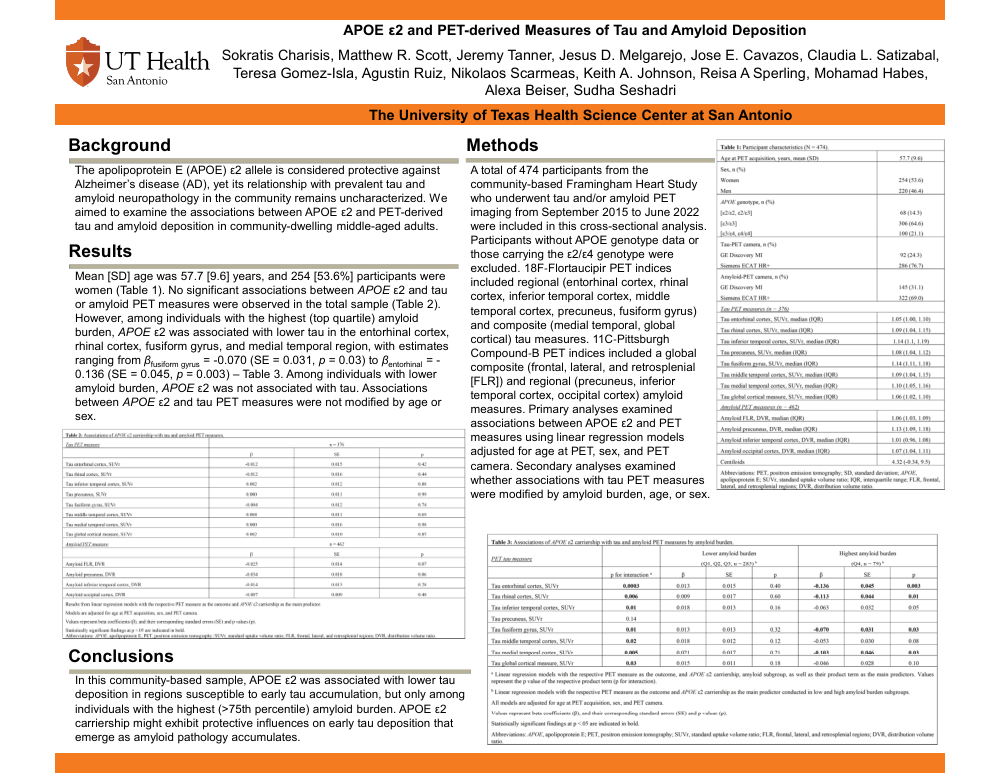
Background: The apolipoprotein E (APOE) ε2 allele is considered protective against Alzheimer’s disease (AD), yet its relationship with prevalent tau and amyloid neuropathology in the community remains uncharacterized. We aimed to examine the associations between APOE ε2 and PET-derived tau and amyloid deposition in community-dwelling middle-aged adults.
Methods: A total of 474 participants from the community-based Framingham Heart Study who underwent tau and/or amyloid PET imaging from September 2015 to June 2022 were included in this cross-sectional analysis. Participants without APOE genotype data or those carrying the ε2/ε4 genotype were excluded. 18F‐Flortaucipir PET indices included regional (entorhinal cortex, rhinal cortex, inferior temporal cortex, middle temporal cortex, precuneus, fusiform gyrus) and composite (medial temporal, global cortical) tau measures. 11C‐Pittsburgh Compound‐B PET indices included a global composite (frontal, lateral, and retrosplenial [FLR]) and regional (precuneus, inferior temporal cortex, occipital cortex) amyloid measures. Primary analyses examined associations between APOE ε2 and PET measures using linear regression models adjusted for age at PET, sex, and PET camera. Secondary analyses examined whether associations with tau PET measures were modified by amyloid burden, age, or sex.
Results: Mean [SD] age was 57.7 [9.6] years, and 254 [53.6%] participants were women (Table 1). No significant associations between APOE ε2 and tau or amyloid PET measures were observed in the total sample (Table 2). However, among individuals with the highest (top quartile) amyloid burden, APOE ε2 was associated with lower tau in the entorhinal cortex, rhinal cortex, fusiform gyrus, and medial temporal region, with estimates ranging from βfusiform gyrus = -0.070 (SE = 0.031, p = 0.03) to βentorhinal = -0.136 (SE = 0.045, p = 0.003) – Table 3. Among individuals with lower amyloid burden, APOE ε2 was not associated with tau. Associations between APOE ε2 and tau PET measures were not modified by age or sex.
Conclusions: In this community-based sample, APOE ε2 was associated with lower tau deposition in regions susceptible to early tau accumulation, but only among individuals with the highest (>75th percentile) amyloid burden. APOE ε2 carriership might exhibit protective influences on early tau deposition that emerge as amyloid pathology accumulates.
Comments
Email is required but is not shown publicly.
Loading comments...