4,068 posters, 219 videos, 101 topics, 69 sessions, 14,365 authors, 6,128 institutions
ePostersLive by SciGen Technologies S.A. All rights reserved.
Alzheimer's Association International Conference 2026
July 12-15, 2026 | London, United Kingdom, and Online

5969
Integrating Multivariate Biomarkers And High-dimensional Multi-omics Data To Identify Integrative Aging Subtypes
Poster Presenter
Part of Topic
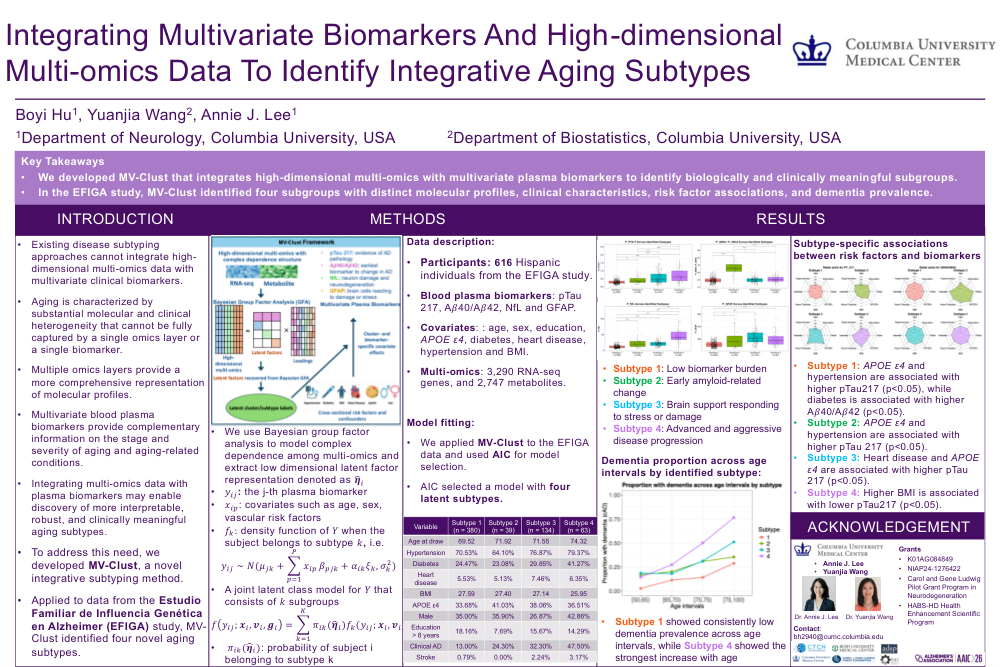
Aging is characterized by substantial molecular and clinical heterogeneity that cannot be fully captured by a single omics layer or a single biomarker. Existing disease subtyping approaches have limited ability to integrate high-dimensional multi-omics data with multivariate clinical biomarkers. To address this limitation, we developed MV-Clust, a novel integrative subtyping method that combines high-dimensional multi-omics data with multivariate plasma biomarker profiles to identify biologically and clinically meaningful aging subtypes.
We applied MV-Clust to data from 616 Hispanic individuals in the Estudio Familiar de Influencia Genética en Alzheimer (EFIGA) study. The analysis included four plasma biomarkers, pTau217, Aβ40/Aβ42, NfL, and GFAP, along with clinical covariates including age, sex, education, APOE ε4, diabetes, heart disease, hypertension, and BMI. Multi-omics data included 3,290 RNA-seq genes and 2,747 metabolites. MV-Clust first used Bayesian group factor analysis to extract low-dimensional latent representations from the multi-omics data, and then incorporated these latent factors into a joint latent class model for multivariate plasma biomarkers.
Using AIC for model selection, MV-Clust identified four aging subtypes with distinct molecular profiles, clinical characteristics, risk factor associations, and dementia prevalence. Subtype 1 showed low biomarker burden and consistently low dementia prevalence across age groups. Subtype 2 showed early amyloid-related changes. Subtype 3 showed biomarker patterns consistent with brain support responding to stress or damage. Subtype 4 showed features consistent with advanced and aggressive disease progression and had the highest dementia prevalence, particularly in older age groups. Subtype-specific analyses further showed that clinical risk factors had different associations with plasma biomarkers across subtypes. For example, APOE ε4 and hypertension were associated with higher pTau217 levels in selected subtypes, while higher BMI was associated with lower pTau217 in Subtype 4.
These findings suggest that MV-Clust can identify interpretable and clinically meaningful aging subtypes by integrating multivariate plasma biomarkers with high-dimensional multi-omics data.
Comments
Email is required but is not shown publicly.
Loading comments...