4,068 posters, 219 videos, 101 topics, 69 sessions, 14,365 authors, 6,128 institutions
ePostersLive by SciGen Technologies S.A. All rights reserved.
Alzheimer's Association International Conference 2026
July 12-15, 2026 | London, United Kingdom, and Online

3537
An Examination Of The Lancet Commission's Modifiable Dementia Risk Factors In A Los Angeles-based Cohort
Poster Presenter
Authors
Part of Topic
Introduction:
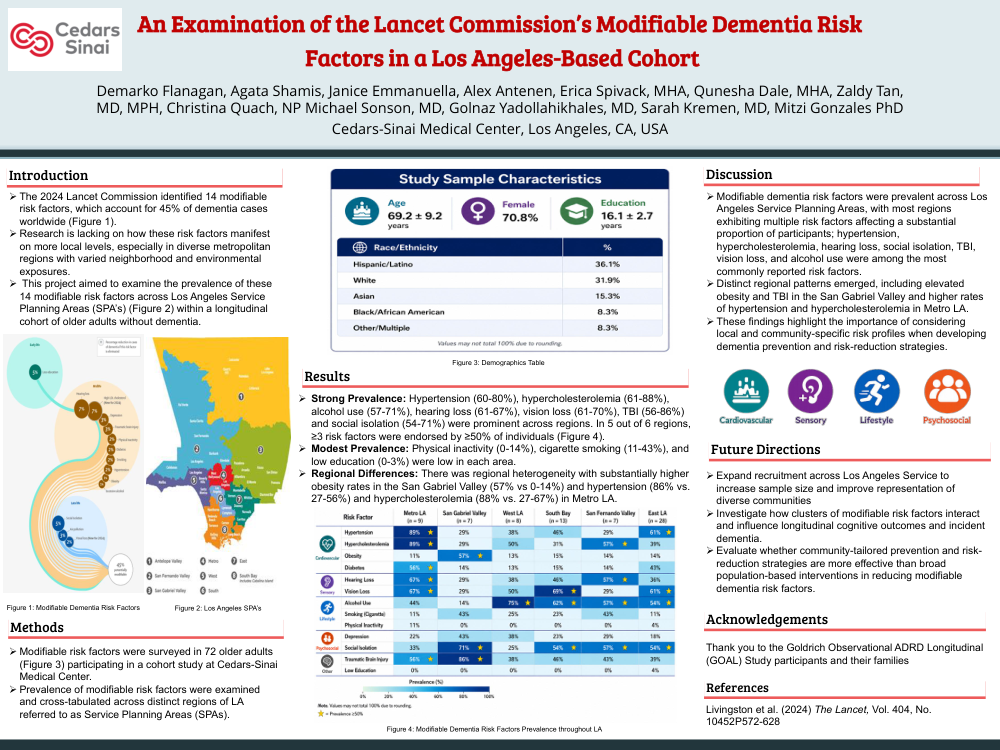
ØThe 2024 Lancet Commission identified 14 modifiable risk factors, which account for 45% of dementia cases worldwide (Figure 1).
ØResearch is lacking on how these risk factors manifest on more local levels, especially in diverse metropolitan regions with varied neighborhood and environmental exposures.
Ø This project aimed to examine the prevalence of these 14 modifiable risk factors across Los Angeles Service Planning Areas (SPA’s) (Figure 2) within a longitudinal cohort of older adults without dementia.
Methods:
ØModifiable risk factors were surveyed in 72 older adults (Figure 3) participating in a cohort study at Cedars-Sinai Medical Center.
ØPrevalence of modifiable risk factors were examined and cross-tabulated across distinct regions of LA referred to as Service Planning Areas (SPAs).
Results:
ØStrong Prevalence: Hypertension (60-80%), hypercholesterolemia (61-88%), alcohol use (57-71%), hearing loss (61-67%), vision loss (61-70%), and social isolation (54-71%) were prominent across regions. In 5 out of 6 regions, ≥3 risk factors were endorsed by ≥50% of individuals (Figure 4).
ØModest Prevalence: Physical inactivity (0-14%), cigarette smoking (11-43%), and low education (0-3%) were low in each area.
ØRegional Differences: There was regional heterogeneity with substantially higher obesity rates in the San Gabriel Valley (57% vs 0-14%) and hypertension (86% vs. 27-56%) and hypercholesterolemia (88% vs. 27-67%) in Metro LA.
Discussion:
ØModifiable dementia risk factors were prevalent across Los Angeles Service Planning Areas, with most regions exhibiting multiple risk factors affecting a substantial proportion of participants; hypertension, hypercholesterolemia, hearing loss, social isolation, vision loss, and alcohol use were among the most commonly reported risk factors.
ØDistinct regional patterns emerged, including elevated obesity and TBI in the San Gabriel Valley and higher rates of hypertension and hypercholesterolemia in Metro LA.
ØThese findings highlight the importance of considering local and community-specific risk profiles when developing dementia prevention and risk-reduction strategies.
Future Directions:
ØExpand recruitment across Los Angeles Service to increase sample size and improve representation of diverse communities
ØInvestigate how clusters of modifiable risk factors interact and influence longitudinal cognitive outcomes and incident dementia.
Evaluate whether community-tailored prevention and risk-reduction strategies are more effective than broad population-based interventions in reducing modifiable dementia risk factors
Acknowledgements:
Thank you to the Goldrich Observational ADRD Longitudinal (GOAL) Study participants and their families
References:
Livingston et al. (2024) The Lancet, Vol. 404, No. 10452P572-628
Comments
Email is required but is not shown publicly.
Loading comments...