4,068 posters, 219 videos, 101 topics, 69 sessions, 14,365 authors, 6,128 institutions
ePostersLive by SciGen Technologies S.A. All rights reserved.
Alzheimer's Association International Conference 2026
July 12-15, 2026 | London, United Kingdom, and Online

9405
Impact Of Social Determinants Of Health On Home Transitions For Individuals With Neurocognitive Disorders
Poster Presenter
Authors
Part of Topic
Impact of Social Determinants of Health on Home Transitions for Individuals with Neurocognitive Disorders
Background:
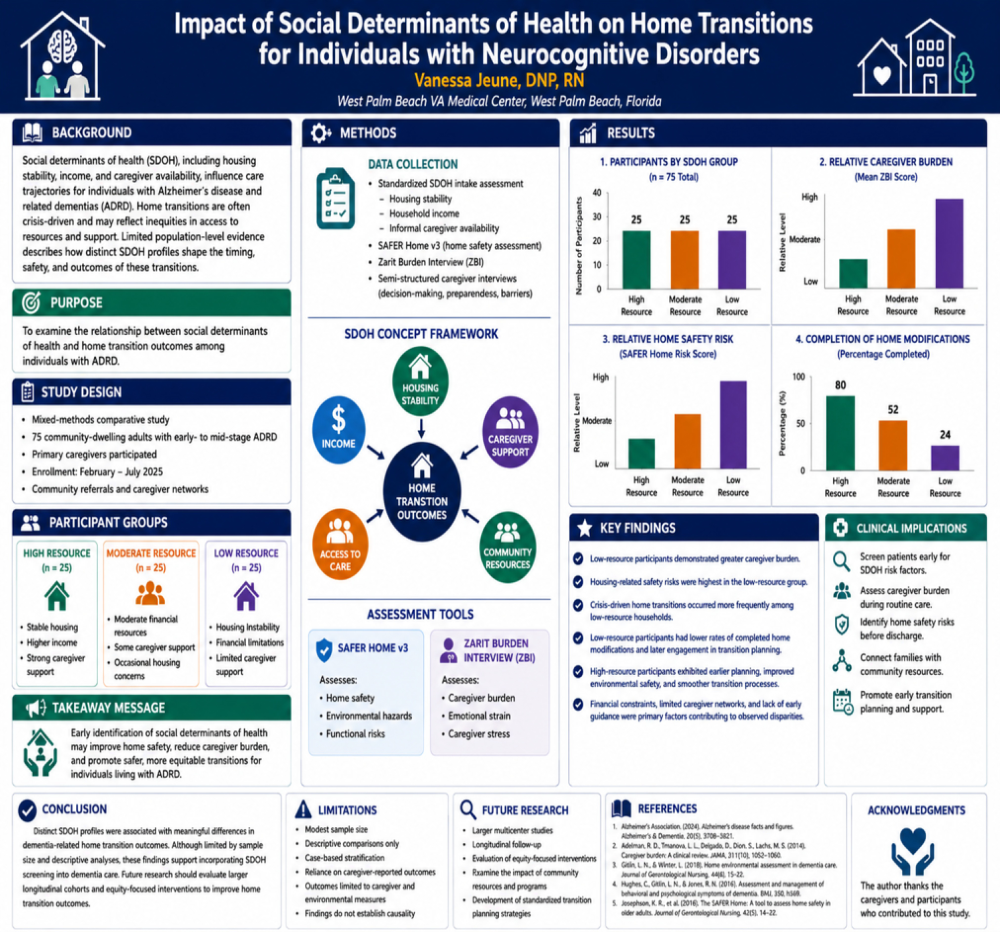
Social determinants of health (SDOH), such as housing stability, income, and caregiver availability, can substantially impact care trajectories for individuals with Alzheimer’s disease and related dementias (ADRD). Home transitions for individuals with ADRD are frequently crisis-driven and may display inequities in access to resources and support. Limited population-level evidence describes how distinct SDOH profiles shape the timing, safety, and outcomes of these transitions.
Methods:
A total of 75 individuals with early to mid-stage ADRD and their primary caregivers participated in the mixed-methods study. Caregiving networks and community referrals generated the participants who enrolled between February and July 2025. A total of 25 participants were assigned to the high-resource group, followed by 25 to the moderate-resource group, and 25 to the low-resource group. Caregivers completed a standardized intake assessment that analyzed SDOH elements encompassing housing stability, household income, and availability of informal caregiver support.
The SAFER Home tool assessed home safety and environmental risks under the clinical oversight of nurses, while the Zarit Burden Interview measured caregiver burden. Transition-related outcomes included timing and type of housing transitions, access to and completion of home modifications, and occurrence of crisis-driven moves. Semi-structured caregiver interviews explored decision-making processes, preparedness, and perceived barriers.
Results:
Participants in the low-resource SDOH profile demonstrated higher caregiver burden, greater housing-related safety risks, and a greater likelihood of crisis-driven home transitions compared with moderate- and high-resource groups. They also showed lower rates of completed home modifications and later engagement in transition planning. In contrast, high-resource participants exhibited earlier planning, improved environmental safety, and smoother transition processes. Qualitative findings highlighted financial constraints, limited caregiver networks, and a lack of early guidance as primary factors contributing to the observed disparities.
Conclusion:
Distinct SDOH profiles were associated with meaningful differences in dementia-related home transition trajectories. Findings should be interpreted in light of limitations, including modest sample size, case-based stratification, and reliance on descriptive comparisons that do not establish causality. Outcomes were limited to caregiver-reported and environmental measures. Despite these limitations, this study advances population-health understanding by operationalizing SDOH profiles and linking them to measurable transition outcomes. Future research should include larger, longitudinal cohorts, and equity-focused interventions to reduce disparities and promote safer, more timely home transitions for individuals living with ADRD.
Comments
Email is required but is not shown publicly.
Loading comments...