4,068 posters, 219 videos, 101 topics, 69 sessions, 14,365 authors, 6,128 institutions
ePostersLive by SciGen Technologies S.A. All rights reserved.
Alzheimer's Association International Conference 2026
July 12-15, 2026 | London, United Kingdom, and Online

1771
Evaluating The Impact Of “Snakes And Ladders For A Healthy Brain” Game On Dementia Awareness And Behavioural Intentions
Poster Presenter
Authors
Affiliations
null,
Part of Topic
Title:
Evaluating the Impact of "Snakes and Ladders for a Healthy Brain" Game on Dementia Awareness and Behavioural Intentions in Public Engagement Activities
Aim:
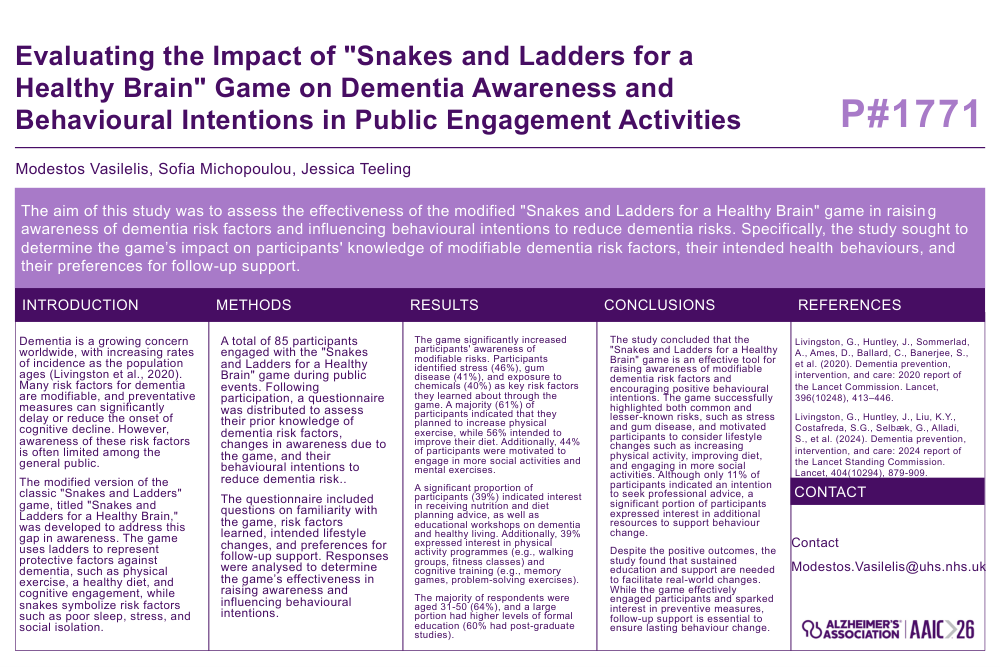
The aim of this study was to assess the effectiveness of the modified "Snakes and Ladders for a Healthy Brain" game in raising awareness of dementia risk factors and influencing behavioural intentions to reduce dementia risks. Specifically, the study sought to determine the game’s impact on participants' knowledge of modifiable dementia risk factors, their intended health behaviours, and their preferences for follow-up support.
Research Questions:
1)How effective is the "Snakes and Ladders for a Healthy Brain" game in increasing participants' awareness of modifiable dementia risk factors?
2) What behavioural changes do participants intend to make after engaging with the game?
3) What follow-up support do participants find most useful in reinforcing the lessons learned from the game?
4) What demographic factors (e.g., age, education level) influence participants’ awareness and behavioural intentions?
Introduction:
Dementia is a growing concern worldwide, with increasing rates of incidence as the population ages (Livingston et al., 2020). Many risk factors for dementia are modifiable, and preventative measures can significantly delay or reduce the onset of cognitive decline. However, awareness of these risk factors is often limited among the general public. The Lancet Commission reports that factors such as stress, sleep, diet, physical inactivity, and social isolation are significant contributors to dementia risk (Livingston et al., 2020; Livingston et al., 2024).
The modified version of the classic "Snakes and Ladders" game, titled "Snakes and Ladders for a Healthy Brain," was developed to address this gap in awareness. The game uses ladders to represent protective factors against dementia, such as physical exercise, a healthy diet, and cognitive engagement, while snakes symbolize risk factors such as poor sleep, stress, and social isolation. By engaging participants in an interactive learning experience, the game aims to highlight modifiable dementia risk factors and encourage lifestyle changes that can reduce the risk of dementia.
Methods:
A total of 85 participants engaged with the "Snakes and Ladders for a Healthy Brain" game during public events. Following participation, a questionnaire was distributed to assess their prior knowledge of dementia risk factors, changes in awareness due to the game, and their behavioural intentions to reduce dementia risk. Demographic data including age and education level were also collected.
The questionnaire included questions on familiarity with the game, risk factors learned, intended lifestyle changes, and preferences for follow-up support. Responses were analysed to determine the game’s effectiveness in raising awareness and influencing behavioural intentions.
Results:
1. Awareness of Modifiable Dementia Risk Factors:
The first research question addressed the effectiveness of the game in raising awareness of dementia risk factors. The results revealed that the game significantly increased participants' awareness of modifiable risks. Participants identified stress (46%), gum disease (41%), and exposure to chemicals (40%) as key risk factors they learned about through the game. Additionally, 34% of participants were made aware of the importance of sleep, while 33% learned about the impact of communication and social networks on dementia risk. These findings suggest that the game was successful in highlighting both common and lesser-known dementia risks, in line with the findings of Livingston et al. (2020), which emphasize factors such as stress and gum disease as modifiable risks.
2. Behavioural Intentions:
Regarding the second research question, which examined participants' intended behavioural changes, the results showed that the game prompted a high level of behavioural intention. A majority (61%) of participants indicated that they planned to increase physical exercise, while 56% intended to improve their diet, such as by eating more fruits and vegetables and reducing sugar intake. Additionally, 44% of participants were motivated to engage in more social activities and mental exercises, such as joining clubs or learning new skills. These behavioural intentions are consistent with the Lancet Commission’s recommendations for increased physical activity and social engagement as key prevention strategies (Livingston et al., 2024).
3. Follow-up Support Preferences:
The third research question focused on the type of follow-up support participants would find useful. The results revealed a clear preference for practical, action-oriented resources. A significant proportion of participants (39%) indicated interest in receiving nutrition and diet planning advice, as well as educational workshops on dementia and healthy living. Additionally, 39% expressed interest in physical activity programmes (e.g., walking groups, fitness classes) and cognitive training (e.g., memory games, problem-solving exercises). These findings suggest that participants are keen to continue their learning and adopt healthier lifestyles, reinforcing the idea that sustained engagement is necessary for lasting behaviour change (Livingston et al., 2020).
4. Demographic Factors:
Demographic factors also played a role in participants’ awareness and intentions. The majority of respondents were aged 31-50 (64%), and a large portion had higher levels of formal education (60% had post-graduate studies). The game’s effectiveness may therefore be influenced by educational background, as those with higher levels of education might be more receptive to health-related messages. However, the game appeared to engage participants across different age groups, suggesting that the game’s format has broad appeal.
Conclusion:
The study concluded that the "Snakes and Ladders for a Healthy Brain" game is an effective tool for raising awareness of modifiable dementia risk factors and encouraging positive behavioural intentions. The game successfully highlighted both common and lesser-known risks, such as stress and gum disease, and motivated participants to consider lifestyle changes such as increasing physical activity, improving diet, and engaging in more social activities. Although only 11% of participants indicated an intention to seek professional advice, a significant portion of participants expressed interest in additional resources to support behaviour change.
Despite the positive outcomes, the study found that sustained education and support are needed to facilitate real-world changes. While the game effectively engaged participants and sparked interest in preventive measures, follow-up support is essential to ensure lasting behaviour change.
Recommendations:
Based on the findings, the following recommendations are made:
Integrate with Healthcare Services: To improve the game’s long-term impact, further integration with healthcare services is needed. Healthcare professionals could reinforce the game’s messages during consultations and provide tailored advice based on individual risk profiles.
Offer Targeted Follow-up Resources: The game developers should consider offering resources such as nutrition planning, fitness classes, and cognitive training workshops, which were identified as the most preferred follow-up activities.
Expand Educational Outreach: Given the broad appeal of the game across various age groups and educational backgrounds, there should be efforts to expand the reach of the game, especially in public health campaigns targeting younger populations.
Monitor Long-term Behavioural Changes: Future studies should include longitudinal follow-up to assess whether the behavioural changes identified in this study are sustained over time and to determine whether the game has a lasting impact on dementia prevention.
References:
Livingston, G., Huntley, J., Sommerlad, A., Ames, D., Ballard, C., Banerjee, S., et al. (2020). Dementia prevention, intervention, and care: 2020 report of the Lancet Commission. Lancet, 396(10248), 413–446. Available from: https://pubmed.ncbi.nlm.nih.gov/32738937/ (Accessed: 22 June 2026).
Livingston, G., Huntley, J., Liu, K.Y., Costafreda, S.G., Selbæk, G., Alladi, S., et al. (2024). Dementia prevention, intervention, and care: 2024 report of the Lancet Standing Commission. Lancet, 404(10294), 879-909. Available from: https://pubmed.ncbi.nlm.nih.gov/39096926/ (Accessed: 22 June 2026).
Comments
Email is required but is not shown publicly.
Loading comments...