4,068 posters, 219 videos, 101 topics, 69 sessions, 14,365 authors, 6,128 institutions
ePostersLive by SciGen Technologies S.A. All rights reserved.
Alzheimer's Association International Conference 2026
July 12-15, 2026 | London, United Kingdom, and Online

2321
Commonly Used Medications And Risk Of MCI And Dementia In A Large Cohort Of Older Adults
Poster Presenter
Authors
Part of Topic
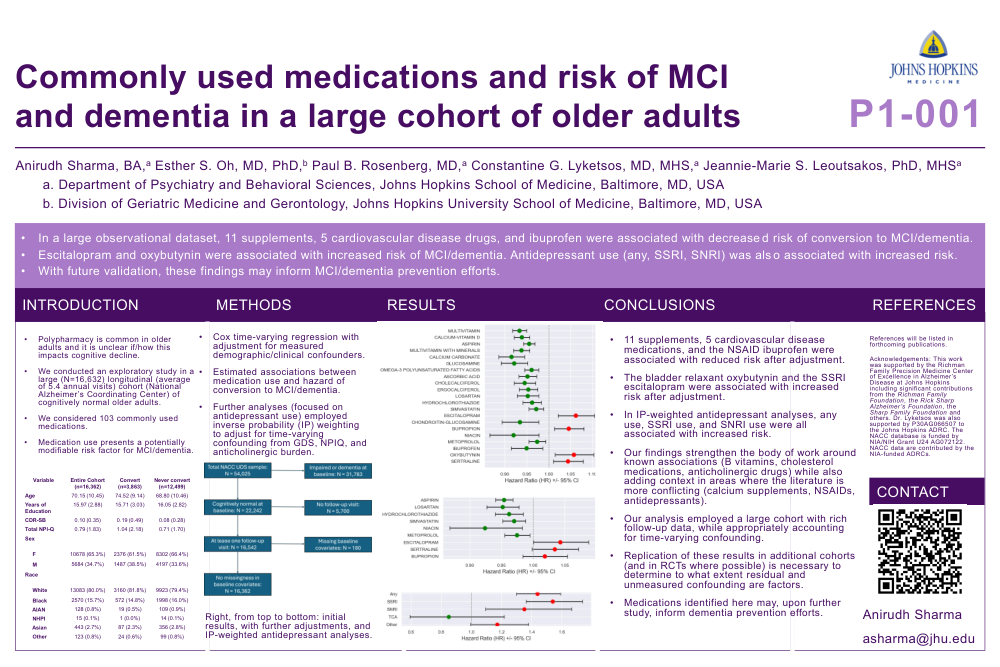
Background: Most older adults take several medications, but it is unclear what role these drugs may play in cognitive decline. We conducted an exploratory study to identify what commonly used medications in cognitively normal older adults are associated with increased or decreased risk of conversion to mild cognitive impairment (MCI) or dementia.
Methods: We examined risk of conversion to MCI or dementia among 16,362 cognitively normal older adults (mean age = 70.2 years) followed longitudinally (mean # visits = 5.4) in the National Alzheimer’s Coordinating Center Uniform Data Set from 2005 to June 1, 2025 as a function of exposure to 103 commonly-used medications. We used adjusted Cox time-varying models to quantify the degree to which a subject’s cumulative use of a drug contributed to conversion risk. Ongoing analyses using inverse probability of treatment weighting (IPTW) are now being run to ensure that novel findings are unbiased with respect to measured confounders, and not a product treatment-confounder feedback.
Results: In our initial analyses, eleven supplements, five cardiovascular disease medications, and the nonsteroidal anti-inflammatory drug (NSAID) ibuprofen were associated with decreased conversion risk. The bladder relaxant oxybutynin and the selective serotonin reuptake inhibitor (SSRI) escitalopram were associated with increased conversion risk. Our current analyses using IPTW will provide additional context for these results, particularly for clarifying whether our SSRI finding is robust (e.g., not confounded by depression severity).
Conclusions: Our work strengthens the body of evidence around several previously documented associations (e.g., B vitamins, cholesterol medications, anticholinergic drugs), while also providing insight into several medications for which the prior literature is more conflicting (e.g., calcium supplements, NSAIDs, antidepressants). The drugs identified here may prove to be candidates for further study as potential modifiable risk factors for MCI and dementia. Our ongoing IPTW analyses, in addition to further clinical studies, will be critical to establishing how each of these medications may contribute causally to cognitive decline.
Comments
Email is required but is not shown publicly.
Loading comments...