4,068 posters, 219 videos, 101 topics, 69 sessions, 14,365 authors, 6,128 institutions
ePostersLive by SciGen Technologies S.A. All rights reserved.
Alzheimer's Association International Conference 2026
July 12-15, 2026 | London, United Kingdom, and Online

5679
Bridging Awareness To Enrollment: Operational Lessons From A Brain Health Education-driven Recruitment Pipeline For Older Adults
Part of Topic
Bridging Awareness to Enrollment: Operational Lessons From a Brain Health Education-Driven Recruitment Pipeline for Older Adults
Abstract Number: 2026-A-5679-AAIC
Triana Abel Encarnacion, Alexandra Ortega, Kirsten Crenshaw, Sofia Ramirez, Elizabeth Crocco, David Loewenstein, Rosie Curiel
Department of Psychiatry, University of Miami Center for Cognitive Neuroscience and Aging, Miami, FL, USA
Key Takeaways:
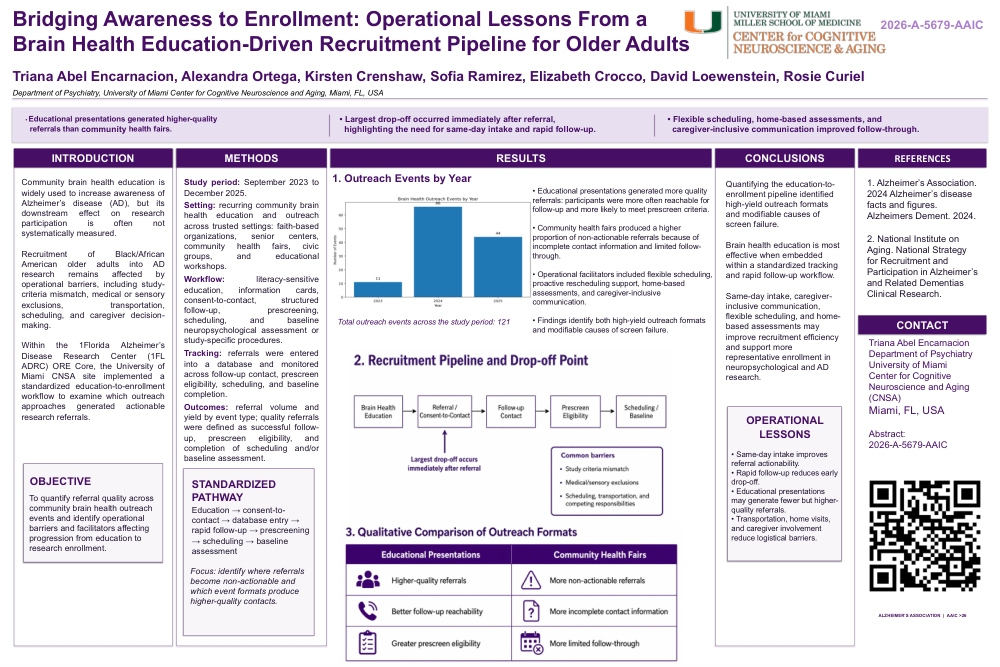
Educational presentations generated higher-quality referrals than community health fairs. The largest drop-off occurred immediately after referral, highlighting the need for same-day intake and rapid follow-up. Flexible scheduling, home-based assessments, and caregiver-inclusive communication improved follow-through.
Introduction:
Community brain health education is widely used to increase awareness of Alzheimer’s disease (AD), but its downstream effect on research participation is often not systematically measured. Recruitment of Black/African American older adults into AD research remains affected by operational barriers, including study-criteria mismatch, medical or sensory exclusions, transportation, scheduling, and caregiver decision-making. Within the 1Florida Alzheimer’s Disease Research Center (1FL ADRC) Outreach, Recruitment, and Engagement (ORE) Core, the University of Miami CNSA site implemented a standardized education-to-enrollment workflow to examine which outreach approaches generated actionable research referrals.
Objective:
To quantify referral quality across community brain health outreach events and identify operational barriers and facilitators affecting progression from education to research enrollment.
Methods:
The study period was September 2023 to December 2025. The University of Miami CNSA site conducted recurring community brain health education and outreach across trusted settings, including faith-based organizations, senior centers, community health fairs, civic groups, and educational workshops. The workflow included literacy-sensitive education, information cards, consent-to-contact, structured follow-up, prescreening, scheduling, and baseline neuropsychological assessment or study-specific procedures. Referrals were entered into a tracking database and monitored across follow-up contact, prescreen eligibility, scheduling, and baseline completion. Outcomes included referral volume and yield by event type. Quality referrals were defined as successful follow-up, prescreen eligibility, and completion of scheduling and/or baseline assessment.
Standardized Pathway:
Education -> consent-to-contact -> database entry -> rapid follow-up -> prescreening -> scheduling -> baseline assessment.
Results:
From September 2023 to December 2025, the CNSA site completed 121 outreach events. Outreach volume included 11 events in 2023, 66 events in 2024, and 44 events in 2025.
Educational presentations generated more quality referrals. Participants from educational presentations were more often reachable for follow-up and more likely to meet prescreen criteria. Community health fairs produced a higher proportion of non-actionable referrals because of incomplete contact information and limited follow-through. The largest drop-off occurred immediately after referral, underscoring the importance of same-day intake and rapid follow-up.
Common barriers included study criteria mismatch, medical or sensory exclusions, scheduling barriers, transportation limitations, and competing responsibilities. Operational facilitators included flexible scheduling, proactive rescheduling support, home-based assessments, and caregiver-inclusive communication.
Qualitative comparison of outreach formats:
Educational presentations were associated with higher-quality referrals, better follow-up reachability, and greater prescreen eligibility. Community health fairs were associated with more non-actionable referrals, more incomplete contact information, and more limited follow-through.
Conclusions:
Quantifying the education-to-enrollment pipeline identified high-yield outreach formats and modifiable causes of screen failure. Brain health education is most effective when embedded within a standardized tracking and rapid follow-up workflow. Same-day intake, caregiver-inclusive communication, flexible scheduling, and home-based assessments may improve recruitment efficiency and support more representative enrollment in neuropsychological and Alzheimer’s disease research.
Operational Lessons:
Same-day intake improves referral actionability. Rapid follow-up reduces early drop-off. Educational presentations may generate fewer but higher-quality referrals. Transportation support, home visits, and caregiver involvement reduce logistical barriers.
References:
1. Alzheimer’s Association. 2024 Alzheimer’s disease facts and figures. Alzheimers Dement. 2024.
2. National Institute on Aging. National Strategy for Recruitment and Participation in Alzheimer’s and Related Dementias Clinical Research.
Contact:
Triana Abel Encarnacion
Department of Psychiatry
University of Miami Center for Cognitive Neuroscience and Aging
Miami, FL, USA
Abstract: 2026-A-5679-AAIC
Comments
Email is required but is not shown publicly.
Loading comments...