4,068 posters, 219 videos, 101 topics, 69 sessions, 14,365 authors, 6,128 institutions
ePostersLive by SciGen Technologies S.A. All rights reserved.
Alzheimer's Association International Conference 2026
July 12-15, 2026 | London, United Kingdom, and Online

1283
Differentially Expressed Proteins In Blood Plasma Of Individuals With Alzheimer's Disease Through Mass Spectrometry
Poster Presenter
Authors
Franco Andrei da Cunha Junqueira, Maria Luiza Vasconcelos Montenegro, Josivan Barbosa de Farias, Roberto Afonso da Silva, Breno José Alencar Pires Barbosa, Fábio Rocha Formiga
Affiliations
University of Pernambuco, Garanhuns, Brazil, Faculty of Medical Sciences, University of Pernambuco, Recife, Brazil, Keizo Asami Institute, Federal University of Pernambuco, Recife, Brazil, Federal University of Pernambuco, Recife, Brazil, University of Pernambuco, Recife, Brazil
Part of Topic
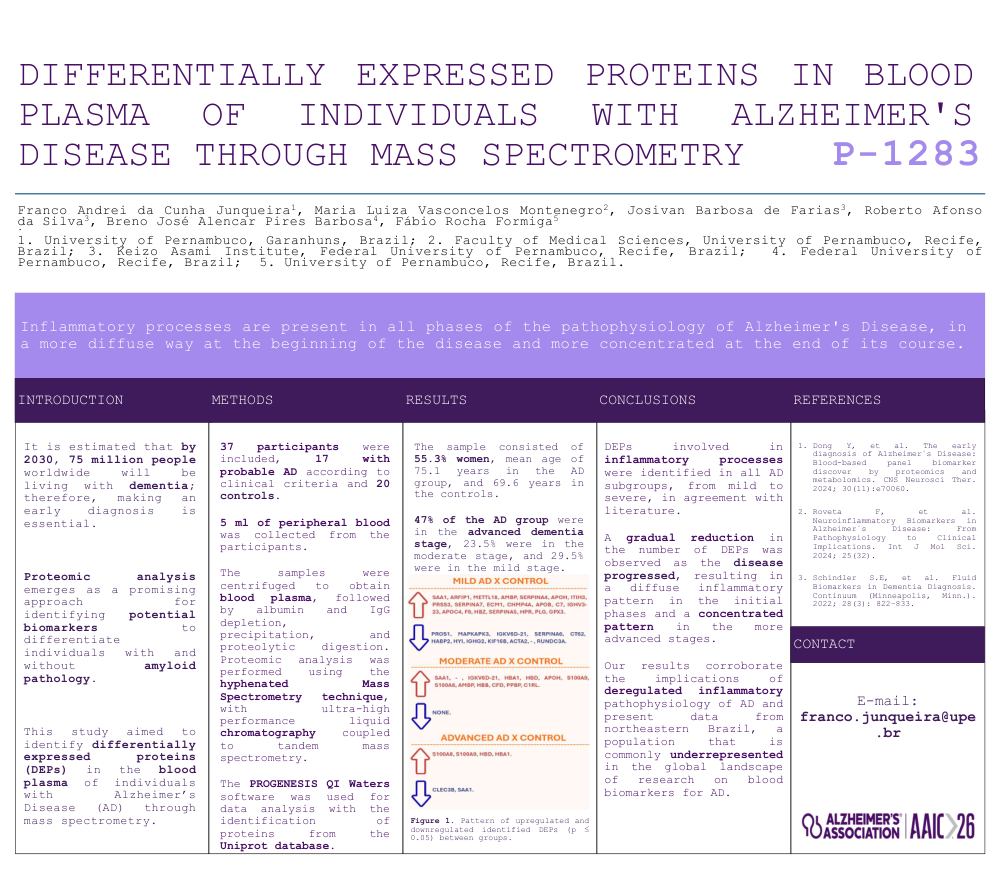
Introduction: It is estimated that by 2030, 75 million people worldwide will be living with dementia; therefore, making an early diagnosis is essential. Proteomic analysis emerges as a promising approachfor identifying potential biomarkers to differentiate individuals with and without amyloid pathology.This study aimed to identify differentially expressed proteins (DEPs) in the blood plasma of individualswith Alzheimer’s Disease (AD) through mass spectrometry. Methods: 37 participants were included, 17 with probable AD according to clinical criteria and 20 controls. 5 ml of peripheral blood was collected from the participants. The samples were centrifuged to obtain blood plasma, followed by albumin and IgG depletion, precipitation, and proteolytic digestion.Proteomic analysis was performed using the hyphenated Mass Spectrometry technique, with ultra-highperformance liquid chromatography coupled to tandem mass spectrometry. The PROGENESIS QI Waters software was used for data analysis with the identification of proteins from the Uniprot database. Results: The sample consisted of 55.3% women, mean age of 75.1 years in the AD group, and 69.6 years in the controls. 47% of the AD group were in the advanced dementia stage, 23.5% were in the moderate stage, and 29.5% were in the mild stage. Conclusions: DEPs involved in inflammatory processes were identified in all AD subgroups, from mild to severe, in agreement with literature. A gradual reduction in the number of DEPs was observed as the disease progressed, resulting in a diffuse inflammatory pattern in the initial phases and a concentrated pattern in the more advanced stages. Our results corroborate the implications of deregulated inflammatory pathophysiology of AD and present data from northeastern Brazil, a population that is commonly underrepresented in the global landscape of research on blood biomarkers for AD.
Comments
Email is required but is not shown publicly.
Loading comments...