4,068 posters, 219 videos, 101 topics, 69 sessions, 14,365 authors, 6,128 institutions
ePostersLive by SciGen Technologies S.A. All rights reserved.
Alzheimer's Association International Conference 2026
July 12-15, 2026 | London, United Kingdom, and Online

9544
Hiv-specific Factors Show No Association With Cognitive Decline In Treatment-experienced Hiv+ Adults In Ethiopia
Poster Presenter
Authors
Akom Foba, Rebecca Bernal, Yannick Wadop, Alice B.S Nono Djotsa, Xueqiu Jian, Alfred Fonteh, Sudha Seshadri, Bernard Fongang, Jayandra Jung Himali, Wondwossen Amogne, Kiran T. Thakur, Biniyam Ayele, Crystal Wiedner
Affiliations
Good Faith Clinic, Limbe, Cameroon, Glenn Biggs Institute for Alzheimer’s & Neurodegenerative Diseases, UT Health San Antonio, 7703 Floyd Curl Drive, San Antonio, TX 78299, USA, VA HSR&D Center for Innovations in Quality, Effectiveness and Safety, Michael E. DeBakey VA Medical Center, Houston, TX 77030, USA., Glenn Biggs Institute for Alzheimer’s & Neurodegenerative Diseases, UT Health San Antonio, 7703 Floyd Curl Drive, San Antonio, TX 78299, USA., Neuroscience Department, Huntington Medical Research Institute, Pasadena, USA., Department of Internal Medicine, Division of Infectious Disease, Addis Ababa University, Addis Ababa, Ethiopia, Department of Neurology, Columbia University Irving Medical Center-New York Presbyterian Hospital, John P. Hussman Institute for Human Genomics, University of Miami Miller School of Medicine, 1501 NW 10th Avenue, Miami, FL 33136 USA.
Part of Topic
Introduction
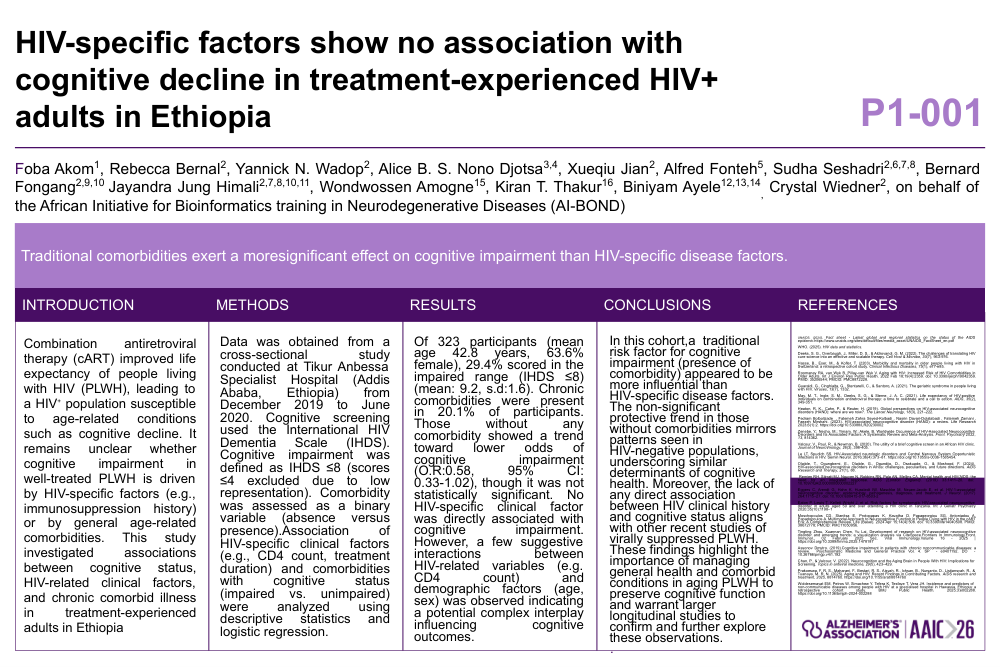
Combination antiretroviral therapy (cART) improved life expectancy of people living with HIV (PLWH), leading to a HIV⁺ population susceptible to age-related conditions such as cognitive decline. It remains unclear whether cognitive impairment in well-treated PLWH is driven by HIV-specific factors (e.g., immunosuppression history) or by general age-related comorbidities. This study investigated associations between cognitive status, HIV-related clinical factors, and chronic comorbid illness in treatment-experienced adults in Ethiopia
Methodology
Data was obtained from a cross-sectional study conducted at Tikur Anbessa Specialist Hospital (Addis Ababa, Ethiopia) from December 2019 to June 2020. Cognitive screening used the International HIV Dementia Scale (IHDS). Cognitive impairment was defined as IHDS ≤8 (scores ≤4 excluded due to low representation). Comorbidity was assessed as a binary variable (absence versus presence).Association of HIV-specific clinical factors (e.g., CD4 count, treatment duration) and comorbidities with cognitive status (impaired vs. unimpaired) were analyzed using descriptive statistics and logistic regression.
Results
Of 323 participants (mean age 42.8 years, 63.6% female), 29.4% scored in the impaired range (IHDS ≤8) (mean: 9.2, s.d:1.6). Chronic comorbidities were present in 20.1% of participants. Those without any comorbidity showed a trend toward lower odds of cognitive impairment (O.R:0.58, 95% CI: 0.33-1.02), though it was not statistically significant. No HIV-specific clinical factor was directly associated with cognitive impairment. However, a few suggestive interactions between HIV-related variables (e.g. CD4 count) and demographic factors (age, sex) was observed indicating a potential complex interplay influencing cognitive outcomes.
Conclusion
In this cohort,a traditional risk factor for cognitive impairment (presence of comorbidity) appeared to be more influential than HIV-specific disease factors. The non-significant protective trend in those without comorbidities mirrors patterns seen in HIV-negative populations, underscoring similar determinants of cognitive health. Moreover, the lack of any direct association between HIV clinical history and cognitive status aligns with other recent studies of virally suppressed PLWH. These findings highlight the importance of managing general health and comorbid conditions in aging PLWH to preserve cognitive function and warrant larger longitudinal studies to confirm and further explore these observations.
Comments
Email is required but is not shown publicly.
Loading comments...