4,068 posters, 219 videos, 101 topics, 69 sessions, 14,365 authors, 6,128 institutions
ePostersLive by SciGen Technologies S.A. All rights reserved.
Alzheimer's Association International Conference 2026
July 12-15, 2026 | London, United Kingdom, and Online

676
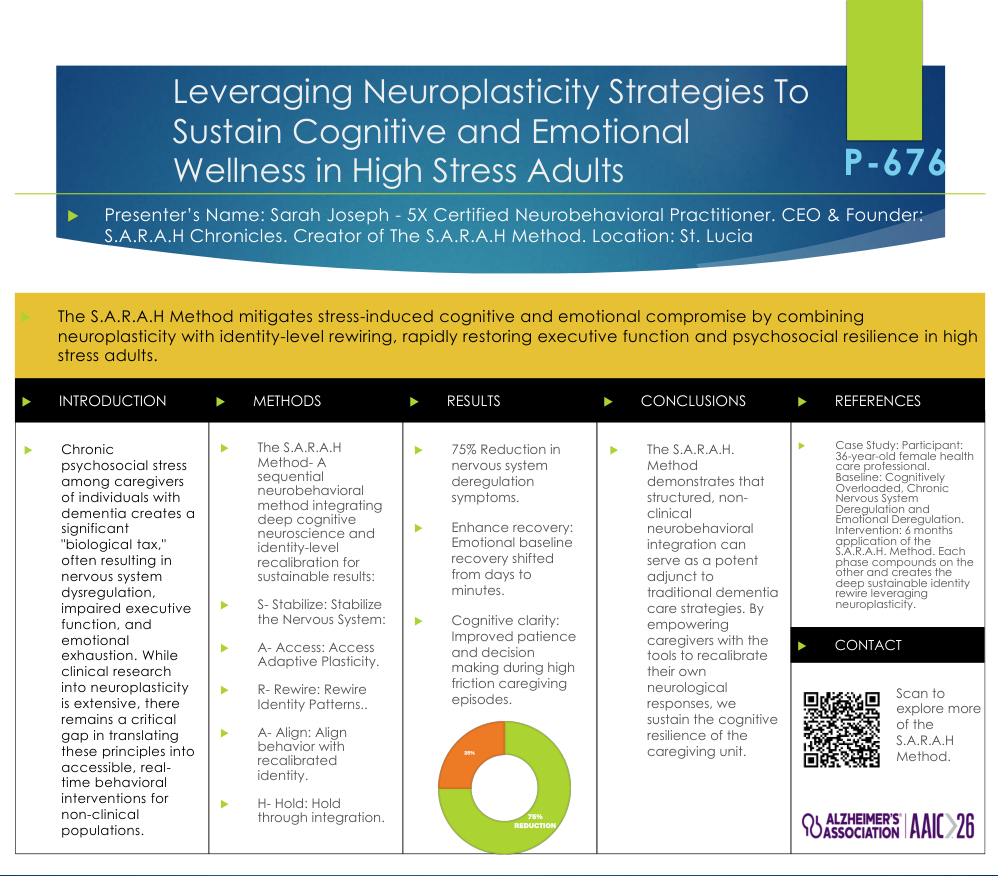
Leveraging Neuroplasticity Strategies To Sustain Cognitive And Emotional Wellness In High Stress Adults.
Poster Presenter
Authors
Part of Topic
Video
Control/Tracking Number: 2026-A-676-AAIC: Leveraging Neuroplasticity Strategies To Sustain Cognitive And Emotional Wellness
In High Stress Adults.:
Author: Sarah Joseph.Neuro-Behavioral Practitioner, S.A.R.A.H Chronicles, Castries, Saint Lucia.
Abstract:
Background: High-stress environments, particularly within caregiving roles can impair
emotional regulation, cognitive processing, and decision-making capacity. These
psychosocial stressors contribute significantly to caregiver burden and may reduce the
quality of support provided to individuals with cognitive decline. While neuroplasticity
research has expanded understanding of the brain’s adaptive capacity, there remains a
practical gap: caregivers and high-stress adults often lack accessible, evidence
informed tools to regulate stress responses and maintain cognitive-emotional stability.
This abstract presents a trauma-responsive, neuroplasticity-based framework designed
to strengthen resilience, improve cognitive flexibility, and support emotional wellbeing
in high stress adults including caregivers.
Methods: Drawing on neuroscience principles, behavioral psychology, emotional
intelligence techniques, neuroplasticity strategies and trauma responsive coaching,
this model outlines a structured set of practices intended for real-world application.
Components include:• Interoceptive and grounding techniques for physiological
downregulation• Cognitive reframing strategies to interrupt stress-driven mental loops•
Emotional labeling and processing tools to reduce reactive patterns• Micro-pattern
rewiring practices targeting habitual stress responses• Sensory-based neural resets to
shift activation states• Daily neuroplasticity micro-practices to reinforce adaptive
pathways
The framework is designed to be time-efficient, accessible, and adaptable to caregiving
contexts.
Results: Although not tested through formal clinical trials, practice-based application
of this framework demonstrates meaningful improvements in emotional steadiness,
cognitive clarity, and stress recovery among high-stress adults. Informal caregivers
using these strategies report reduced overwhelm, enhanced emotional regulation
capacity, and improved day-to-day functioning. These observed patterns highlight the
potential value of neuroplasticity-informed lifestyle approaches within caregiver
support initiatives. Further empirical study is recommended.
Conclusion: Neuroplasticity-based lifestyle strategies represent a promising, non
pharmacological approach to strengthening cognitive and emotional wellness in high
stress adults, including those in caregiving roles. By targeting modifiable psychosocial
and behavioral factors, this framework supports resilience, reduces emotional strain,
and enhances the caregiving environment. Future work should focus on formal
evaluation, integration into caregiver support programming, and adaptation for diverse
caregiving populations.
Comments
Email is required but is not shown publicly.
Loading comments...