4,068 posters, 219 videos, 101 topics, 69 sessions, 14,365 authors, 6,128 institutions
ePostersLive by SciGen Technologies S.A. All rights reserved.
Alzheimer's Association International Conference 2026
July 12-15, 2026 | London, United Kingdom, and Online

7163
“Social Robots Would Be Great For Confidence, Orientation, Feeling In Control”: Measuring The Impact Of Social Robots In Dementia Care
Poster Presenter
Part of Topic
Background
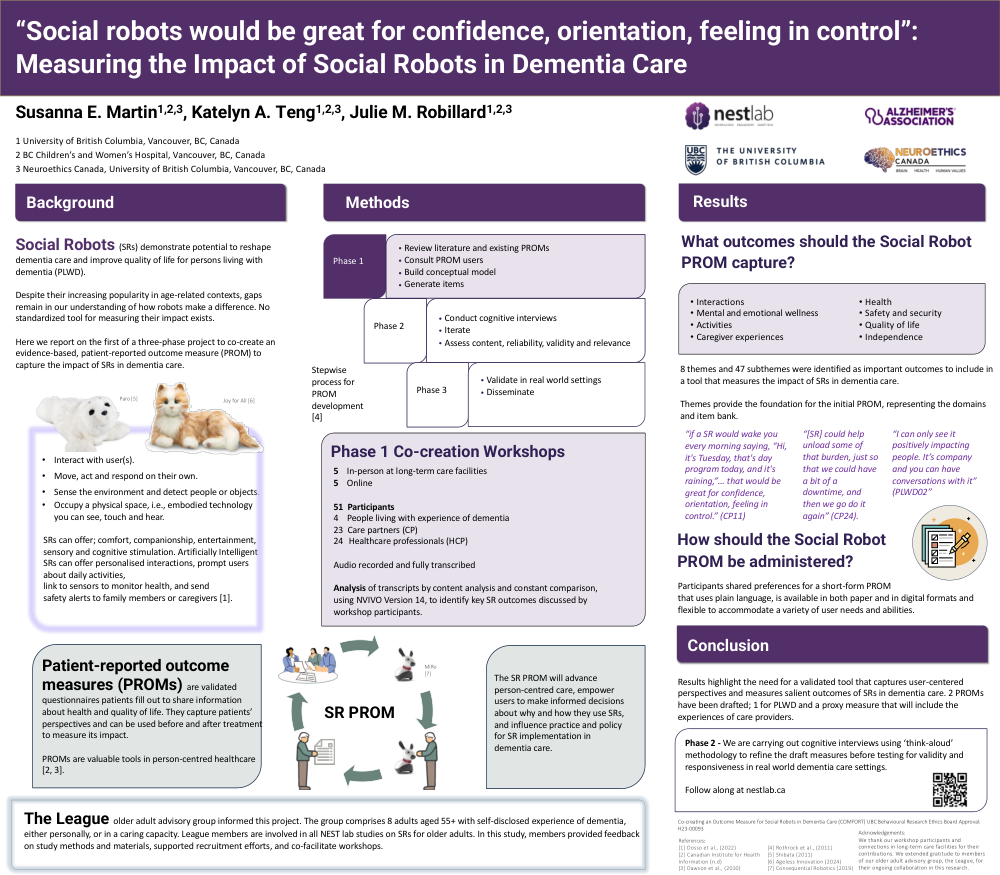
Social robots demonstrate potential to reshape dementia care. Offering comfort, companionship, entertainment and cognitive stimulation, social robots are increasingly being used to support persons living with dementia (PLWD). Recent advances in artificial intelligence have further extended technical capacities enabling robots to hold conversations and offer personalized responses that support daily roles and routines. However, despite such potential, the true value of social robots in dementia care is poorly understood. No standardized tool for measuring their impact exists. This work reports on the first phase of a project to co-create a patient-reported outcome measure (PROM) for social robots in dementia care.
Methods
To develop an item bank for the PROM we carried out 10 co-creation workshops with 51 members of the dementia community, including healthcare providers, PLWD and care partners. Workshops were conducted online (n=5) and in-person at long-term care facilities (n=5). Participants shared their perspectives on how social robots could impact the experience of living with dementia and offered feedback on how the PROM may be formatted and worded. Transcripts of audio recordings were analyzed using conceptual content analysis to identify key social robot outcomes. This project is being carried out in consultation with a research advisory group for older adults, the Lived Experience Expert Group (LEEG) or ‘League’.
Results
Forty-seven candidate PROM items emerged across 8 domains: 1) interactions, 2) mental and emotional wellness, 3) activities, 4) caregiver experiences, 5) health, 6) safety and security, 7) quality of life, and 8) independence. Participants also shared preferences for a PROM that uses plain language and visual icons, has a limited number of items and response options, and is administered online or on paper. Two complementary PROMs were drafted; one for PLWD and a second proxy measure to include caregiver experiences.
Conclusion
Findings confirm the value of incorporating PLWD, caregiver and provider perspectives when developing tools to measure the impact of health interventions and offer novel insights into areas of impact for social robots. Following validation, the final PROM will advance person-centered care planning and facilitate informed decision making about the use of social robots in dementia care.
Comments
Email is required but is not shown publicly.
Loading comments...