4,068 posters, 219 videos, 101 topics, 69 sessions, 14,365 authors, 6,128 institutions
ePostersLive by SciGen Technologies S.A. All rights reserved.
Alzheimer's Association International Conference 2026
July 12-15, 2026 | London, United Kingdom, and Online

9865
Evaluating Educational Needs In Dementia Care: Insights To Guide Expansion Of A Home Health Caregiver Curriculum
Poster Presenter
Authors
Part of Topic
Evaluating Educational Needs in Dementia Care: Insights to Guide Expansion of a Home Health Caregiver Curriculum
Molly Schroeder, CSW1, Tammi Albrecht, DNP1, Jennifer Landeta Vidal, MPH1, Tamara J. LeCaire, MS, PhD1,
Sarah Endicott, DNP, PMHNP-BC, GNP-BC, FNAP4, Cynthia M. Carlsson, MD, MS1,3 and Art Walaszek, MD1,2
(1) Wisconsin Alzheimer’s Institute, University of Wisconsin School of Medicine and Public Health (UW-SMPH), Madison, WI, USA, (2) Department of Psychiatry, UW-SMPH
(3) Department of Medicine, Division of Geriatrics and Gerontology, UW-SMPH,, (4) University of Wisconsin Madison, School of Nursing, Madison, WI, USA
BACKGROUND
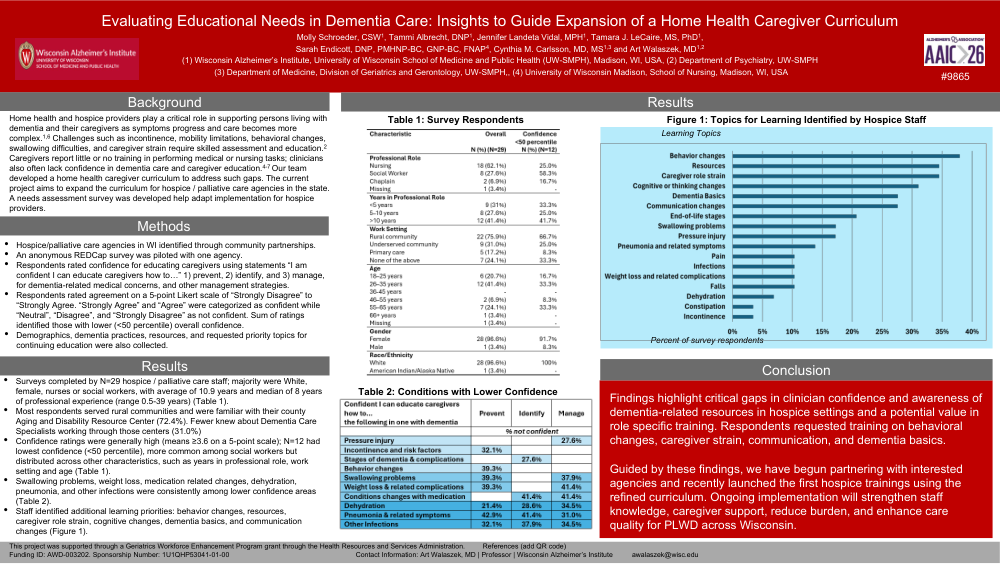
Home health and hospice providers play a critical role in supporting persons living with dementia and their caregivers as symptoms progress and care becomes more complex.1,6 Challenges such as incontinence, mobility limitations, behavioral changes, swallowing difficulties, and caregiver strain require skilled assessment and education.2 Caregivers report little or no training in performing medical or nursing tasks; clinicians also often lack confidence in dementia care and caregiver education.4-7 Our team developed a home health caregiver curriculum to address such gaps. The current project aims to expand the curriculum for hospice / palliative care agencies in the state. A needs assessment survey was developed help adapt implementation for hospice providers.
METHODS
Findings highlight critical gaps in clinician confidence and awareness of dementia‑related resources in hospice settings and a potential value in role specific training. Respondents requested training on behavioral changes, caregiver strain, communication, and dementia basics.
Guided by these findings, we have begun partnering with interested agencies and recently launched the first hospice trainings using the refined curriculum. Ongoing implementation will strengthen staff knowledge, caregiver support, reduce burden, and enhance care quality for PLWD across Wisconsin.
Comments
Email is required but is not shown publicly.
Loading comments...