4,068 posters, 219 videos, 101 topics, 69 sessions, 14,365 authors, 6,128 institutions
ePostersLive by SciGen Technologies S.A. All rights reserved.
Alzheimer's Association International Conference 2026
July 12-15, 2026 | London, United Kingdom, and Online

546
Promote DemenTitude®- Urge For "Dementia Inclusive Design" In Residential Care Homes From The Voice Of People With Dementia In Hong Kong
Poster Presenter
Authors
Part of Topic
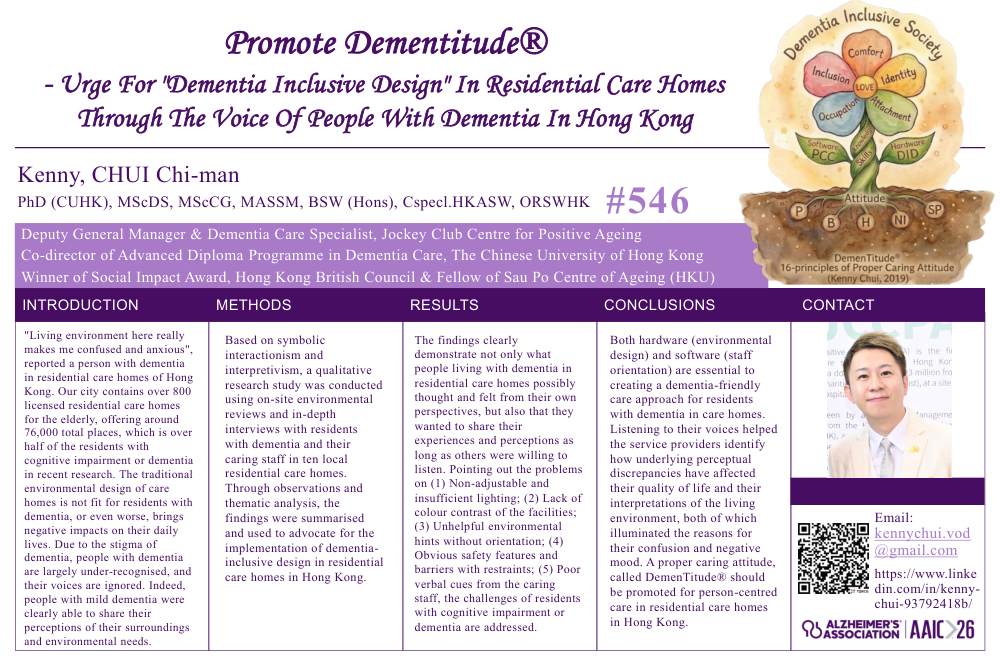
Promote Dementitude®- Urge For "Dementia Inclusive Design" In Residential Care Homes Through The Voice Of People With Dementia In Hong Kong
Background: "Living environment here really makes me confused and anxious", reported a person with dementia in residential care homes of Hong Kong. Our city contains over 800 licensed residential care homes for the elderly, offering around 76,000 total places, which is over half of the residents with cognitive impairment or dementia in recent research. The traditional environmental design of care homes is not fit for residents with dementia, or even worse, brings negative impacts on their daily lives. Due to the stigma of dementia, people with dementia are largely under-recognised, and their voices are ignored. Indeed, people with mild dementia were clearly able to share their perceptions of their surroundings and environmental needs.
Methods: Based on symbolic interactionism and interpretivism, a qualitative research study was conducted using on-site environmental reviews and in-depth interviews with residents with dementia and their caring staff in ten local residential care homes. Through observations and thematic analysis, the findings were summarised and used to advocate for the implementation of dementia-inclusive design in residential care homes in Hong Kong.
Results: The findings clearly demonstrate not only what people living with dementia in residential care homes possibly thought and felt from their own perspectives, but also that they wanted to share their experiences and perceptions as long as others were willing to listen. Pointing out the problems on (1) Non-adjustable and insufficient lighting; (2) Lack of colour contrast of the facilities; (3) Unhelpful environmental hints without orientation; (4) Obvious safety features and barriers with restraints; (5) Poor verbal cues from the caring staff, the challenges of residents with cognitive impairment or dementia are addressed.
Conclusion: Both hardware (environmental design) and software (staff orientation) are essential to creating a dementia-friendly care approach for residents with dementia in care homes. Listening to their voices helped the service providers identify how underlying perceptual discrepancies have affected their quality of life and their interpretations of the living environment, both of which illuminated the reasons for their confusion and negative mood. A proper caring attitude, called DemenTitude® should be promoted for person-centred care in residential care homes in Hong Kong.
Comments
Email is required but is not shown publicly.
Loading comments...