4,068 posters, 219 videos, 101 topics, 69 sessions, 14,365 authors, 6,128 institutions
ePostersLive by SciGen Technologies S.A. All rights reserved.
Alzheimer's Association International Conference 2026
July 12-15, 2026 | London, United Kingdom, and Online

2792
Exploring risk reduction, screening, and treatment of cognitive decline by clinicians: a qualitative study based on CFIR
Poster Presenter
Authors
Jane Sachs, Katlyn Dillane, Elizabeth Lehman, Magdalene Wellman, Andrea Garcia
Affiliations
Part of Topic
Background:
An estimated 55 to 57 million people are living withdementia globally. These numbers are risingglobally, and annual diagnoses are projected todouble by 2060.
Primary care physicians (PCPs) are at the forefrontof Alzheimer’s Disease and Related Dementia(ADRD) care. However, many PCPs experiencesignificant knowledge gaps and face barriers toeffective prevention, diagnosis, and treatment. It isimperative to identify and address these gaps withrelevant continuing medical education.
Methods:
As part of a larger project on brain health andADRD, we conducted semi-structured interviewswith PCPs, specialists, and ancillary healthproviders in the United States.
The methods described here represent a portion ofthe overall study, focusing on N=9 PCPs' barriersand facilitators to effective prevention, screening,and treatment of ADRD. Qualitative analysis wasconducted in NVivo 14 and guided by Damschroer'sUpdated CFIR, enabling systematic identification ofkey implementation constructs.
Key takeaways:
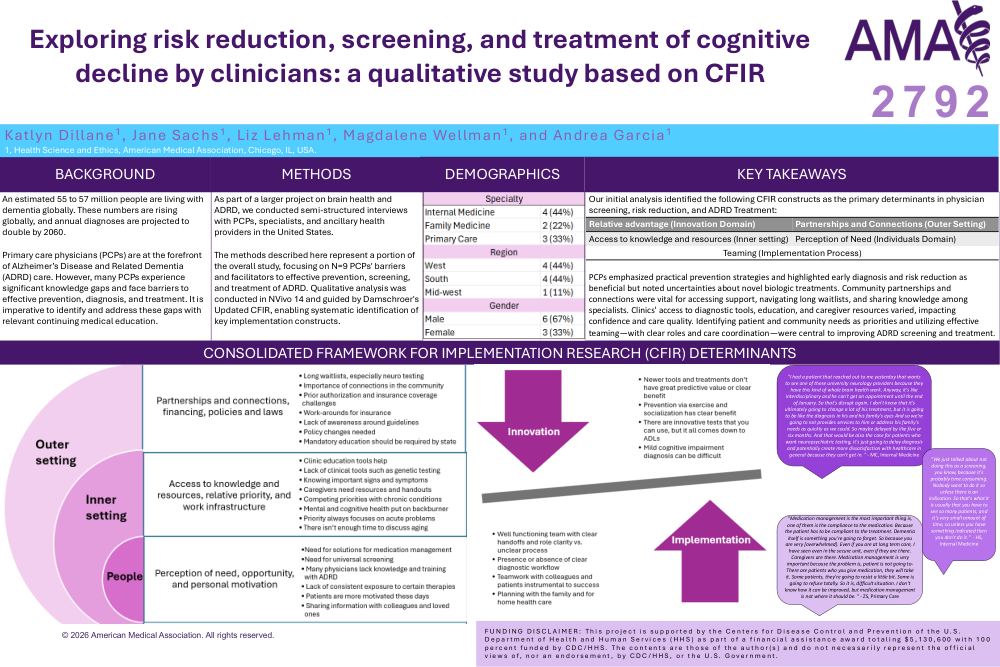
Our initial analysis identified the following CFIR constructs as the primary determinants in physician screening, risk reduction, and ADRD Treatment:
PCPs highlighted early diagnosis and risk reduction as beneficial,but noted uncertainties about novelbiologic treatments and emphasized practical prevention strategies. Community partnerships andconnections were vital for accessing support, navigating long waitlists, and sharing knowledge amongspecialists. Clinics' access to diagnostic tools, education, and caregiver resources varied, impactingconfidence and care quality. Identifying patient and community needs as priorities, and utilizing effectiveteaming—with clear roles and care coordination—were central to improving ADRD screening and treatment.
Comments
Email is required but is not shown publicly.
Loading comments...