4,068 posters, 219 videos, 101 topics, 69 sessions, 14,365 authors, 6,128 institutions
ePostersLive by SciGen Technologies S.A. All rights reserved.
Alzheimer's Association International Conference 2026
July 12-15, 2026 | London, United Kingdom, and Online

1657
Cultural Adaptation And Validation Of The Everyday Cognition Scale-12 (ECog-12) In A Multiethnic Asian Population
Poster Presenter
Authors
Affiliations
Medicine Academic Clinical Programme, Singapore General Hospital, Singapore, Health Services and Systems Research, Duke-NUS Medical School, Singapore; Department of Psychiatry, Singapore General Hospital, Singapore; SingHealth Duke-NUS Medicine Academic Clinical Programme, Duke-NUS Medical School, Singapore; Saw Swee Hock School of Public Health, National University of Singapore, Singapore.
Part of Topic
Background: Everyday Cognition Scale (ECog-12) is widely used to identify cognitive concerns reported by informants during routine evaluations. However, validation has largely focus on Western populations. Evidence on its applicability in non-Western settings—where cultural norms and functional expectations differ—remains scarce. This study addresses this gap by evaluating the English ECog-12 in a large, multiethnic Asian population, providing one of the most comprehensive validations of this measure in the region.
Methods:Informants of community-dwelling older adults in Singapore (n=1,520) completed questionnaires, including ECog-12, AD8, and the Modified Lawton scale. Participants underwent cognitive screening (Montreal Cognitive Assessment [MoCA] and neuropsychological tests), global dementia severity (Clinical Dementia Rating [CDR]), and mood and anxiety assessments (Patient Health Questionnaire‑9 [PHQ-9]; Generalized Anxiety Disorder‑7 [GAD-7]). ECog-12 was culturally adapted through cognitive interviews to assess clarity and comprehension. Psychometric evaluation included factorial validity (confirmatory factor analysis), convergent and discriminant validity (Pearson’s correlations with cognitive, functional, and neuropsychiatric measures), known‑group validity (diagnostic group comparisons), and internal consistency (Cronbach’s α). Informants were classified as high‑contact (daily interaction) or low‑contact (non-daily interaction) to examine whether contact frequency influences the validity and reliability of ECog‑12 ratings.
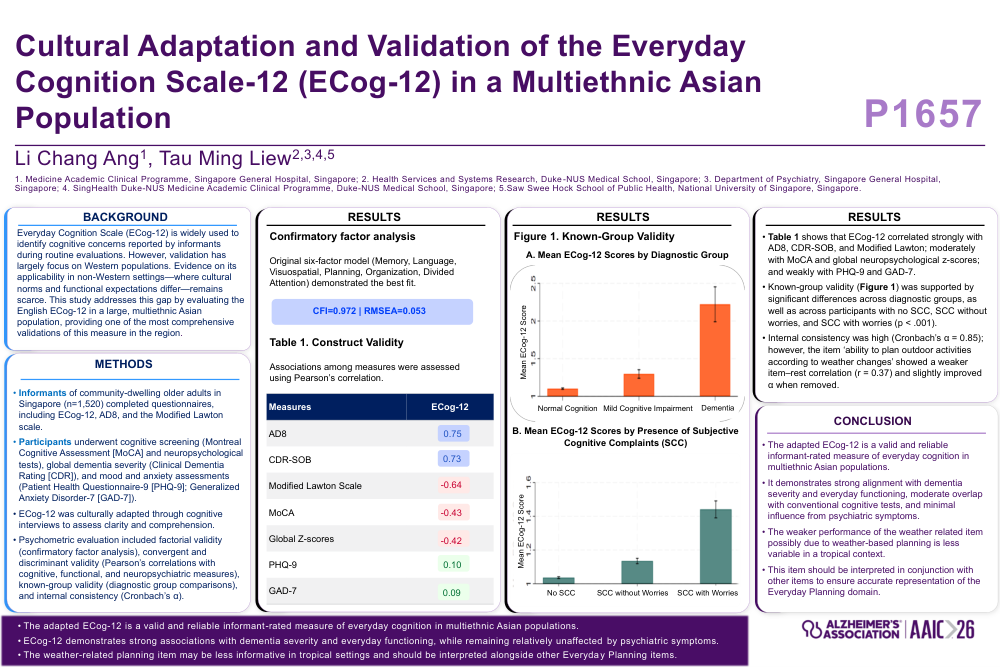
Results: The original six-factor model (Memory, Language, Visuospatial, Planning, Organization, Divided Attention) demonstrated the best fit (CFI=0.972, RMSEA=0.053). As shown in Table 1, ECog-12 scores correlated strongly with AD8, CDR-SOB and Modified Lawton. ECog-12 correlated moderately with MoCA and global neuropsychological z-scores, and correlated weakly with PHQ-9 and GAD-7. ECog-12 domain scores demonstrated weak correlations with their corresponding neuropsychological domains (r= -0.11 to -0.29). Known-group validity (Figure 1) was supported by significant differences across diagnostic groups (i.e. normal cognition, mild cognitive impairment, dementia; p< .001); and across participants without subjective cognitive complaints (SCC), SCC without worries, and SCC with worries (p < .001). Internal consistency was high (Cronbach’s α = 0.85), except for item ‘The ability to plan outdoor activities according to weather changes’, which showed weaker item-rest correlation (r=0.37) and a marginal increase in Cronbach’s α when removed. ECog‑12 psychometric performance was stronger among high‑contact informants (n=1,072) than low‑contact informants (n=448).
Conclusion: The adapted ECog‑12 is a valid and reliable informant‑rated measure of everyday cognition in multiethnic Asian populations. It aligns well with dementia severity and everyday functioning, with higher validity when informants have daily contact—indicating that limited‑contact informants may provide less reliable ratings and that relational context must be considered. Two unexpected findings emerged. First, ECog‑12 did not map closely onto traditional neuropsychological domains, likely reflecting that everyday behaviours draw on multiple cognitive processes rather than discrete domains. Clinically, this suggests ECog‑12 domain scores should be interpreted as markers of functional change rather than direct proxies for specific cognitive domains. Second, a weather related item performed weakly, possibly due to weather‑based planning is less variable in a tropical context. This item is therefore best interpreted with other items in the Everyday Planning domain. Further regional use will require translation and evaluation of measurement equivalence across languages.
Comments
Email is required but is not shown publicly.
Loading comments...