4,068 posters, 219 videos, 101 topics, 69 sessions, 14,365 authors, 6,128 institutions
ePostersLive by SciGen Technologies S.A. All rights reserved.
Alzheimer's Association International Conference 2026
July 12-15, 2026 | London, United Kingdom, and Online

4257
Subjective reports of problems remembering names reflect performance on neuropsychological tests for recalling proper names
Poster Presenter
Part of Topic
Background:
Although subjective cognitive complaints (SCC), particularly difficulty recalling proper names, is a common age-related occurrence, 18-53% of people who report SCC have elevated amyloid.
Proper name recall (PNR) is especially susceptible to brain injury or neurodegeneration; amyloid burden accelerates decline in objectively measured PNR.
Objective:
We hypothesized that
– Participants with more subjective cognitive complaints (i.e total score; T-SCC) in general, and specifically complaints about remembering names (N-SCC), would perform poorly on objectively measured proper name recall (PNR)
– The presence of beta-amyloid accumulation would moderate the association between SCC and PNR
Methods:
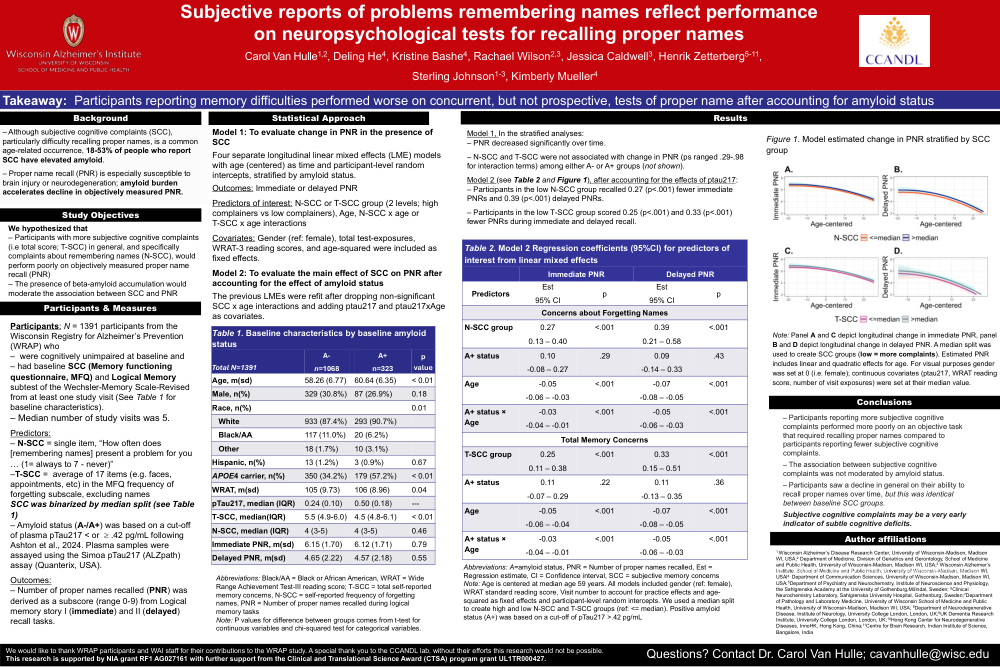
Participants: N = 1391 participants from the Wisconsin Registry for Alzheimer’s Prevention (WRAP) who
– were cognitively unimpaired at baseline and
– had baseline SCC (Memory functioning questionnaire, MFQ) and Logical Memory subtest of the Wechsler-Memory Scale-Revised from at least one study visit (See Table 1 for baseline characteristics).
– Median number of study visits was 5.
Predictors:
– N-SCC = single item, “How often does [remembering names] present a problem for you … (1= always to 7 - never)”
–T-SCC = average of 17 items (e.g. faces, appointments, etc) in the MFQ frequency of forgetting subscale, excluding names
SCC was binarized by median split (see Table 1)
– Amyloid status (A-/A+) was based on a cut-off of plasma pTau217 < or ³ .42 pg/mL following Ashton et al., 2024. Plasma samples were assayed using the Simoa pTau217 (ALZpath) assay (Quanterix, USA).
Outcomes:
– Number of proper names recalled (PNR) was derived as a subscore (range 0-9) from Logical memory story I (immediate) and II (delayed) recall tasks.
Statistical approach:
Model 1: To evaluate change in PNR in the presence of SCC
Four separate longitudinal linear mixed effects (LME) models with age (centered) as time and participant‑level random intercepts, stratified by amyloid status.
Outcomes: Immediate or delayed PNR
Predictors of interest: N-SCC or T-SCC group (2 levels; high complainers vs low complainers), Age, N-SCC x age or T-SCC x age interactions
Covariates: Gender (ref: female), total test‑exposures, WRAT‑3 reading scores, and age-squared were included as fixed effects.
Model 2: To evaluate the main effect of SCC on PNR after accounting for the effect of amyloid status
The previous LMEs were refit after dropping non-significant SCC x age interactions and adding ptau217 and ptau217xAge as covariates.
Results:
Model 1, In the stratified analyses:
– PNR decreased significantly over time.
– N-SCC and T-SCC were not associated with change in PNR (ps ranged .29-.98 for interaction terms) among either A- or A+ groups (not shown).
Model 2 (see Table 2 and Figure 1), after accounting for the effects of ptau217:
– Participants in the low N-SCC group recalled 0.27 (p<.001) fewer immediate PNRs and 0.39 (p<.001) delayed PNRs.
– Participants in the low T-SCC group scored 0.25 (p<.001) and 0.33 (p<.001) fewer PNRs during immediate and delayed recall
Conclusion:
– Participants reporting more subjective cognitive complaints performed more poorly on an objective task that required recalling proper names compared to participants reporting fewer subjective cognitive complaints.
– The association between subjective cognitive complaints was not moderated by amyloid status.
– Participants saw a decline in general on their ability to recall proper names over time, but this was identical between baseline SCC groups.
Subjective cognitive complaints may be a very early indicator of subtle cognitive deficits.
Acknowledgements:
We would like to thank WRAP participants and WAI staff for their contributions to the WRAP study. A special thank you to the CCANDL lab, without their efforts this research would not be possible. This research is supported by NIA grant RF1 AG027161 with further support from the Clinical and Translational Science Award (CTSA) program grant UL1TR000427.
Authors and affiliations:
Carol Van Hulle1,2, Deling He4, Kristine Bashe4, Rachael Wilson2,3, Jessica Caldwell3, Henrik Zetterberg5-11,
Sterling Johnson1-3, Kimberly Mueller4
1 Wisconsin Alzheimer’s Disease Research Center, University of Wisconsin-Madison, Madison WI, USA;2 Department of Medicine, Division of Geriatrics and Gerontology, School of Medicine and Public Health, University of Wisconsin-Madison, Madison WI, USA;3 Wisconsin Alzheimer’s Institute, School of Medicine and Public Health, University of Wisconsin-Madison, Madison WI, USAl4 Department of Communication Sciences, University of Wisconsin-Madison, Madison WI, USA;5Department of Psychiatry and Neurochemistry, Institute of Neuroscience and Physiology, the Sahlgrenska Academy at the University of Gothenburg,Mölndal, Sweden; 6Clinical Neurochemistry Laboratory, Sahlgrenska University Hospital, Gothenburg, Sweden;7Department of Pathology and Laboratory Medicine, University of Wisconsin School of Medicine and Public Health, University of Wisconsin-Madison, Madison WI, USA; 8Department of Neurodegenerative Disease, Institute of Neurology, University College London, London, UK;9UK Dementia Research Institute, University College London, London, UK;10Hong Kong Center for Neurodegenerative Diseases, InnoHK, Hong Kong, China;11Centre for Brain Research, Indian Institute of Science, Bangalore, India
Comments
Email is required but is not shown publicly.
Loading comments...