4,068 posters, 219 videos, 101 topics, 69 sessions, 14,365 authors, 6,128 institutions
ePostersLive by SciGen Technologies S.A. All rights reserved.
Alzheimer's Association International Conference 2026
July 12-15, 2026 | London, United Kingdom, and Online

617
Vfs-Net: Vertex- And Face-based Deep Learning Pipeline For Three-dimensional Model Segmentation And Analysis
Poster Presenter
Authors
Morgan Mekale Smith, Elizabeth Ochoa, Mallory Keating, Margaret E. Flanagan, Sudha Seshadri, Kevin F. Bieniek
Affiliations
Glenn Biggs Institute for Alzheimer’s and Neurodegenerative Diseases, UT Health San Antonio, Glenn Biggs Institute for Alzheimer’s and Neurodegenerative Diseases and the Department of Pathology and Laboratory Medicine, UT Health San Antonio, Glenn Biggs Institute for Alzheimer’s and Neurodegenerative Diseases and the Department of Neurology, UT Health San Antonio
Part of Topic
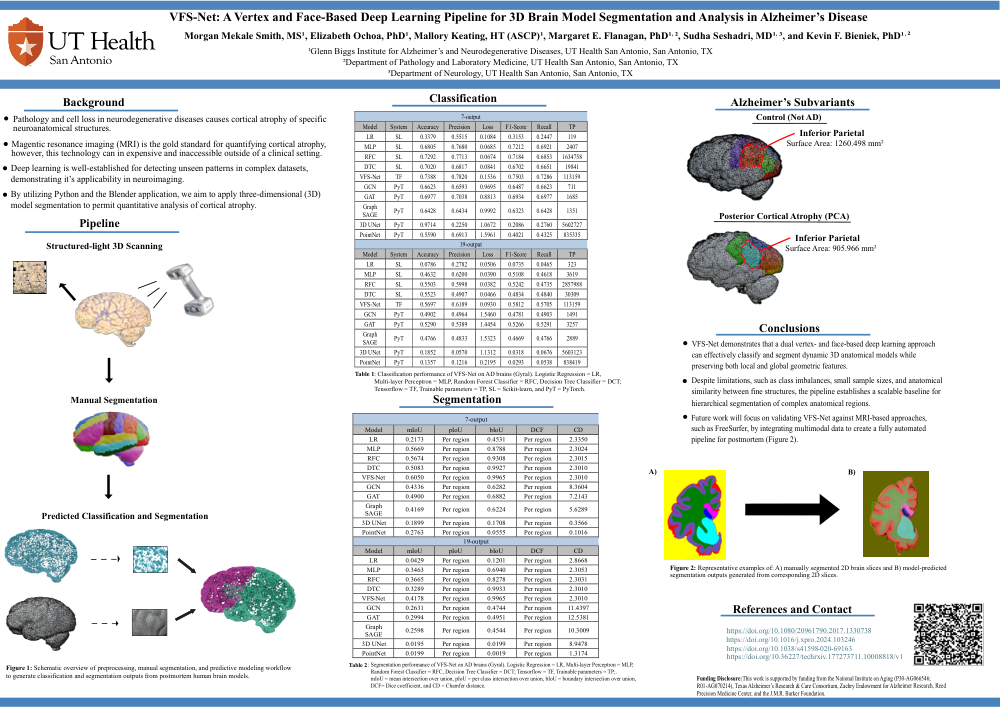
Neurodegenerative diseases, such as Alzheimer’s disease (AD), are characterized by progressive regional loss of cortical tissue. In neuropathology, three-dimensional (3D) model segmentation and analysis via magnetic resonance imaging (MRI) is the gold standard for quantifying cortical atrophy. MRI requires access to specialized facilities, advanced technical training, neuroimaging expertise, and is time-consuming. To address these challenges, we have developed pipeline leveraging structured-light scanning and deep learning to investigate structural patterns of atrophy associated with AD and other neurodegenerative diseases.
3D files of postmortem human brains were decimated and manually segmented using the Blender application. Models were segmented into several relevant neuroanatomical regions and exported as .csv files as input into the Python-based deep learning pipeline. A neural network model was trained on 3D models of brains with minimal cortical atrophy, tracking classification metrics of accuracy, precision, loss, recall, the number of trainable parameters, and F1-score. Segmentation performance was evaluated using mean intersection over union (mIoU), per class intersection over union (pIoU), boundary intersection over union (bIoU), dice coefficient, and chamfer distance (CD), allowing visualization and quantification of predicted regional atrophy. Surface area measurements from regions of interest were also obtained to assign quartiles of atrophy when compared to controls. The VFS-Net model was compared to common machine learning algorithms, such as Random Forest Classifier and Logistic Regression, to compare evaluation metrics to well established models.
Our results demonstrate that VFS-Net outperformed traditional machine learning methods in both classification and segmentation metrics. This suggests that using this pipeline, 3D models obtained from structured-light scanning can be classified and segmented with favorable evaluation metrics (70-98%). Surface area measurements obtained using traditional machine learning methods and VFS-Net did not differ significantly and future work will incorporate this data for 3D visualization of predictions.
Our findings support the utilization of this pipeline to generate quartiles of regional atrophy associated with complex disease processes, including AD. Future work will validate these findings with cortical thickness measurements obtained from MRI upon the integration of two-dimensional images within the 3D models as volumetric data.
Comments
Email is required but is not shown publicly.
Loading comments...