4,068 posters, 219 videos, 101 topics, 69 sessions, 14,365 authors, 6,128 institutions
ePostersLive by SciGen Technologies S.A. All rights reserved.
Alzheimer's Association International Conference 2026
July 12-15, 2026 | London, United Kingdom, and Online

897
Transport Of aβ Aggregates In The Brain Via Diffusion Through The Interstitial Fluid And Its Effects On Alzheimer’S
Poster Presenter
Authors
Affiliations
null,
Part of Topic
Transport of Aβ Aggregates in the Brain Via Diffusion Through the Interstitial Fluid and Its Effects on Alzheimer’s Disease
Sindhu Bilapati, Maha Islam, Nadia Pavlov
Aβ transport depends strongly on aggregate size: monomeric Aβ can diffuse through the interstitial fluid, but as aggregates grow into oligomers and fibrils, diffusion rapidly becomes ineffective. Péclet number analysis suggests that larger Aβ aggregates require convective bulk flow, such as glymphatic clearance, for effective clearance from brain tissue, meaning impaired glymphatic function may contribute to Aβ accumulation in Alzheimer’s disease.
INTRODUCTION
Alzheimer’s disease remains one of the most devastating neurodegenerative disorders, and understanding why toxic proteins accumulate in the brain is critical for developing effective treatments. Central to this problem is the buildup of amyloid-beta (Aβ), a peptide that originates from normal amyloid precursor protein (APP) processing but can misfold, aggregate, and ultimately form plaques that disrupt neuronal communication. For many decades, it was believed that the brain relied solely on diffusion to eliminate metabolic waste, but the discovery of the glymphatic system introduced a new framework for understanding how larger aggregated molecules, such as Aβ oligomers and fibrils, might be removed through bulk flow rather than diffusion alone.
METHODS
Amyloid-beta (Aβ) transport in the brain interstitial fluid was analyzed using fundamental biotransport principles. The interstitial space was modeled as a continuous fluid medium where solute transport occurs through diffusion and convection, or bulk flow. Aβ aggregates were assumed to be approximately spherical, and transport behavior was evaluated under steady-state conditions as aggregate size increased.
Transport quantities included diffusive flux, diffusion coefficient, Péclet number, and the transport threshold where Pe = 1. Diffusive flux was described using Fick’s First Law. The diffusion coefficient was estimated using the Stokes–Einstein relationship with T = 310 K, μ = 1.0 cP, and aggregate radius as the changing variable. The Péclet number was calculated using interstitial fluid velocity, characteristic transport length, and the diffusion coefficient.
RESULTS
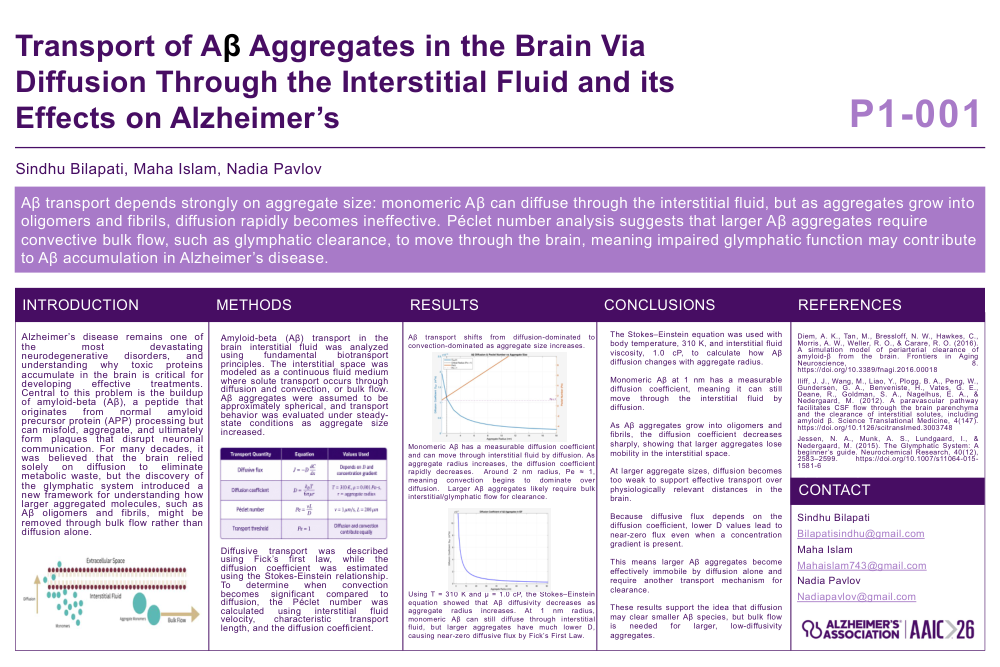
Aβ transport shifts from diffusion-dominated to convection-dominated as aggregate size increases. Monomeric Aβ has a measurable diffusion coefficient and can move through interstitial fluid by diffusion. As aggregate radius increases, the diffusion coefficient rapidly decreases. Around 2 nm radius, Pe ≈ 1, meaning convection begins to dominate over diffusion. Larger Aβ aggregates likely require bulk interstitial or glymphatic flow for clearance.
Using T = 310 K and μ = 1.0 cP, the Stokes–Einstein equation showed that Aβ diffusivity decreases as aggregate radius increases. At 1 nm radius, monomeric Aβ can still diffuse through interstitial fluid, but larger aggregates have much lower D, causing near-zero diffusive flux by Fick’s First Law.
CONCLUSIONS
The Stokes–Einstein equation was used with body temperature, 310 K, and interstitial fluid viscosity, 1.0 cP, to calculate how Aβ diffusion changes with aggregate radius.
Monomeric Aβ at 1 nm has a measurable diffusion coefficient, meaning it can still move through the interstitial fluid by diffusion.
As Aβ aggregates grow into oligomers and fibrils, the diffusion coefficient decreases sharply, showing that larger aggregates lose mobility in the interstitial space.
At larger aggregate sizes, diffusion becomes too weak to support effective transport over physiologically relevant distances in the brain.
Because diffusive flux depends on the diffusion coefficient, lower D values lead to near-zero flux even when a concentration gradient is present.
This means larger Aβ aggregates become effectively immobile by diffusion alone and require another transport mechanism for clearance.
These results support the idea that diffusion may clear smaller Aβ species, but bulk flow is needed for larger, low-diffusivity aggregates.
REFERENCES
Diem, A. K., Tan, M., Bressloff, N. W., Hawkes, C., Morris, A. W., Weller, R. O., & Carare, R. O. (2016). A simulation model of periarterial clearance of amyloid-β from the brain. Frontiers in Aging Neuroscience, 8.
Iliff, J. J., Wang, M., Liao, Y., Plogg, B. A., Peng, W., Gundersen, G. A., Benveniste, H., Vates, G. E., Deane, R., Goldman, S. A., Nagelhus, E. A., & Nedergaard, M. (2012). A paravascular pathway facilitates CSF flow through the brain parenchyma and the clearance of interstitial solutes, including amyloid β. Science Translational Medicine, 4(147).
Jessen, N. A., Munk, A. S., Lundgaard, I., & Nedergaard, M. (2015). The glymphatic system: A beginner’s guide. Neurochemical Research, 40(12), 2583–2599.
Comments
Email is required but is not shown publicly.
Loading comments...