4,068 posters, 219 videos, 101 topics, 69 sessions, 14,365 authors, 6,128 institutions
ePostersLive by SciGen Technologies S.A. All rights reserved.
Alzheimer's Association International Conference 2026
July 12-15, 2026 | London, United Kingdom, and Online

3273
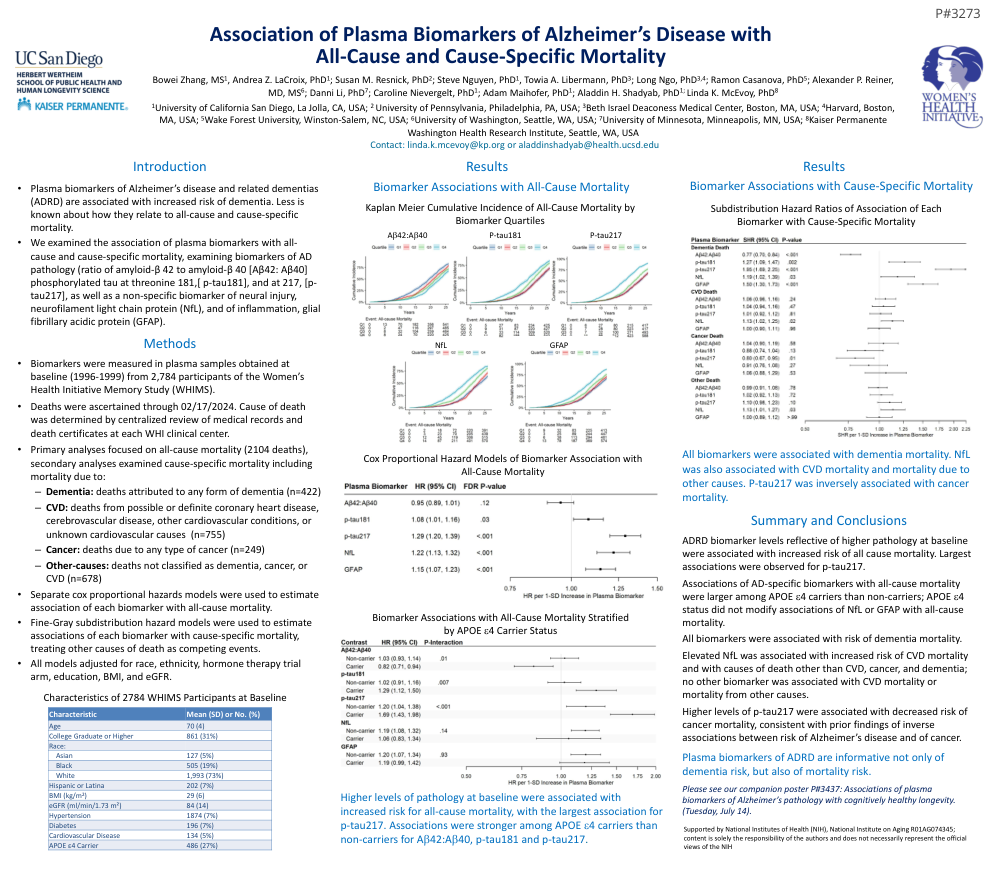
Association Of Plasma Biomarkers Of Alzheimer’s Disease With All-cause And Cause-specific Mortality
Poster Presenter
Authors
Linda McEvoy, Bowei Zhang, Andrea LaCroix, Susan Resnick, Steve Nguyen, Towia Libermann, Long Ngo, Ramon Casanova, Alexander Reiner, Danni Li, Caroline Nievergelt,, Adam Maihofer, Aladdin Shadyab
Affiliations
University of Washington, Kaiser Permanente Washington Health Research Institute, University of California San Diego, University of Pennsylvania, Beth Israel Deaconess Medical Center, University of Minnesota, Beth Israel Deaconess Medical Center and Harvard, Wake Forest University
Part of Topic
Introduction
Plasma biomarkers of Alzheimer’s disease and related dementias (ADRD) are associated with increased risk of dementia. Less is known about how they relate to all-cause and cause-specific mortality.
We examined the association of plasma biomarkers with all-cause and cause-specific mortality, examining biomarkers of AD pathology (ratio of amyloid-β 42 to amyloid-β 40 [Aβ42: Aβ40] phosphorylated tau at threonine 181,[ p-tau181], and at 217, [p-tau217], as well as a non-specific biomarker of neural injury, neurofilament light chain protein (NfL), and of inflammation, glial fibrillary acidic protein (GFAP).
Methods
Biomarkers were measured in plasma samples obtained at baseline (1996-1999) from 2,784 participants of the Women’s Health Initiative Memory Study (WHIMS).
Deaths were ascertained through 02/17/2024. Cause of death was determined by centralized review of medical records and death certificates at each WHI clinical center.
Primary analyses focused on all-cause mortality (2104 deaths), secondary analyses examined cause-specific mortality including mortality due to:
Dementia: deaths attributed to any form of dementia (n=422)
CVD: deaths from possible or definite coronary heart disease, cerebrovascular disease, other cardiovascular conditions, or unknown cardiovascular causes (n=755)
Cancer: deaths due to any type of cancer (n=249)
Other-causes: deaths not classified as dementia, cancer, or CVD (n=678)
Separate cox proportional hazards models were used to estimate association of each biomarker with all-cause mortality.
Fine-Gray subdistribution hazard models were used to estimate associations of each biomarker with cause-specific mortality, treating other causes of death as competing events.
All models adjusted for race, ethnicity, hormone therapy trial arm, education, BMI, and eGFR.
Results
Higher levels of pathology at baseline were associated with increased risk for all-cause mortality, with the largest association for p-tau217. Associations were stronger among APOE e4 carriers than non-carriers among AD-specific biomarkers: Ab42:Ab40, p-tau181 and p-tau217. APOE e4 status did not modify associations of NfL or GFAP with all-cause mortality.
All biomarkers were associated with dementia mortality. Elevated NfL was associated with increased risk of CVD mortality and with causes of death other than CVD, cancer, and dementia; no other biomarker was associated with CVD mortality or mortality from other causes.
NfL was also associated with CVD mortality and mortality due to other causes.
P-tau217 was inversely associated with cancer mortality, consistent with prior findings of inverse associations between risk of Alzheimer’s disease and of cancer.
Conclusions
Plasma biomarkers of ADRD are informative not only of dementia risk, but also of mortality risk.
Comments
Email is required but is not shown publicly.
Loading comments...