4,068 posters, 219 videos, 101 topics, 69 sessions, 14,365 authors, 6,128 institutions
ePostersLive by SciGen Technologies S.A. All rights reserved.
Alzheimer's Association International Conference 2026
July 12-15, 2026 | London, United Kingdom, and Online

4290
Hippocampal Suppression Of Pgc-1α By Gsk3β Defines A Metabolic Target For Lithium In Alzheimer’S Disease
Poster Presenter
Authors
Carlos Wagner Leal Cordeiro Júnior, Maria Eduarda Dorneles Ferraz, Samuel Cândido Freres, Carlos Roberto Sales, Rafael Everton Assunção Ribeiro da Costa, Vanessa de Jesus Rodrigues de Paula
Affiliations
LIM-27, Institute of Psychiatry, Hospital das Clínicas, Faculdade de Medicina, Universidade de São Paulo (FMUSP), São Paulo, Brazil, Department of Health Sciences, Faculdades Integradas do Norte de Minas (FUNORTE), Federal University of Paraná (UFPR), Curitiba, UNINASSAU, Vilhena, Brazil, State University of Campinas (UNICAMP), Campinas, Brazil
Part of Topic
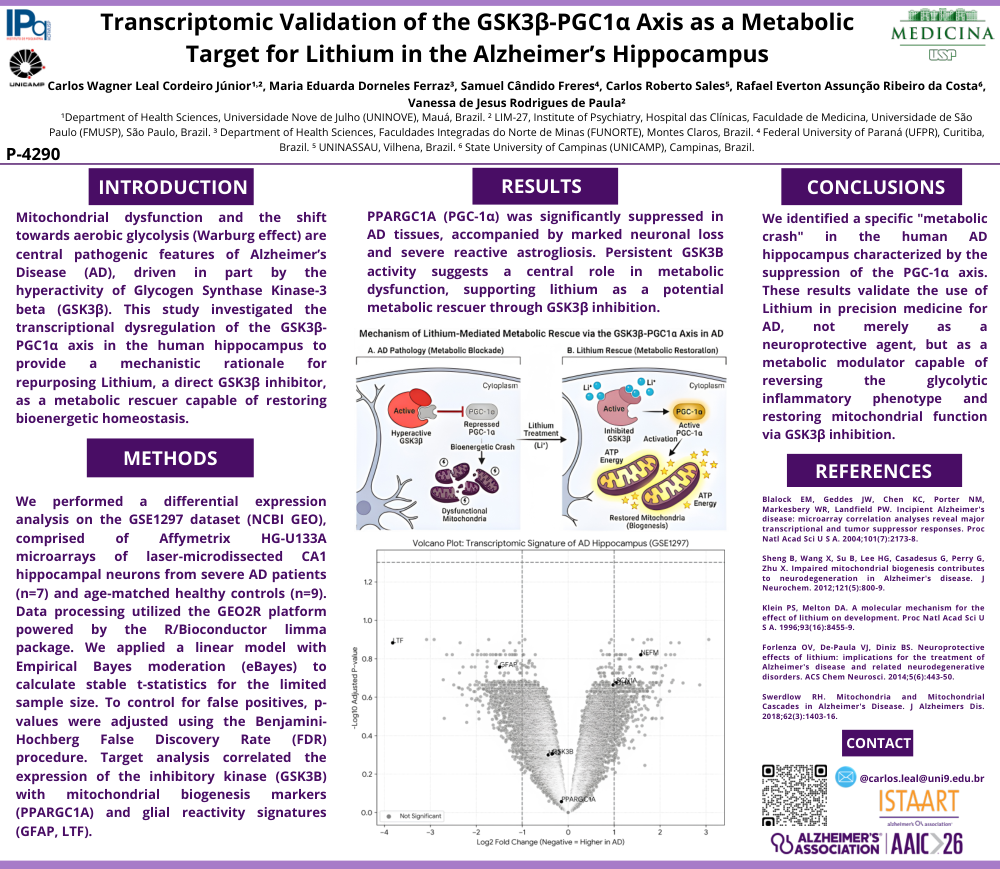
Background: Mitochondrial dysfunction and the pathological shift toward aerobic glycolysis (the Warburg effect) are core features of Alzheimer’s disease (AD). These metabolic abnormalities are driven, in part, by the hyperactivity of glycogen synthase kinase-3 beta (GSK3β), a kinase that suppresses the master regulator of mitochondrial biogenesis, PGC-1α (PPARGC1A). We investigated transcriptional dysregulation of the GSK3β-PGC-1α axis in the human hippocampus to establish a mechanistic rationale for repurposing lithium, a direct GSK3β inhibitor, as a metabolic rescue therapy in AD.
Methods: We performed differential gene-expression analysis of the publicly available GSE1297 dataset (NCBI GEO), consisting of Affymetrix HG-U133A microarrays from laser-microdissected CA1 hippocampal neurons of patients with severe AD (n=7) and age-matched cognitively normal controls (n=9). Data were processed using GEO2R with the R/Bioconductor limma package. Linear modeling with empirical Bayes moderation (eBayes) was used to generate stable statistics for this limited sample size. False discovery was controlled using the Benjamini-Hochberg FDR procedure. Targeted analyses examined the relationship between GSK3B and markers of mitochondrial biogenesis (PPARGC1A), neuronal integrity (NEFM, SCN1A), and glial reactivity (GFAP, LTF).
Results: AD hippocampal neurons exhibited marked transcriptional signatures of neurodegeneration and gliosis, including profound loss of neuronal structural and functional markers (NEFM; SCN1A, p<0.001) together with severe reactive astrogliosis and innate immune activation (GFAP; LTF). Within this pathological milieu, the master regulator of mitochondrial biogenesis PPARGC1A was suppressed (LogFC +0.36, indicating reduced expression in AD relative to controls), while GSK3B expression remained active. This transcriptional configuration identifies a metabolic bottleneck in which persistent GSK3β signaling constrains PGC-1α-dependent mitochondrial function.
Conclusion: Our transcriptomic analysis demonstrates that hippocampal neurons in Alzheimer’s disease are locked in a GSK3β-driven state of metabolic repression characterized by impaired PGC-1α signaling, neurodegeneration, and glial activation. These data provide direct human molecular evidence that lithium, through pharmacological inhibition of GSK3β, is mechanistically positioned to relieve repression of PPARGC1A and restore mitochondrial bioenergetic capacity. The GSK3β-PGC-1α axis therefore represents a rational and actionable metabolic target for disease-modifying intervention in Alzheimer’s disease.
Comments
Email is required but is not shown publicly.
Loading comments...