4,068 posters, 219 videos, 101 topics, 69 sessions, 14,365 authors, 6,128 institutions
ePostersLive by SciGen Technologies S.A. All rights reserved.
Alzheimer's Association International Conference 2026
July 12-15, 2026 | London, United Kingdom, and Online

6638
Association Of Vascular Biomarkers With Vascular Health And Cognition In Cognitively Unimpaired Veterans
Poster Presenter
Authors
Part of Topic
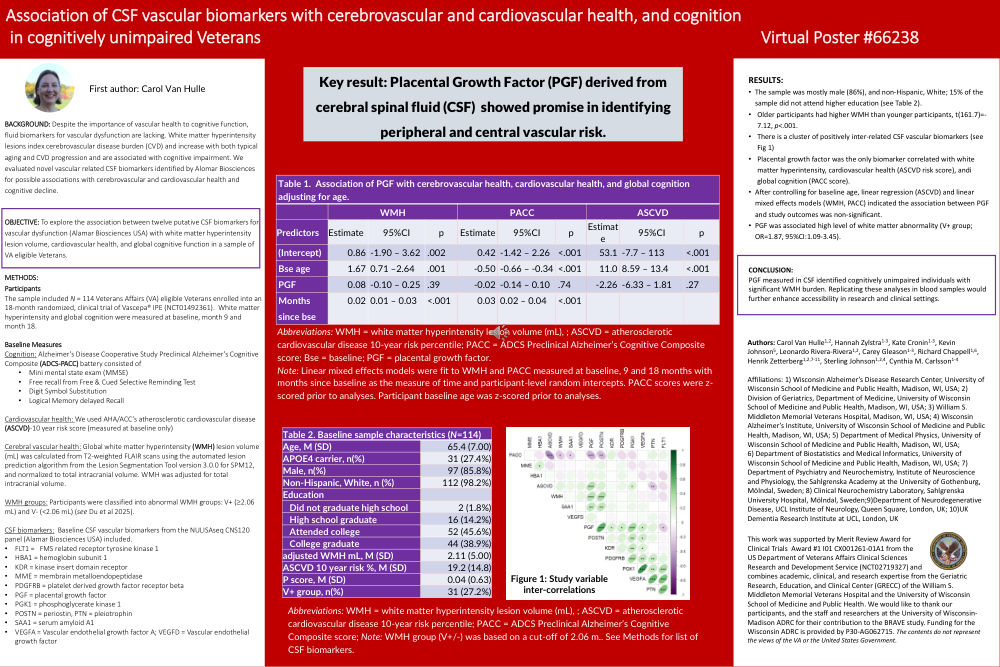
BACKGROUND: Despite the importance of vascular health to cognitive function, fluid biomarkers for vascular dysfunction are lacking. White matter hyperintensity lesions index cerebrovascular disease burden (CVD) and increase with both typical aging and CVD progression and are associated with cognitive impairment. We evaluated novel vascular related CSF biomarkers identified by Alomar Biosciences for possible associations with cerebrovascular and cardiovascular health and cognitive decline.
OBJECTIVE: To explore the association between twelve putative CSF biomarkers for vascular dysfunction (Alamar Biosciences USA) with white matter hyperintensity lesion volume, cardiovascular health, and global cognitive function in a sample of VA eligible Veterans.
METHODS:
Participants
The sample included N = 114 Veterans Affairs (VA) eligible Veterans enrolled into an 18-month randomized, clinical trial of Vascepa® IPE (NCT01492361). White matter hyperintensity and global cognition were measured at baseline, month 9 and month 18.
Baseline Measures
Cognition: Alzheimer’s Disease Cooperative Study Preclinical Alzheimer’s Cognitive Composite (ADCS-PACC) battery consisted of
Cardiovascular health:We used AHA/ACC’s atherosclerotic cardiovascular disease (ASCVD)-10 year risk score (measured at baseline only)
Cerebral vascular health: Global white matter hyperintensity (WMH) lesion volume (mL) was calculated from T2-weighted FLAIR scans using the automated lesion prediction algorithm from the Lesion Segmentation Tool version 3.0.0 for SPM12, and normalized to total intracranial volume. WMH was adjusted for total intracranial volume.
WMH groups: Participants were classified into abnormal WMH groups: V+ (³2.06 mL) and V- (<2.06 mL) (see Du et al 2025).
CSF biomarkers: Baseline CSF vascular biomarkers from the NULISAseq CNS120 panel (Alamar Biosciences USA) included.
RESULTS:
CONCLUSION:
PGF measured in CSF identified cognitively unimpaired individuals with significant WMH burden. Replicating these analyses in blood samples would further enhance accessibility in research and clinical settings.
Authors: Carol Van Hulle1,2, Hannah Zylstra1-3, Kate Cronin1-3, Kevin Johnson5, Leonardo Rivera-Rivera1,2, Carey Gleason1-3, Richard Chappell1,6, Henrik Zetterberg1,2,7-11, Sterling Johnson1,2,4, Cynthia M. Carlsson1-4
Affiliations: 1) Wisconsin Alzheimer’s Disease Research Center, University of Wisconsin School of Medicine and Public Health, Madison, WI, USA; 2) Division of Geriatrics, Department of Medicine, University of Wisconsin School of Medicine and Public Health, Madison, WI, USA; 3) William S. Middleton Memorial Veterans Hospital, Madison, WI, USA; 4) Wisconsin Alzheimer’s Institute, University of Wisconsin School of Medicine and Public Health, Madison, WI, USA; 5) Department of Medical Physics, University of Wisconsin School of Medicine and Public Health, Madison, WI, USA6) Department of Biostatistics and Medical Informatics, University of Wisconsin School of Medicine and Public Health, Madison, WI, USA; 7) Department of Psychiatry and Neurochemistry, Institute of Neuroscience and Physiology, the Sahlgrenska Academy at the University of Gothenburg, Mölndal, Sweden; 8) Clinical Neurochemistry Laboratory, Sahlgrenska University Hospital, Mölndal, Sweden;9)Department of Neurodegenerative Disease, UCL Institute of Neurology, Queen Square, London, UK; 10)UK Dementia Research Institute at UCL, London, UK
This work was supported by Merit Review Award for
Clinical Trials Award #1 I01 CX001261-01A1 from the
US Department of Veterans Affairs Clinical Sciences
Research and Development Service (NCT02719327) and
combines academic, clinical, and research expertise from the Geriatric Research, Education, and Clinical Center (GRECC) of the William S. Middleton Memorial Veterans Hospital and the University of Wisconsin School of Medicine and Public Health. We would like to thank our participants, and the staff and researchers at the University of Wisconsin-Madison ADRC for their contribution to the BRAVE study. Funding for the Wisconsin ADRC is provided by P30-AG062715. The contents do not represent the views of the VA or the United States Government.
Comments
Email is required but is not shown publicly.
Loading comments...