4,068 posters, 219 videos, 101 topics, 69 sessions, 14,365 authors, 6,128 institutions
ePostersLive by SciGen Technologies S.A. All rights reserved.
Alzheimer's Association International Conference 2026
July 12-15, 2026 | London, United Kingdom, and Online

2970
LANGaware: Non-invasive Speech-based Screening For Cognitive Impairment With Pet-confirmed Validation
Poster Presenter
Authors
Part of Topic
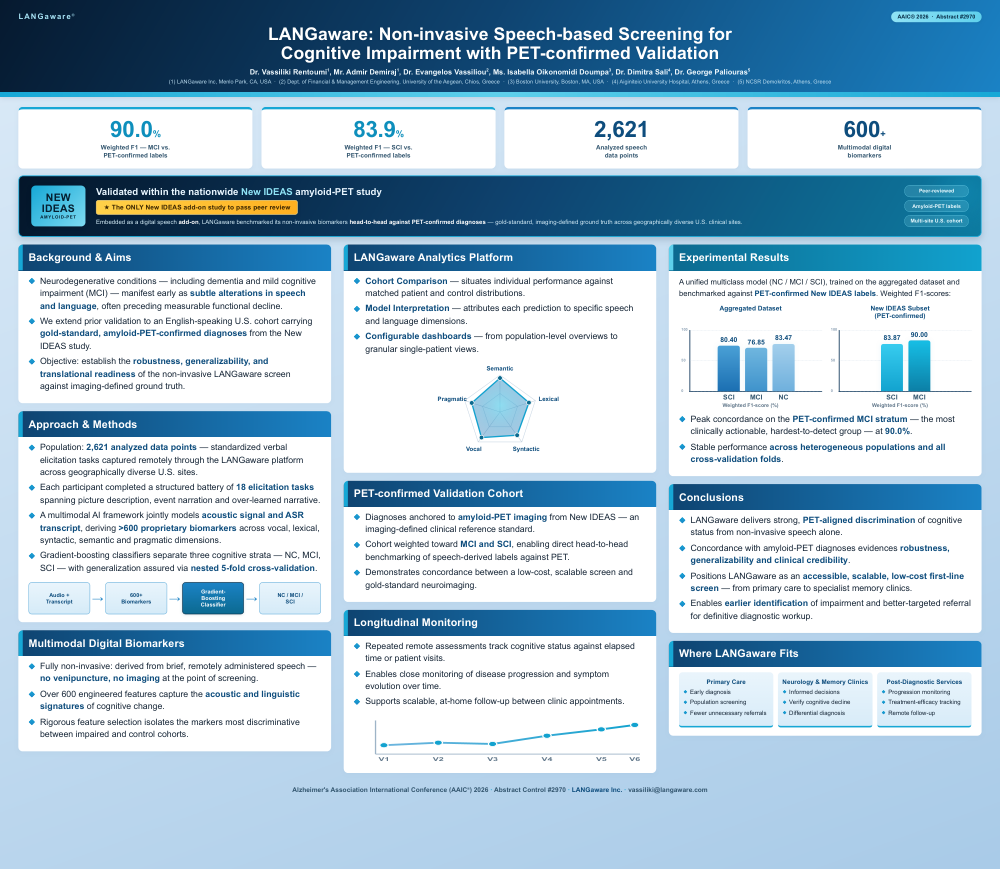
Background: Neurodegenerative diseases, including dementia and mild cognitive impairment (MCI), are characterized by progressive alterations in speech and language that may be detectable in preclinical and early symptomatic stages. This study advances prior investigations by validating the LANGaware framework in an English-speaking cohort with PET-confirmed diagnoses from the New IDEAS study, providing a stringent reference standard to evaluate model robustness, external validity, and translational applicability.
Methods: Participants recruited across multiple regions of the United States completed a standardized battery of 18 speech elicitation tasks administered through the LANGaware digital platform. A subset of 46 New IDEAS participants consented to a LANGaware add-on, contributing 569 recordings within a total of 2,621 analyzed tasks. A multimodal AI pipeline jointly processed acoustic signals and textual transcriptions, extracting over 600 proprietary biomarkers encompassing phonetic, lexical, syntactic, semantic, and pragmatic features. Gradient-boosted classifiers were trained to discriminate among normal cognition (NC), mild cognitive impairment (MCI), and severe cognitive impairment (SCI). Model performance was assessed using nested 5-fold cross-validation to minimize bias and enhance generalizability.
Results: The combined dataset supported development of a robust multiclass classification model. Across all cohorts, LANGaware achieved weighted F1-scores of 83.47% for NC, 76.85% for MCI, and 80.40% for SCI. When evaluated against PET-confirmed clinical labels within the New IDEAS subset, the model demonstrated F1-scores of 90.00% for MCI and 83.87% for SCI, indicating strong concordance with imaging-based diagnostic categories.
Conclusion: LANGaware exhibits high discriminative performance for cognitive status classification using non-invasive speech-derived biomarkers, with results consistent with PET-confirmed diagnoses. These findings support its potential utility as a scalable, low-burden screening modality suitable for deployment across a range of clinical contexts, facilitating early identification of cognitive impairment and timely referral for comprehensive diagnostic evaluation.
Comments
Email is required but is not shown publicly.
Loading comments...