4,068 posters, 219 videos, 101 topics, 69 sessions, 14,365 authors, 6,128 institutions
ePostersLive by SciGen Technologies S.A. All rights reserved.
Alzheimer's Association International Conference 2026
July 12-15, 2026 | London, United Kingdom, and Online

5555
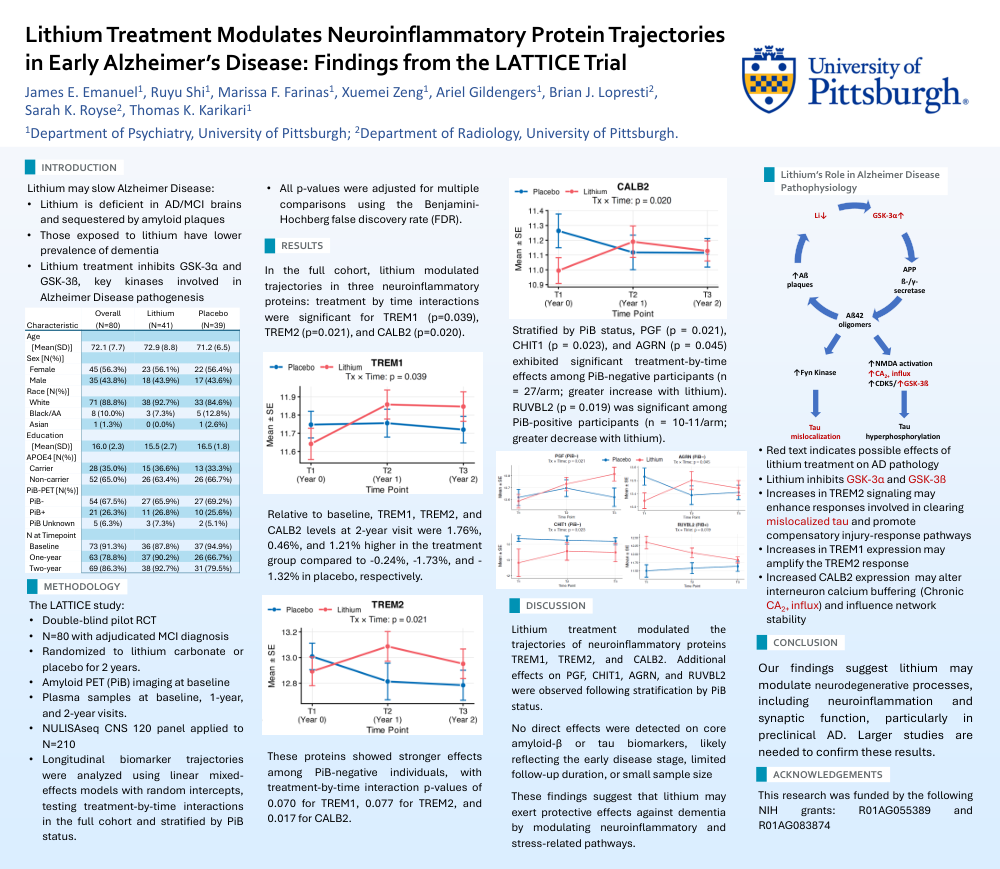
Lithium Treatment Modulates Neuroinflammatory Protein Trajectories In Early Alzheimer’s Disease: Findings From The Lattice Trial
Poster Presenter
Part of Topic
Title: Lithium Treatment Modulates Neuroinflammatory Protein Trajectories in Early Alzheimer’s Disease: Findings from the LATTICE Trial
James E. Emanuel, Ruyu Shi, Marissa F. Farinas, Xuemei Zeng, Ariel Gildengers, Brian J. Lopresti, Sarah K. Royse, Thomas K. Karikari
Background:
Lithium is known to inhibit GSK3β, a key kinase involved in tau phosphorylation. Brain lithium levels are reduced in individuals with mild cognitive impairment (MCI) and Alzheimer disease (AD), and lithium exposure has been associated with lower dementia rates, suggesting a potential protective effect against AD. Several clinical trials have found cognitive benefit of lithium treatment. However, its effects on AD-related blood-based biomarkers have not been established.
Methods:
The LATTICE study, a double-blind randomized clinical trial, randomized 83 MCI participants to lithium carbonate or placebo, with 80 participants (median age 71.5 years, 56% female, 88.9% non-Hispanic White) starting treatment, for up to 2 years. Amyloid PET (PiB) imaging was obtained at baseline; plasma samples were collected at baseline, 1-year, and 2-year visits. NULISAseq CNS 120 panel was applied to 210 plasma samples. Longitudinal biomarker trajectories were analyzed using linear mixed-effects models with random intercepts, testing treatment-by-time interactions in the full cohort and stratified by PiB status. All p-values were adjusted for multiple comparisons using the Benjamini-Hochberg false discovery rate (FDR).
Results:
In the full cohort, lithium significantly modulated trajectories in three neuroinflammatory proteins: TREM1 (p=0.039), TREM2 (p=0.021), and CALB2 (p=0.020). At 1-year, TREM1, TREM2, and CALB2 levels were 1.86%, 1.51%, and 1.78% higher in the treatment group compared to 0.07%, -1.50%, and -1.29% in placebo; at 2-year visit, these increases were 1.76%, 0.46%, and 1.21% versus -0.24%, -1.73%, and -1.32% in placebo, respectively. All three proteins showed stronger effects among PiB-negative individuals, with treatment-by-time interaction p-values of 0.017 for CALB2, 0.070 for TREM1, and 0.077 for TREM2. When stratified by PiB status, PGF (p = 0.021), CHIT1 (p = 0.023), and ARGN (p = 0.045) exhibited significant treatment-by-time effects among PiB-negative participants (n = 27 per arm), while RUVBL2 (p = 0.019) was significant among PiB-positive participants (n = 10-11 per arm). Lithium treatment was associated with greater increases in PGF, CHIT1, and ARGN, and a greater decrease in RUVBL2.
Conclusions:
Our findings suggest lithium may modulate neurodegenerative processes, including neuroinflammation and synaptic function, particularly in preclinical AD. Larger studies are needed to confirm these results.
Comments
Email is required but is not shown publicly.
Loading comments...