4,068 posters, 219 videos, 101 topics, 69 sessions, 14,365 authors, 6,128 institutions
ePostersLive by SciGen Technologies S.A. All rights reserved.
Alzheimer's Association International Conference 2026
July 12-15, 2026 | London, United Kingdom, and Online

10245
Older African American Apoe4 Carriers Found To Have Higher Plasma P-tau217 And Greater Risk For Amyloid-positive Status
Poster Presenter
Authors
Part of Topic
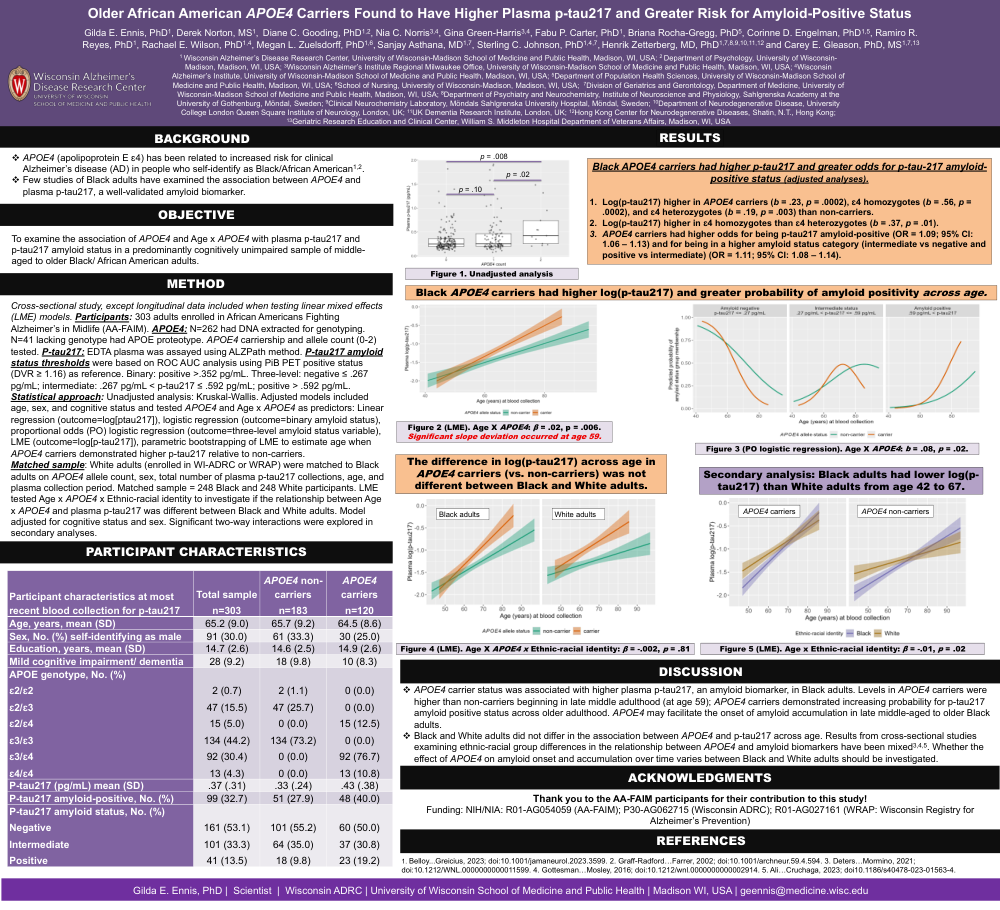
Background: APOE4 (apolipoprotein E ɛ4) has been related to increased risk for clinical Alzheimer’s disease (AD) in people who self-identify as Black/African American. Few studies of Black adults have examined the association between APOE4 and plasma p-tau217, a well-validated amyloid biomarker.
Objective: To examine the association of APOE4 and Age x APOE4 with plasma p-tau217 and p-tau217 amyloid status in a predominantly cognitively unimpaired sample of middle-aged to older Black/ African American adults.
Method: Cross-sectional study, except longitudinal data included when testing linear mixed effects (LME) models. Participants: 303 adults enrolled in African Americans Fighting Alzheimer’s in Midlife (AA-FAIM). APOE4: N=262 had DNA extracted for genotyping. N=41 lacking genotype had APOE proteotype. APOE4 carriership and allele count (0-2) tested. P-tau217: EDTA plasma was assayed using ALZPath method. P-tau217 amyloid status thresholds were based on ROC AUC analysis using PiB PET positive status (DVR ≥ 1.16) as reference. Binary: positive >.352 pg/mL. Three-level: negative ≤ .267 pg/mL; intermediate: .267 pg/mL < p-tau217 ≤ .592 pg/mL; positive > .592 pg/mL. Statistical approach: Unadjusted analysis: Kruskal-Wallis. Adjusted models included age, sex, and cognitive status and tested APOE4 and Age x APOE4 as predictors: Linear regression (outcome=log[ptau217]), logistic regression (outcome=binary amyloid status), proportional odds (PO) logistic regression (outcome=three-level amyloid status variable), LME (outcome=log[p-tau217]), parametric bootstrapping of LME to estimate age when APOE4 carriers demonstrated higher p-tau217 relative to non-carriers. Matched sample: White adults (enrolled in WI-ADRC or WRAP) were matched to Black adults on APOE4 allele count, sex, total number of plasma p-tau217 collections, age, and plasma collection period. Matched sample = 248 Black and 248 White participants. LME tested Age x APOE4 x Ethnic-racial identity to investigate if the relationship between Age x APOE4 and plasma p-tau217 was different between Black and White adults. Model adjusted for cognitive status and sex. Significant two-way interactions were explored in secondary analyses.
Result summary: Black APOE4 carriers had higher p-tau217 and greater odds for p-tau-217 amyloid- positive status (adjusted analyses). Black APOE4 carriers had higher log(p-tau217) and greater probability of amyloid positivity across age. The difference in log(p-tau217) across age in APOE4 carriers (vs. non-carriers) was not different between Black and White adults. In secondary analysis, Black adults had lower log(p-tau217) than White adults from age 42 to 67.
Discussion: APOE4 carrier status was associated with higher plasma p-tau217, an amyloid biomarker, in Black adults. Levels in APOE4 carriers were higher than non-carriers beginning in late middle adulthood (at age 59); APOE4 carriers demonstrated increasing probability for p-tau217 amyloid positive status across older adulthood. APOE4 may facilitate the onset of amyloid accumulation in late middle-aged to older Black adults. Black and White adults did not differ in the association between APOE4 and p-tau217 across age. Results from cross-sectional studies examining ethnic-racial group differences in the relationship between APOE4 and amyloid biomarkers have been mixed. Whether the effect of APOE4 on amyloid onset and accumulation over time varies between Black and White adults should be investigated.
Comments
Email is required but is not shown publicly.
Loading comments...