4,068 posters, 219 videos, 101 topics, 69 sessions, 14,365 authors, 6,128 institutions
ePostersLive by SciGen Technologies S.A. All rights reserved.
Alzheimer's Association International Conference 2026
July 12-15, 2026 | London, United Kingdom, and Online

10999
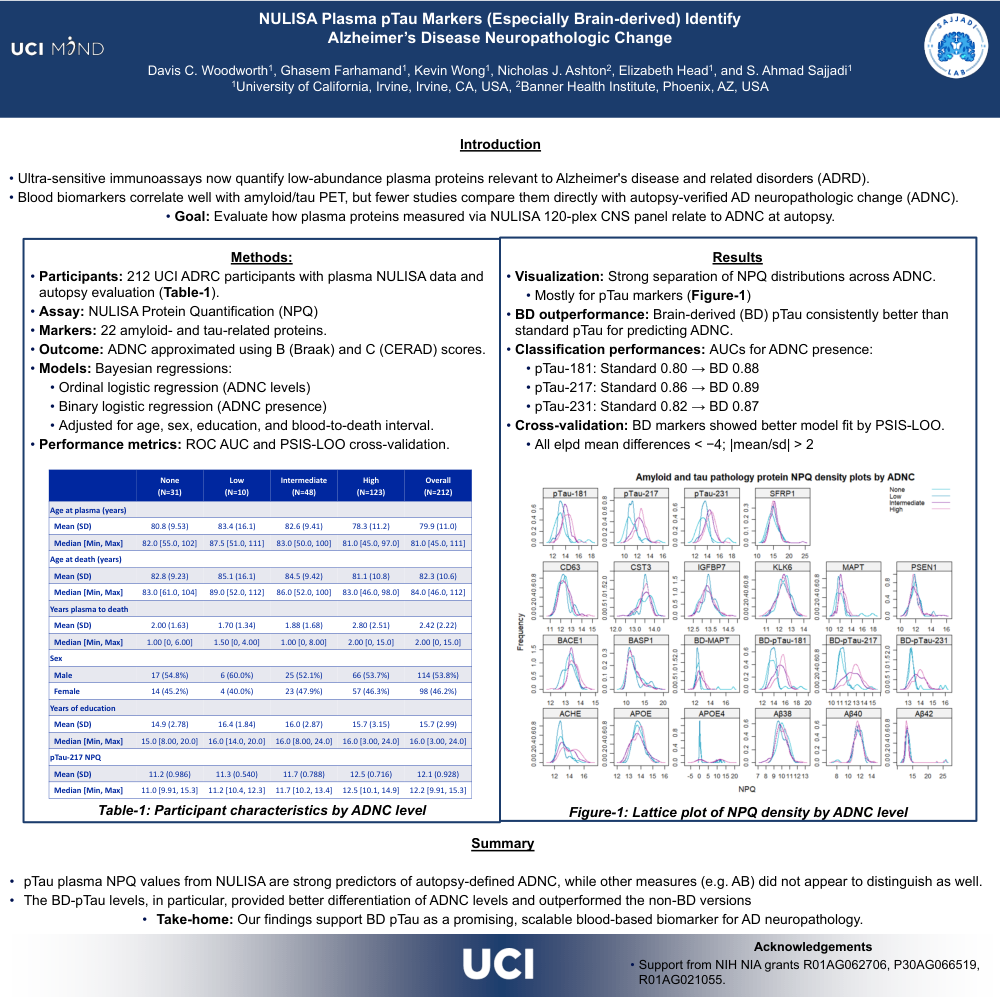
NULISA Plasma Ptau Markers (especially Brain-derived) Identify Alzheimer’S Disease Neuropathologic Change
Part of Topic
Background:
Novel immunoassays now enable quantification of low‑abundance proteins in fluids, including proteins relevant to Alzheimer’s disease (AD). While several blood‑based biomarkers have been shown to correlate strongly with amyloid and tau PET, fewer studies have evaluated their performance against the gold‑standard of neuropathology. We investigated associations between plasma protein levels measured using a multiplex NULISA platform and Alzheimer’s disease neuropathologic change (ADNC) at autopsy.
Methods:
Plasma samples from participants enrolled in the UCI Alzheimer’s Disease Research Center (ADRC) were profiled using the Nucleic Acid Linked Immuno‑Sandwich Assay (NULISA) 120‑plex CNS Disease Panel. Relative protein abundance was summarized as NULISA Protein Quantification (NPQ; log2 scale). We focused on amyloid and tau pathology proteins (N=22 markers) from plasma in relation to Alzheimer’s disease neuropathologic change (ADNC) from autopsy, which we approximated using B scores and C scores due to the historic nature of some of the samples. We fit models predicting ADNC level or presence (intermediate/high) using plasma markers and basic demographic variables. We used Bayesian ordinal (for levels) or binary (for presence) logistic regressions, with weakly-informative priors, adjusting for age at blood collection, sex, education, and interval from blood collection to death. Predictive performance was evaluated via ROC analyses and robust Bayesian Pareto‑smoothed importance sampling leave‑one‑out cross‑validation (PSIS‑LOO).
Results:
We used data from N=212 participants with NULISA data that passed QC and were assessed for neuropathological changes at autopsy, excluding certain participants with frontotemporal lobar degeneration neuropathologies (Table-1). Figure-1 shows density plots of NPQ values for the selected amyloid and tau related proteins by ADNC level, showing especially promising separation of pTau measures across ADNC levels. Brain-derived (BD) versions outperformed standard pTau protein levels for predicting ADNC presence and level for each of the epitopes by AUCs (pTau-181: standard=0.80, BD=0.88; pTau-217: standard=0.86, BD=0.89; pTau-231: standard=0.82, BD=0.87) for ADNC presence and by PSIS-LOO for both ADNC presence and levels (all elpd differences in means<-4 and |mean/sd|s>2).
Discussion:
NPQ values from NULISA, specifically pTau and especially brain-derived pTau, performed well in predicting ADNC levels from autopsy.
Comments
Email is required but is not shown publicly.
Loading comments...