4,068 posters, 219 videos, 101 topics, 69 sessions, 14,365 authors, 6,128 institutions
ePostersLive by SciGen Technologies S.A. All rights reserved.
Alzheimer's Association International Conference 2026
July 12-15, 2026 | London, United Kingdom, and Online

3567
Autonomic Dysfunction Due To Mitochondrial And Neuro-immune Pathway Suppression In Alzheimer’S Disease
Poster Presenter
Part of Topic
Title: Autonomic Dysfunction due to Mitochondrial and Neuro-Immune Pathway Suppression in Alzheimer’s Disease
Background:
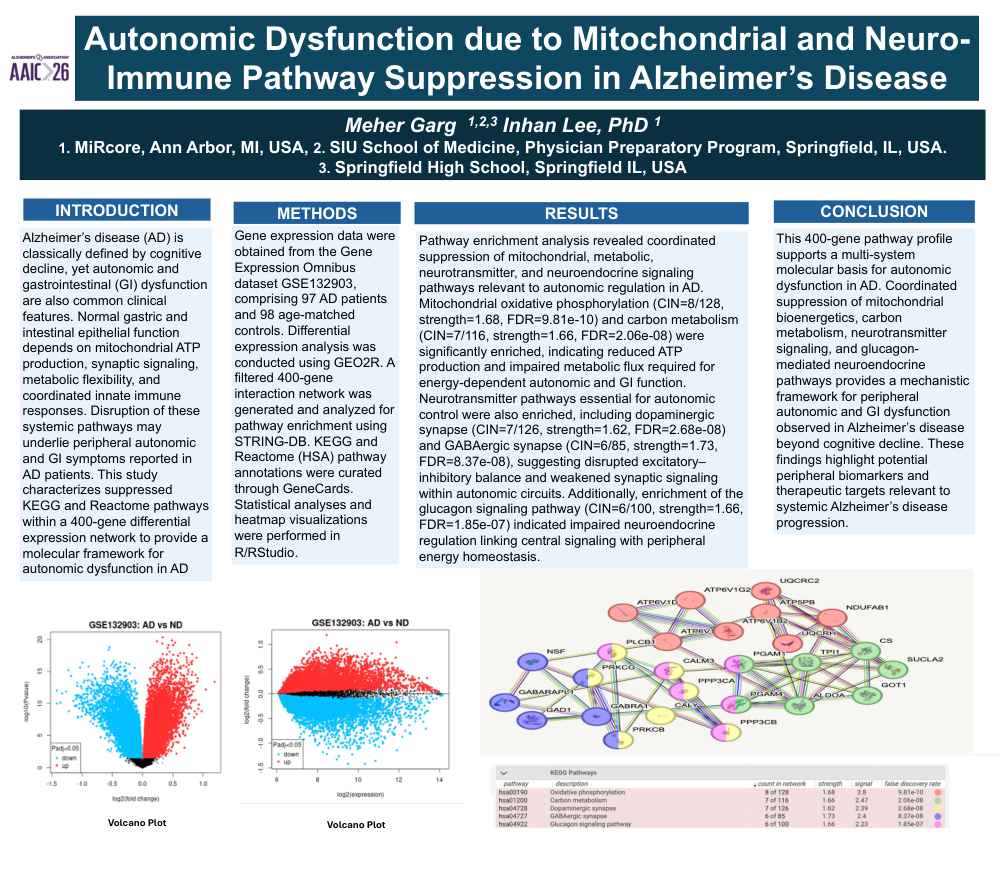
Alzheimer’s disease (AD) is classically defined by cognitive decline, yet autonomic and gastrointestinal (GI) dysfunction are also common clinical features. Normal gastric and intestinal epithelial function depends on mitochondrial ATP production, synaptic signaling, metabolic flexibility, and coordinated innate immune responses. Disruption of these systemic pathways may underlie peripheral autonomic and GI symptoms reported in AD patients. This study characterizes suppressed KEGG and Reactome pathways within a 400-gene differential expression network to provide a molecular framework for autonomic dysfunction in AD.
Methods:
Gene expression data were obtained from the Gene Expression Omnibus dataset GSE132903, comprising 97 AD patients and 98 age-matched controls. Differential expression analysis was conducted using GEO2R. A filtered 400-gene interaction network was generated and analyzed for pathway enrichment using STRING-DB. KEGG and Reactome (HSA) pathway annotations were curated through GeneCards. Statistical analyses and heatmap visualizations were performed in R/RStudio.
Results:
Pathway enrichment analysis revealed coordinated suppression of mitochondrial, metabolic, neurotransmitter, and neuroendocrine signaling pathways relevant to autonomic regulation in AD. Mitochondrial oxidative phosphorylation (CIN=8/128, strength=1.68, FDR=9.81e-10) and carbon metabolism (CIN=7/116, strength=1.66, FDR=2.06e-08) were significantly enriched, indicating reduced ATP production and impaired metabolic flux required for energy-dependent autonomic and GI function. Neurotransmitter pathways essential for autonomic control were also enriched, including dopaminergic synapse (CIN=7/126, strength=1.62, FDR=2.68e-08) and GABAergic synapse (CIN=6/85, strength=1.73, FDR=8.37e-08), suggesting disrupted excitatory–inhibitory balance and weakened synaptic signaling within autonomic circuits. Additionally, enrichment of the glucagon signaling pathway (CIN=6/100, strength=1.66, FDR=1.85e-07) indicated impaired neuroendocrine regulation linking central signaling with peripheral energy homeostasis.
Conclusion:
This 400-gene pathway profile supports a multi-system molecular basis for autonomic dysfunction in AD. Coordinated suppression of mitochondrial bioenergetics, carbon metabolism, neurotransmitter signaling, and glucagon-mediated neuroendocrine pathways provides a mechanistic framework for peripheral autonomic and GI dysfunction observed in Alzheimer’s disease beyond cognitive decline. These findings highlight potential peripheral biomarkers and therapeutic targets relevant to systemic Alzheimer’s disease progression.
Comments
Email is required but is not shown publicly.
Loading comments...