4,068 posters, 219 videos, 101 topics, 69 sessions, 14,365 authors, 6,128 institutions
ePostersLive by SciGen Technologies S.A. All rights reserved.
Alzheimer's Association International Conference 2026
July 12-15, 2026 | London, United Kingdom, and Online

5236
Plasma-derived Proteomic Risk Score In Alzheimer’s Disease: Diagnostic, Cognitive, And Biomarker Associations In ADNI1
Poster Presenter
Authors
Part of Topic
Background:
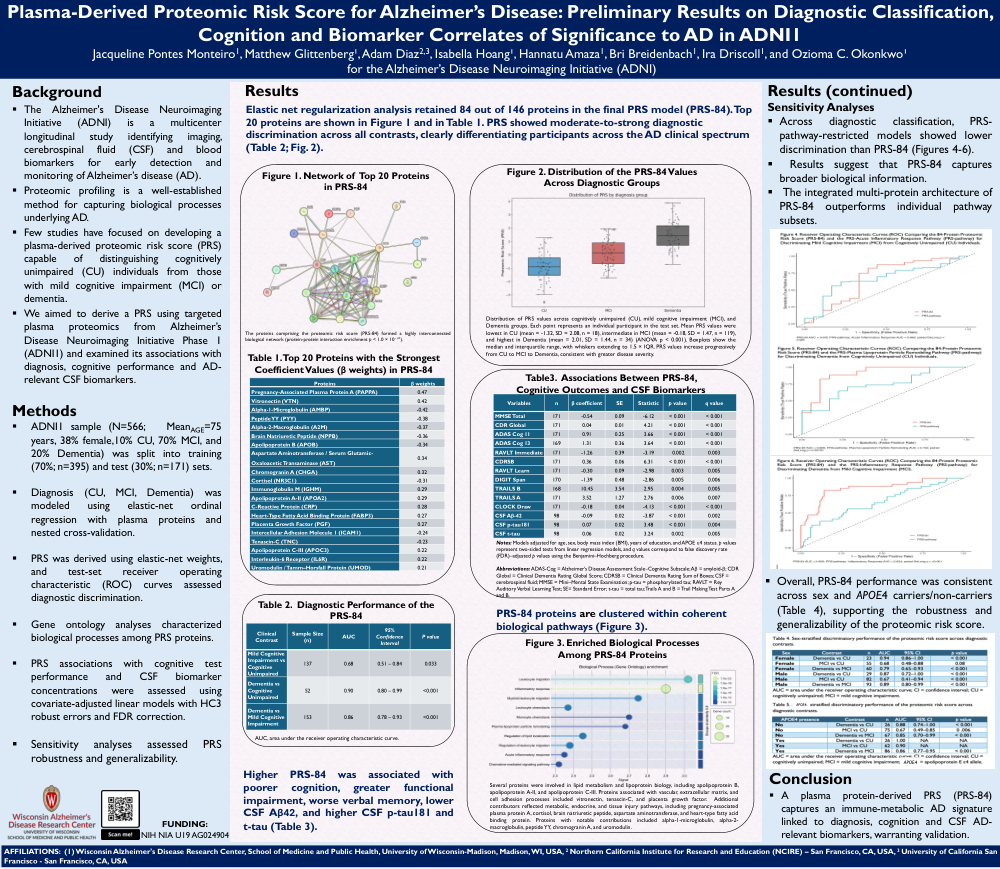
Proteomic profiling is a well-established method for capturing biological processes underlying Alzheimer’s disease (AD), yet only a few studies have focused on developing a plasma-derived proteomic risk score (PRS) capable of distinguishing cognitively unimpaired (CU) individuals from those with mild cognitive impairment (MCI) or Dementia. We derived a PRS using targeted plasma proteomics from Alzheimer’s Disease Neuroimaging Initiative Phase 1 (ADNI1) and examined its associations with diagnosis, cognition and AD-relevant CSF biomarkers.
Methods:
ADNI1 participants (N=566; MeanAGE=75 years, 38% female; 10% CU, 70% MCI, and 20% Dementia) with available data of interest were split into training (70%; n=395) and test (30%; n=171) sets using stratified randomization based on diagnosis. Consensus diagnostic category (CU vs MCI vs Dementia) was modeled as an ordered outcome using elastic-net ordinal regression with plasma proteins as predictors and nested cross-validation. Yeo-Johnson transformation, imputation and scaling was applied to 146 plasma proteins for preprocessing. A continuous PRS was computed using elastic-net-derived protein weights. Test-set ROC curves evaluated discrimination between diagnostic groups. GO analyses characterized biological processes among PRS proteins. Associations of PRS with cognitive and CSF biomarker outcomes were assessed using linear models adjusted for age, sex, BMI, education and APOE ε4 allele carriage, with HC3 robust errors and false discovery rate correction. Analyses were repeated after controlling for diagnostic group.
Results:
The PRS, based on 84/146 proteins, moderately discriminated MCI from CU (AUC=0.68) while robustly discriminating Dementia from both CU (AUC=0.90) and MCI (AUC=0.86) (all ps<0.05). GO analyses showed enrichment (FDR q≈10⁻²²) of immune/inflammatory pathways, cytokine signaling, leukocyte migration and lipid metabolism, indicating an immune-metabolic AD signature. Higher PRS was associated with greater functional impairment (β=0.36, p<0.001) and worse global cognition (β=−0.54, p<0.001), episodic memory (β=−1.26, p=0.002) and executive function (β=10.5, p=0.004). Higher PRS was also associated with lower CSF amyloid-β42 (Aβ42; β=−0.09, p<0.001), higher phosphorylated tau181 (p-tau181: β=0.07, p<0.001), and higher total tau (t-tau; β=0.06, p=0.002). These associations were no longer significant after adjustment for diagnostic group.
Conclusion:
A plasma protein-derived PRS captures an immune-metabolic AD signature linked to diagnosis, cognition and CSF AD-relevant biomarkers, warranting validation longitudinally and in a diverse population.
Comments
Email is required but is not shown publicly.
Loading comments...