4,068 posters, 219 videos, 101 topics, 69 sessions, 14,365 authors, 6,128 institutions
ePostersLive by SciGen Technologies S.A. All rights reserved.
Alzheimer's Association International Conference 2026
July 12-15, 2026 | London, United Kingdom, and Online

6607
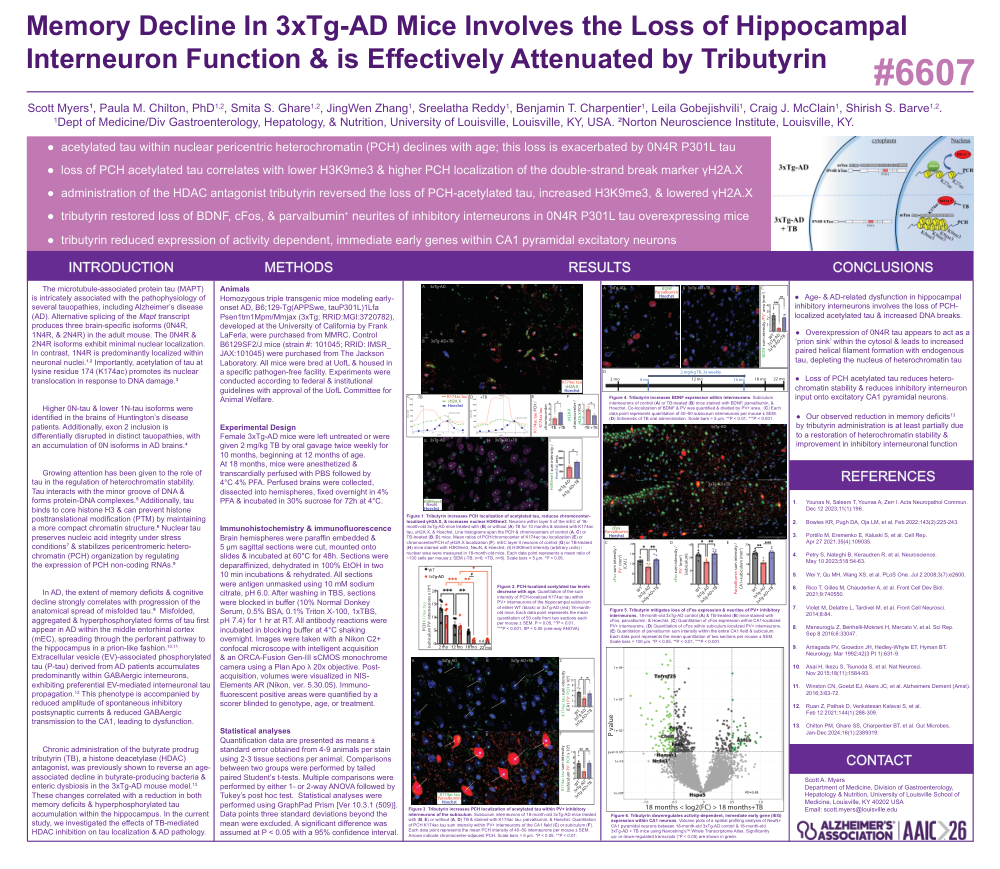
Memory Decline In 3xTg-AD Mice Involves The Loss Of Hippocampal Interneuron Function And Is Effectively Attenuated By Tributyrin
Poster Presenter
Part of Topic
The microtubule-associated protein tau (MAPT)
is intricately associated with the pathophysiology of
several tauopathies, including Alzheimer’s disease
(AD). Alternative splicing of the Mapt transcript
produces three brain-specific isoforms (0N4R,
1N4R, & 2N4R) in the adult mouse. The 0N4R &
2N4R isoforms exhibit minimal nuclear localization.
In contrast, 1N4R is predominantly localized within
neuronal nuclei.¹,² Importantly, acetylation of tau at
lysine residue 174 (K174ac) promotes its nuclear
translocation in response to DNA damage.³
Higher 0N-tau & lower 1N-tau isoforms were
identified in the brains of Huntington’s disease
patients. Additionally, exon 2 inclusion is
differentially disrupted in distinct tauopathies, with
an accumulation of 0N isoforms in AD brains.⁴
Growing attention has been given to the role of
tau in the regulation of heterochromatin stability.
Tau interacts with the minor groove of DNA &
forms protein-DNA complexes.⁵ Additionally, tau
binds to core histone H3 & can prevent histone
posttranslational modification (PTM) by maintaining
a more compact chromatin structure.⁶ Nuclear tau
preserves nucleic acid integrity under stress
conditions⁷ & stabilizes pericentromeric hetero-
chromatin (PCH) organization by regulating
the expression of PCH non-coding RNAs.⁸
Comments
Email is required but is not shown publicly.
Loading comments...