4,068 posters, 219 videos, 101 topics, 69 sessions, 14,365 authors, 6,128 institutions
ePostersLive by SciGen Technologies S.A. All rights reserved.
Alzheimer's Association International Conference 2026
July 12-15, 2026 | London, United Kingdom, and Online

10398
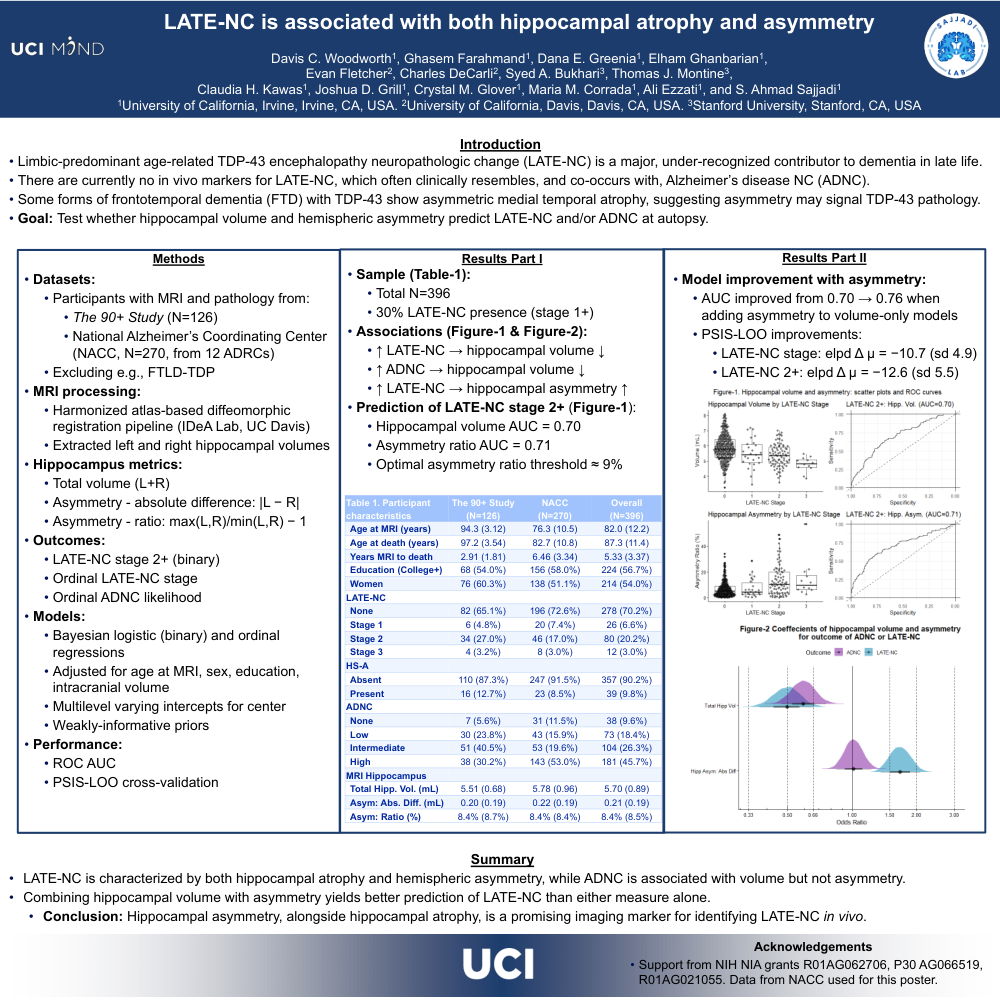
LATE-NC Is Associated With Both Hippocampal Atrophy And Asymmetry
Poster Presenter
Authors
Davis Woodworth, Ghasem Farahmand, Dana Greenia, Elham Ghanbarian, Evan Fletcher, Charles DeCarli, Syed Bukhari, Thomas Montine, Claudia Kawas, Joshua Grill, Crystal Glover, Maria Corrada, Ali Ezzati, S. Ahmad Sajjai
Affiliations
University of California, Irvine, Irvine, CA, USA, University of California, Davis, Davis, CA, USA, Stanford University, Stanford, CA
Part of Topic
Background:
Limbic-predominant age-related TDP-43 encephalopathy neuropathologic change (LATE-NC) is a major contributor to cognitive decline in later life but it is currently not possible to identify LATE-NC in vivo. Given the observation that some forms of frontotemporal dementia with TDP-43 present with asymmetrical medial temporal atrophy, we examined different parametrizations of hippocampal volumes across both hemispheres in relation to LATE-NC or Alzheimer’s disease NC (ADNC).
Methods:
We included data from participants with in vivo MRI and autopsy data from The 90+ Study and the National Alzheimer’s Coordinating Center (NACC) excluding certain rarer NCs/diagnoses. Hippocampal volumes in both datasets were calculated using the same atlas-based diffeomorphic registration pipeline (IDeA lab, UC Davis) and neuropathologies were determined at autopsy using standard approaches. We examined total hippocampal volume (left+right), and hippocampal asymmetry in two ways: absolute difference (|left-right|, better for modelling alongside hippocampal volume) and asymmetry ratio (max[left,right]/min[left,right]-1, easier to interpret). We fit logistic regressions for the outcome of LATE-NC stage 2+ and ordinal regressions for the outcomes of LATE-NC stage and ADNC likelihood, hippocampal volume and asymmetry as predictors of interest, adjusting for age at MRI, sex, education, and intracranial volume. We used Bayesian multilevel models with varying intercepts for center and weakly-informative priors. Predictive performance was evaluated via ROC and robust Bayesian leave-one-out approximation (PSIS-LOO).
Results:
We used data from N=396 participants (126 from The 90+ Study, 270 from 12 centers in NACC), 30% with LATE-NC at autopsy (Table-1). Increasing LATE-NC was associated with both lower hippocampal volume and greater hippocampal asymmetry (Figure-1). Hippocampal volume (AUC=0.70) and asymmetry ratio (AUC=0.71) similarly predicted LATE-NC stage 2+; optimal asymmetry ratio was 9% (Youden). Both hippocampal volume and asymmetry (absolute difference) were strongly associated with LATE-NC, while only hippocampal volume was associated with ADNC (Figure-2). Adding hippocampal asymmetry to models with hippocampal volume and other predictors improved AUC for LATE-NC stage 2+ (0.70 to 0.76) and model fit for the outcomes of LATE-NC stage (PSIS-LOO, elpd difference mean=-10.7, sd=4.9) and LATE-NC stage 2+ (elpd difference mean=-12.6, sd=5.5).
Conclusion:
In this multicenter analysis, LATE-NC was associated with both hippocampal atrophy and asymmetry and using both measures improved prediction of LATE-NC.
Comments
Email is required but is not shown publicly.
Loading comments...