4,068 posters, 219 videos, 101 topics, 69 sessions, 14,365 authors, 6,128 institutions
ePostersLive by SciGen Technologies S.A. All rights reserved.
Alzheimer's Association International Conference 2026
July 12-15, 2026 | London, United Kingdom, and Online

9203
Proteomic Mapping Of The Amyloid-β Interactome In Down Syndrome Offers Insights Into Alzheimer’s Disease Pathways
Poster Presenter
Authors
Affiliations
Part of Topic
Proteomic Mapping Of The Amyloid‑β Interactome In Down Syndrome Offers Insights Into Alzheimer’s Disease Pathways
Mitchell Marta-Ariza1, Lauren C Tang1, Manon Thierry2, Dominique Leitner, PhD3, Beatrix Ueberheide4, Thomas Wisniewski1.
1Neurology, NYU Grossman School of Medicine, New York, NY, USA, 2Institut du Cerveau (Paris Brain Institute), Sorbonne Université/APHP, Paris, France, 3Neurology, NYU Langone, New York, NY, USA, 4Biochemistry and Molecular Pharmacology, NYU Grossman School of Medicine, New York, NY, USA.
Abstract:
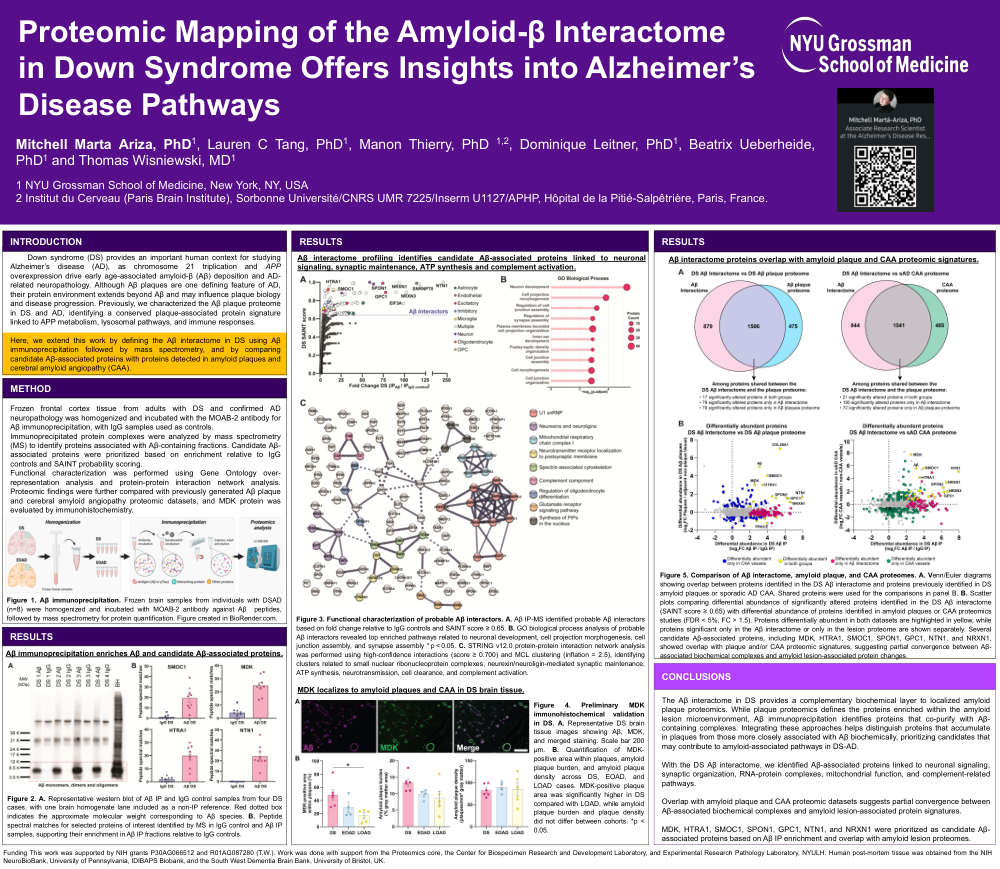
Background: Down syndrome (DS) provides an important context for studying Alzheimer’s disease (AD). Chromosome 21 triplication drives APP overexpression and early amyloid‑β (Aβ) buildup, leading to an early age-associated AD‑related Aβ and tau pathology. Our previous work characterized the protein composition of Aβ plaques in DS, establishing a foundation for understanding their molecular environment. Here, we extend this work by defining the Aβ interactome in DS to explore the proteins that directly associate with Aβ.
Methods: The Aβ interactome was examined in frozen frontal cortex tissue samples from adults with DS and confirmed AD pathology (n=8; 56.7 ± 3.56 years). Aβ‑associated proteins were isolated by immunoprecipitation using an anti‑Aβ MOAB-2 antibody and identified by mass spectrometry. Proteomic results were analyzed through Gene Ontology (GO) over‑representation and protein network analyses, complemented with neuropathological assessment by immunohistochemistry.
Results: We identified 2430 proteins, including 1679 proteins enriched in Aβ samples compared with IgG controls (FC ≥ 1.50). A group of 134 proteins met the criteria for probable Aβ interactors (SAINT score ≥ 0.65), including 15 proteins previously detected in Aβ plaques and 16 in CAA proteomics. Enriched Gene Ontology (GO) biological processes included neuron development (p = 5.13×10⁻⁶), cell projection morphogenesis (p = 0.00014), regulation of cell junction assembly (p = 0.00064), and regulation of synapse assembly (p = 0.0012). Top cellular component terms included U1 snRNP, neuron projection, and synaptic membrane (p = 5.17×10⁻⁵). Protein interaction network analysis revealed clusters related to RNA-protein complexes, synaptic adhesion molecules, mitochondrial metabolism, and the complement system (PPI p<1.0x10⁻¹⁶).
Conclusion: Our findings define the Aβ interactome in DS and show overlap with the protein signatures previously identified in Aβ plaques and CAA, linking direct Aβ interactors to known features of amyloid pathology. These results highlight molecular pathways that may influence Aβ behavior in DS and offer candidates for understanding AD‑related vulnerability in this population.
Comments
Email is required but is not shown publicly.
Loading comments...