4,068 posters, 219 videos, 101 topics, 69 sessions, 14,365 authors, 6,128 institutions
ePostersLive by SciGen Technologies S.A. All rights reserved.
Alzheimer's Association International Conference 2026
July 12-15, 2026 | London, United Kingdom, and Online

5916
Plasma APOE4 Proteotyping Enables Accurate Carrier Classification And Reveals Molecular Links To Alzheimer’s Risk
Poster Presenter
Authors
Lamia Choity, Ruyu Shi, Marissa Farinas, Xuemei Zeng, James Emanuel, Anum Saeed, Steven Reis, Oscar Lopez, Ann Cohen, Ariel Gildengers, Kristine Wilckens, Thomas Karikari
Affiliations
University of Pittsburgh, University of Pittsburgh School of Medicine, University of Pittsburgh School of Medicine, University of Pittsburgh
Part of Topic
Plasma APOE4 Proteotyping Enables Accurate Carrier Classification And Reveals Molecular Links To Alzheimer’s Risk:
Lamia T. Choity1, Ruyu Shi1, Marissa F. Farinas1, Xuemei Zeng1, James E. Emanuel, B.S.1, Anum Saeed1,2, Steven E. Reis, Prof1,2, Oscar L. Lopez1,2, Ann D. Cohen2, Ariel G. Gildengers1,2, Kristine A. Wilckens1,2, Thomas K. Karikari1,2.
1University of Pittsburgh School of Medicine, Pittsburgh, PA, USA, 2University of Pittsburgh, Pittsburgh, PA, USA.
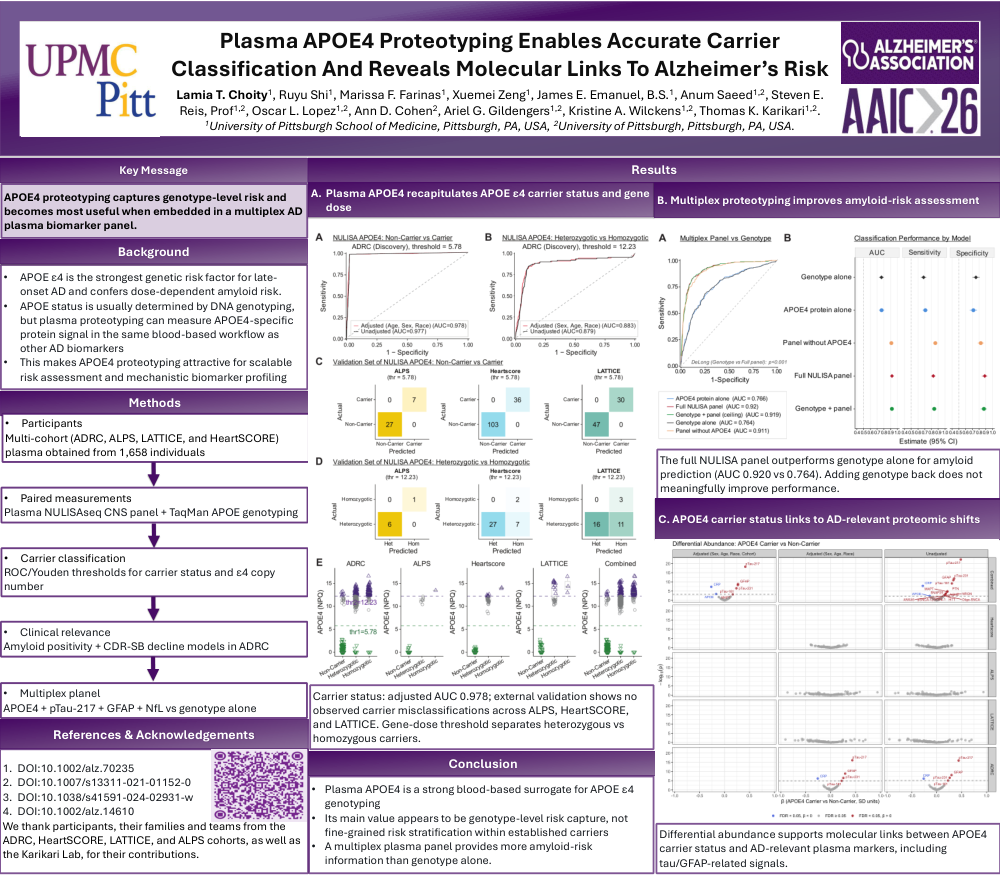
Key Message: APOE4 proteotyping captures genotype-level risk and becomes most useful when embedded in a multiplex AD plasma biomarker panel.
Background:
Methods:
Multi-cohort (ADRC, ALPS, LATTICE, and HeartSCORE) plasma obtained from 1,658 individuals
Plasma NULISAseq CNS panel + TaqMan APOE genotyping
ROC/Youden thresholds for carrier status and ε4 copy number
Amyloid positivity + CDR-SB decline models in ADRC
APOE4 + pTau-217 + GFAP + NfL vs genotype alone
Results:
Carrier status: adjusted AUC 0.978; external validation shows no observed carrier misclassifications across ALPS, HeartSCORE, and LATTICE. Gene-dose threshold separates heterozygous vs homozygous carriers.
The full NULISA panel outperforms genotype alone for amyloid prediction (AUC 0.920 vs 0.764). Adding genotype back does not meaningfully improve performance.
Differential abundance supports molecular links between APOE4 carrier status and AD-relevant plasma markers, including tau/GFAP-related signals.
Conclusion:
Comments
Email is required but is not shown publicly.
Loading comments...