4,068 posters, 219 videos, 101 topics, 69 sessions, 14,365 authors, 6,128 institutions
ePostersLive by SciGen Technologies S.A. All rights reserved.
Alzheimer's Association International Conference 2026
July 12-15, 2026 | London, United Kingdom, and Online

1644
Myelin Damage And Its Role In Alzheimer's Disease Pathology
Part of Topic
Video
Abstract:
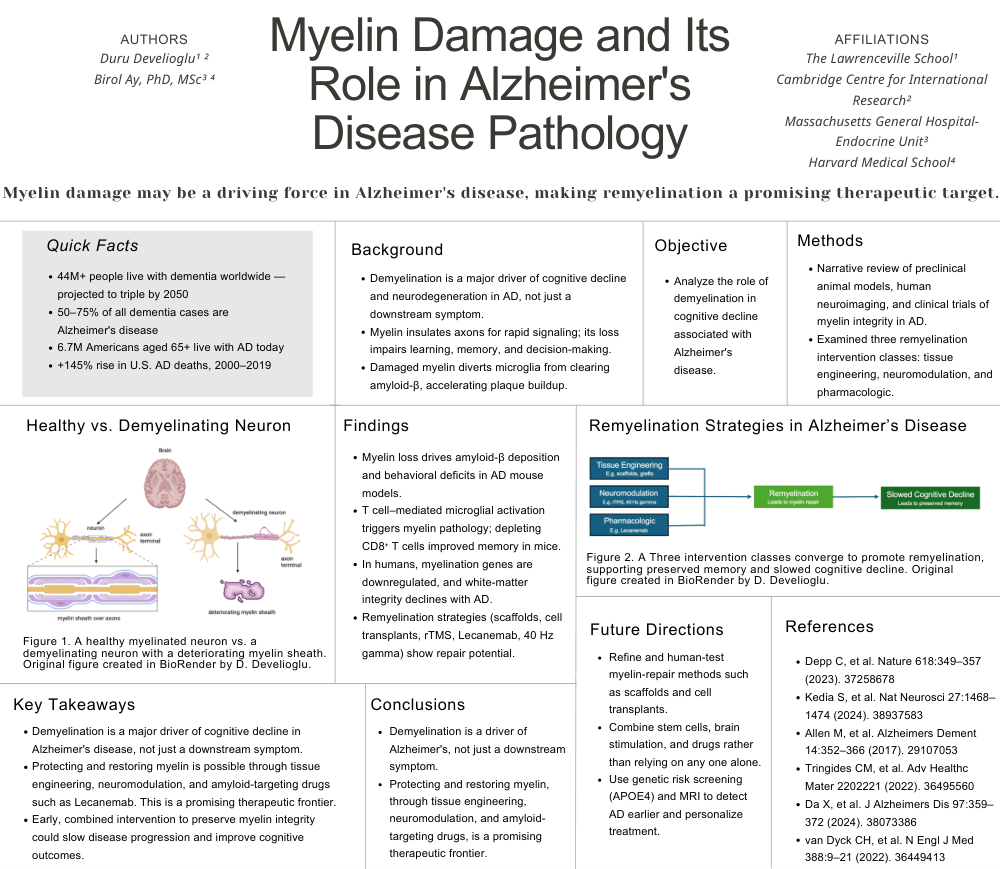
Background: Recent research increasingly recognizes demyelination as a major contributor to cognitive decline and neurodegeneration in Alzheimer’s disease (AD). Myelin, the sheath insulating axons, enables rapid neuronal signaling, and its degeneration impairs learning, memory, and decision-making. While demyelination is clearly detrimental, the mechanisms underlying myelin damage in AD remain insufficiently understood. Understanding these pathways is critical for developing therapies that preserve or restore myelin integrity.
Methods: This review synthesized findings from preclinical animal models, human neuroimaging studies, and clinical trials evaluating myelin integrity in AD. Literature on tissue engineering approaches, including hydrogel scaffolds and glial progenitor cell transplantation, neuromodulation strategies such as neural stimulation and glutamate receptor modulation, and pharmacologic interventions including Lecanemab was systematically examined to assess their potential in promoting remyelination and mitigating cognitive decline.
Results: Evidence indicates that myelin damage contributes to amyloid-β accumulation, neuroinflammation, and behavioral deficits in animal models, and correlates with white matter deterioration and cognitive impairment in humans. Tissue engineering and cell-based therapies demonstrate potential for remyelination, while neuromodulation techniques can stimulate oligodendrocyte differentiation and myelin repair. Pharmacologic treatments, particularly Lecanemab, reduce amyloid burden and may indirectly support myelin preservation. Integrating molecular, cellular, and bioengineering strategies appears to be the most promising approach for maintaining myelin integrity.
Conclusion: Targeting myelin repair represents a critical therapeutic direction in AD. Early intervention to strengthen myelin, combined with pharmacologic and neuromodulatory strategies, could slow disease progression and improve cognitive outcomes. Future research should focus on optimizing remyelination techniques, validating their efficacy in humans, and developing combinatory therapies that integrate tissue engineering, stimulation, and pharmacologic approaches.
Comments
Email is required but is not shown publicly.
Loading comments...