4,068 posters, 219 videos, 101 topics, 69 sessions, 14,365 authors, 6,128 institutions
ePostersLive by SciGen Technologies S.A. All rights reserved.
Alzheimer's Association International Conference 2026
July 12-15, 2026 | London, United Kingdom, and Online

10417
Correlation Between Drug Burden And Cognitive Decline In Older Adults From The South Of Brazil
Poster Presenter
Authors
Bianca Barros Parron Fernandes, Karen Barros Parron Fernandes, Denilson de Castro Teixeira, Mario Molari, Eros de Oliveira Júnior, Gustavo Aliano Gâmbaro, Lindsey Mitie Nakakogue
Affiliations
School of Medicine, Pontifical Catholic University of Paraná (PUCPR), Londrina, Brazil, Department of Physical Education, State University of Londrina (UEL), Londrina, Brazil, Centre of Research in Health Sciences, University of Northern Paraná (UNOPAR), Londrina, Brazil, Graduate Program of Health Sciences, Pontifical Catholic University of Paraná (PUCPR), Curitiba, Brazil
Part of Topic
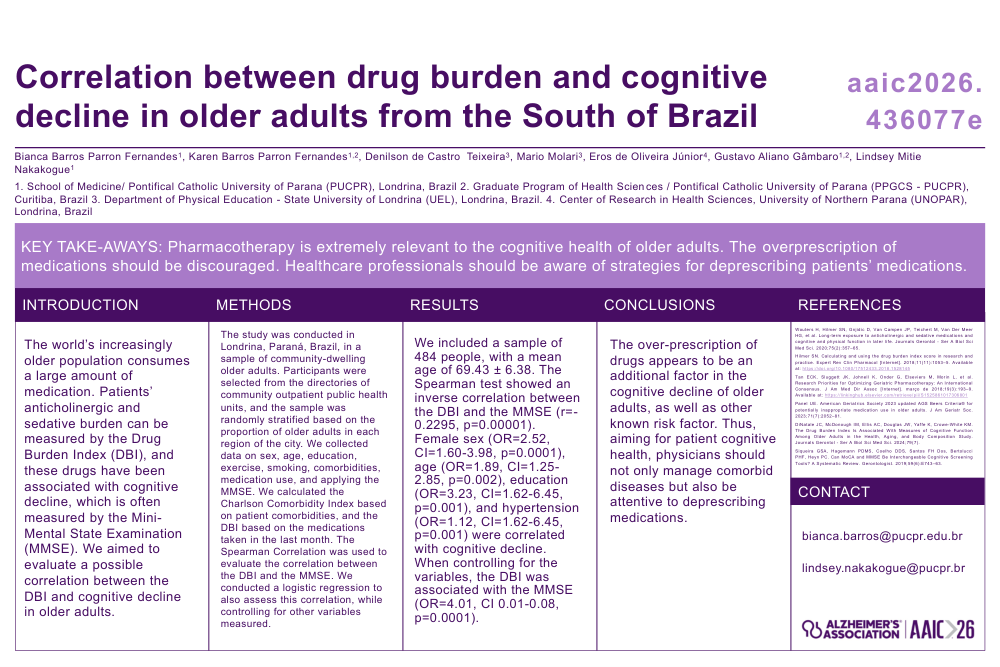
Background: The world’s increasingly older population consumes a large amount of medication. Patients’ anticholinergic and sedative burden can be measured by the Drug Burden Index (DBI), and these drugs have been associated with cognitive decline, which is often measured by the Mini-Mental State Examination (MMSE). We aimed to evaluate a possible correlation between the DBI and cognitive decline in older adults. Method: The study was conducted in Londrina, Paraná, Brazil, in a sample of community-dwelling older adults. Participants were selected from the directories of community outpatient public health units, and the sample was randomly stratified based on the proportion of older adults in each region of the city. We collected data on sex, age, education, exercise, smoking, comorbidities, medication use, and applying the MMSE. We calculated the Charlson Comorbidity Index based on patient comorbidities, and the DBI based on the medications taken in the last month. The Spearman Correlation was used to evaluate the correlation between the DBI and the MMSE. We conducted a logistic regression to also assess this correlation, while controlling for other variables measured. Result: We included a sample of 484 people, with a mean age of 69.43 ± 6.38. The Spearman test showed an inverse correlation between the DBI and the MMSE (r=-0.2295, p=0.00001). Female sex (OR=2.52, CI=1.60-3.98, p=0.0001), age (OR=1.89, CI=1.25-2.85, p=0.002), education (OR=3.23, CI=1.62-6.45, p=0.001), and hypertension (OR=1.12, CI=1.62-6.45, p=0.001) were correlated with cognitive decline. When controlling for the variables, the DBI was associated with the MMSE (OR=4.01, CI 0.01-0.08, p=0.0001). Conclusion: The over-prescription of drugs appears to be an additional factor in the cognitive decline of older adults, as well as other known risk factor. Thus, aiming for patient cognitive health, physicians should not only manage comorbid diseases but also be attentive to deprescribing medications.
Comments
Email is required but is not shown publicly.
Loading comments...