4,068 posters, 219 videos, 101 topics, 69 sessions, 14,365 authors, 6,128 institutions
ePostersLive by SciGen Technologies S.A. All rights reserved.
Alzheimer's Association International Conference 2026
July 12-15, 2026 | London, United Kingdom, and Online

10802
Sleep Phenotypes And Language-specific Cognitive Decline In Hispanic Older Adults
Poster Presenter
Authors
Saurabh Kalra, Tali Elfassy, Deepak Kalra, WayWay Hlaing, Tatjana Rundek
Affiliations
Evelyn F. McKnight Brain Institute, University of Miami Miller School of Medicine, Miami, FL, Department of Nephrology, University of Miami Miller School of Medicine, Miami, FL, Department of Neurology, Cleveland Clinic Florida, Weston, FL, Department of Public Health Sciences, University of Miami Miller School of Medicine, Miami, FL
Part of Topic
Sleep Phenotypes And Language-specific Cognitive Decline In Hispanic Older Adults
Saurabh Kalra, MS1, Tali Elfassy, PhD2, Deepak Kalra, MD, PhD3, WayWay M. Hlaing, PhD1, Tatjana Rundek, MD, PhD4.
1Department of Public Health, University of Miami Miller School of Medicine, Miami, FL, USA,
2Department of Nephrology, University of Miami Miller School of Medicine, Miami, FL, USA,
3Department of Neurology, Cleveland Clinic Hospital, Weston, FL, USA,
4Evelyn F. McKnight Brain Institute, University of Miami Miller School of Medicine, Miami, FL, USA.
2026-A-10802-AAIC
Key Takeaway:Baseline insomnia was associated with faster longitudinal language decline among Hispanic older adults, whereas no similar effect modification was observed for memory, executive function, processing speed, or global cognition.
METHODS
RESULTS
CONCLUSIONS
BACKGROUND
-
Data source: National Alzheimer’s Coordinating Center (NACC) (2015–2024).
-
Participants: Age ≥60 years; ≥3 visits
-
Sleep phenotypes: Neither, insomnia only, obstructive sleep apnea (OSA) only, and co-morbid insomnia and sleep apnea (COMISA).
-
Outcome: Language composite score (Boston Naming, Animal Fluency, Vegetable Fluency).
-
Analysis: Linear mixed-effects models with random intercepts and slope, adjusted for age, sex, education, race, and APOE ε4 status. Sleep phenotype, Hispanic ethnicity, and time interaction was tested.
-
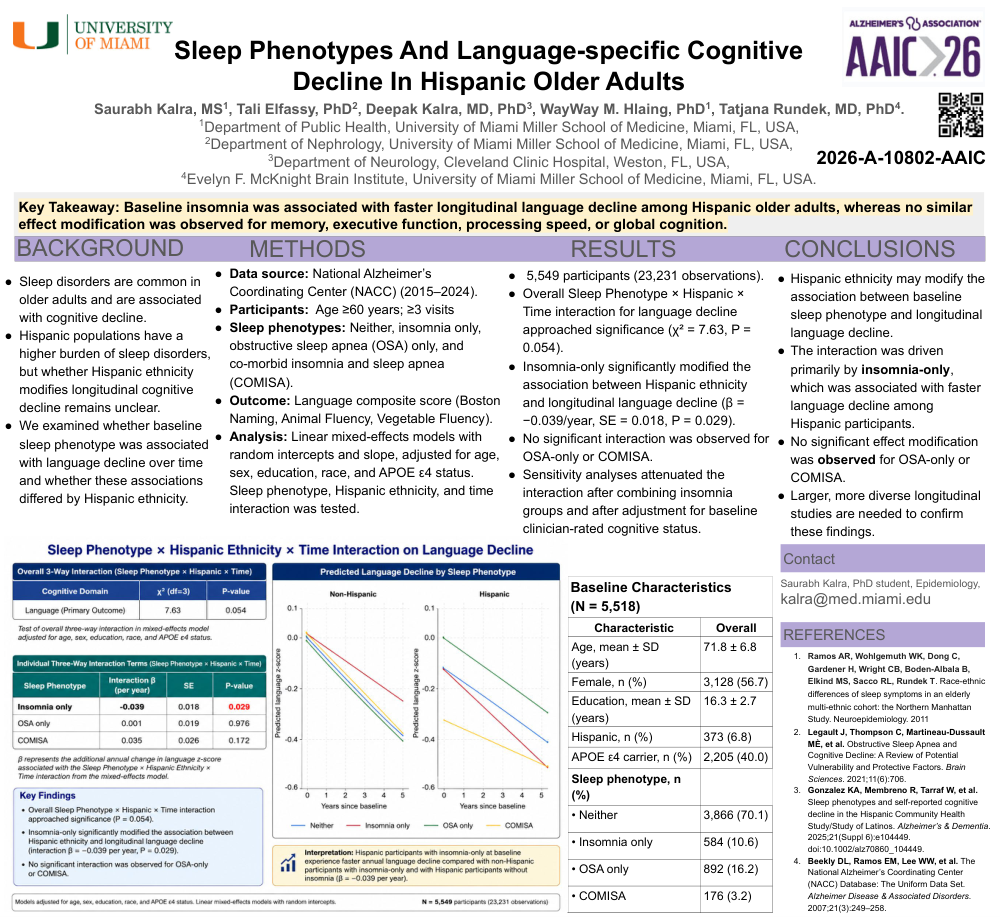
5,549 participants (23,231 observations).
-
Overall Sleep Phenotype × Hispanic × Time interaction for language decline approached significance (χ² = 7.63, P = 0.054).
-
Insomnia-only significantly modified the association between Hispanic ethnicity and longitudinal language decline (β = −0.039/year, SE = 0.018, P = 0.029).
-
No significant interaction was observed for OSA-only or COMISA.
-
Sensitivity analyses attenuated the interaction after combining insomnia groups and after adjustment for baseline clinician-rated cognitive status.
-
Hispanic ethnicity may modify the association between baseline sleep phenotype and longitudinal language decline.
-
The interaction was driven primarily by insomnia-only, which was associated with faster language decline among Hispanic participants.
-
No significant effect modification was observed for OSA-only or COMISA.
-
Larger, more diverse longitudinal studies are needed to confirm these findings.
-
Sleep disorders are common in older adults and are associated with cognitive decline.
-
Hispanic populations have a higher burden of sleep disorders, but whether Hispanic ethnicity modifies longitudinal cognitive decline remains unclear.
-
We examined whether baseline sleep phenotype was associated with language decline over time and whether these associations differed by Hispanic ethnicity.
Contact
Saurabh Kalra, PhD student, Epidemiology, kalra@med.miami.edu
|
Baseline Characteristics (N = 5,518) |
|
|
Characteristic |
Overall |
|
Age, mean ± SD (years) |
71.8 ± 6.8 |
|
Female, n (%) |
3,128 (56.7) |
|
Education, mean ± SD (years) |
16.3 ± 2.7 |
|
Hispanic, n (%) |
373 (6.8) |
|
APOE ε4 carrier, n (%) |
2,205 (40.0) |
|
Sleep phenotype, n (%) |
|
|
• Neither |
3,866 (70.1) |
|
• Insomnia only |
584 (10.6) |
|
• OSA only |
892 (16.2) |
|
• COMISA |
176 (3.2) |
REFERENCES
-
Ramos AR, Wohlgemuth WK, Dong C, Gardener H, Wright CB, Boden-Albala B, Elkind MS, Sacco RL, Rundek T. Race-ethnic differences of sleep symptoms in an elderly multi-ethnic cohort: the Northern Manhattan Study. Neuroepidemiology. 2011
-
Legault J, Thompson C, Martineau-Dussault MÈ, et al. Obstructive Sleep Apnea and Cognitive Decline: A Review of Potential Vulnerability and Protective Factors. Brain Sciences. 2021;11(6):706.
-
Gonzalez KA, Membreno R, Tarraf W, et al. Sleep phenotypes and self-reported cognitive decline in the Hispanic Community Health Study/Study of Latinos. Alzheimer’s & Dementia. 2025;21(Suppl 6):e104449. doi:10.1002/alz70860_104449.
-
Beekly DL, Ramos EM, Lee WW, et al. The National Alzheimer’s Coordinating Center (NACC) Database: The Uniform Data Set. Alzheimer Disease & Associated Disorders. 2007;21(3):249–258.
Comments
Email is required but is not shown publicly.
Loading comments...